Department of Rheumatology and Immunology, the Second Hospital of Hebei Medical University, Shijiazhuang, 050000, Hebei Province, China.
Hebei Medical University, Shijiazhuang, 050000, Hebei Province, China.
Stem Cell Res Ther. 2022 Mar 21;13(1):118. doi: 10.1186/s13287-022-02786-3.
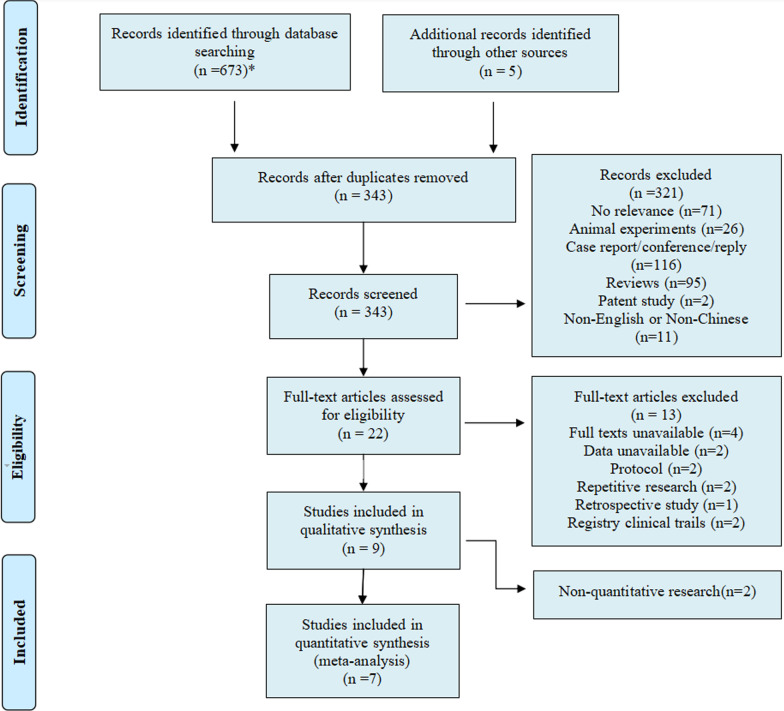
Systemic sclerosis (SSc) is an autoimmune disease with high morbidity and mortality characterized by fibrosis of the skin and internal organs. Some studies have investigated the use of stem cells to treat SSc. Herein, a systematic review and meta-analysis was conducted to determine the efficacy and safety of mesenchymal stem cells (MSCs) in the treatment of SSc.
PubMed, Embase, Cochrane Library, Web of Science, OVID, China National Knowledge Infrastructure and Wanfang databases were searched up to February 1, 2021. Literature screening, data extraction and quality assessment were conducted independently by two researchers in according to the inclusion and exclusion criteria. The discrepancies were resolved by a third researcher.
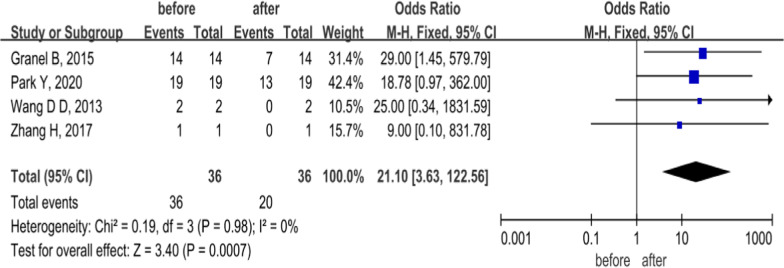
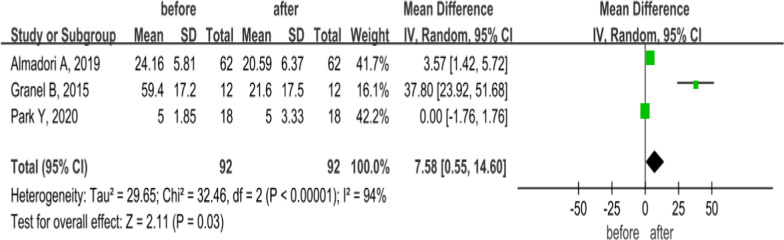
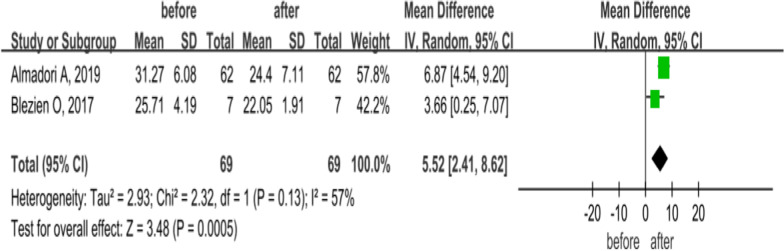
A total of 9 studies encompassing 133 SSc patients were included in the study. Compared to the baseline after treatment with MSCs: 1. The modified Rodnan skin score (mRSS) was significantly reduced in patients with SSc (P < 0.00001). 2. MSCs decreased the number of digital ulcer, mouth handicap scale, and visual analog scale of hand pain in SSc patients (P = 0.0007 and P = 0.03, respectively). 3. No statistical differences were detected in Raynaud's condition score and Cochin hand function scale score at 6 months of MSCs therapy (P = 0.5 and P = 0.62). 4. After 12 months of follow-up, MSCs improve carbon monoxide diffusing capacity and forced vital capacity of SSc patients (P < 0.05). 5. Overall, MSCs application was safe; a few cases exhibited swelling at the injection site, diarrhea and arthralgia, which had self-recovery, and no severe adverse events occurred in the included trials.
MSC therapy improves the degree of skin thickening, lung function, and mouth opening and relieves finger ulcers and pain in patients with SSc without severe adverse events. Thus, MSCs or MSCs combined with plasma and traditional medicine might be an effective and promising treatment of SSc patients. PROSPERO registration number: CRD42020200350.
系统性硬化症(SSc)是一种具有高发病率和死亡率的自身免疫性疾病,其特征为皮肤和内脏器官纤维化。一些研究已经探讨了使用干细胞来治疗 SSc。在此,我们进行了一项系统评价和荟萃分析,以确定间充质干细胞(MSCs)治疗 SSc 的疗效和安全性。
检索了 PubMed、Embase、Cochrane 图书馆、Web of Science、OVID、中国知网和万方数据库,截至 2021 年 2 月 1 日。两位研究人员根据纳入和排除标准独立进行文献筛选、数据提取和质量评估。分歧由第三位研究人员解决。
共有 9 项研究纳入了 133 例 SSc 患者。与 MSC 治疗后的基线相比:1. SSc 患者的改良 Rodnan 皮肤评分(mRSS)显著降低(P<0.00001)。2. MSCs 减少了 SSc 患者的手指溃疡、口腔残疾量表和手部疼痛视觉模拟量表的数量(P=0.0007 和 P=0.03)。3. 在 MSC 治疗 6 个月时,雷纳德状况评分和科钦手部功能量表评分无统计学差异(P=0.5 和 P=0.62)。4. 12 个月随访后,MSCs 改善了 SSc 患者的一氧化碳弥散能力和用力肺活量(P<0.05)。5. 总体而言,MSC 应用是安全的;少数病例在注射部位出现肿胀、腹泻和关节痛,这些症状自行恢复,且纳入的试验中未发生严重不良事件。
MSC 治疗可改善 SSc 患者皮肤增厚程度、肺功能和张口程度,并缓解手指溃疡和疼痛,且无严重不良事件。因此,MSC 或 MSC 联合血浆和传统药物可能是治疗 SSc 患者的一种有效且有前途的方法。PROSPERO 注册号:CRD42020200350。