Department of Pediatric Surgery, Children's Hospital of Fudan University, National Children's Medical Center, Shanghai Key Laboratory of Birth Defect, and Key Laboratory of Neonatal Disease, Ministry of Health, 399 Wan Yuan Road, Shanghai, 201102, China.
State Key Laboratory of Cell Biology, CAS Center for Excellence in Molecular Cell Science, Shanghai Institute of Biochemistry and Cell Biology, Chinese Academy of Sciences, University of Chinese Academy of Sciences, Shanghai, 200031, China.
Stem Cell Res Ther. 2022 Mar 21;13(1):114. doi: 10.1186/s13287-022-02795-2.
The progression of Biliary Atresia (BA) is associated with the number of reactive ductular cells (RDCs) whose heterogeneity in origin and evolution in humans remains unknown. SOX9-positive liver progenitor-like cells (LPLCs) have been shown to participate in RDCs and new hepatocyte formation during cholestatic liver regeneration in an animal model, which implies the possibility that hepatocyte-reprogrammed LPLCs could be a source of RDCs in BA. The present study aimed to elucidate the characteristics of SOX9-positive LPLCs in BA for exploring new possible therapeutic targets by manipulating the bi-differentiation process of LPLCs to prevent disease progression.
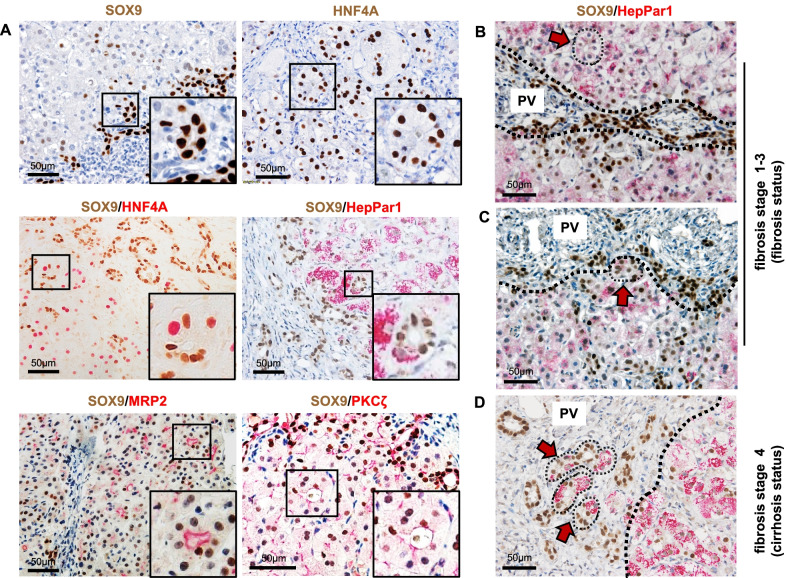
Twenty-eight patients, including 24 patients with BA and 4 patients with Congenital Choledochal Cyst as the control group, were retrospectively recruited. Liver biopsy samples were classified histologically using a 4-point scale based on fibrosis severity. LPLCs were detected by SOX9 and HNF4A double positive staining. Single immunohistochemistry, double immunohistochemistry, and multiple immunofluorescence staining were used to determine the different cell types and characteristics of LPLCs.
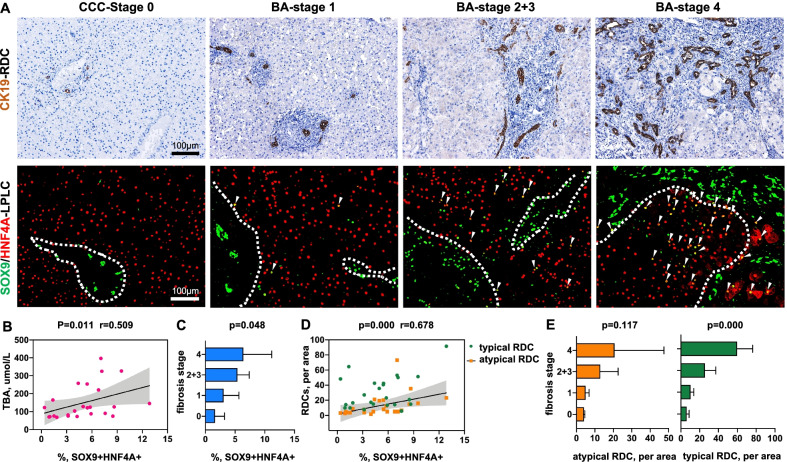
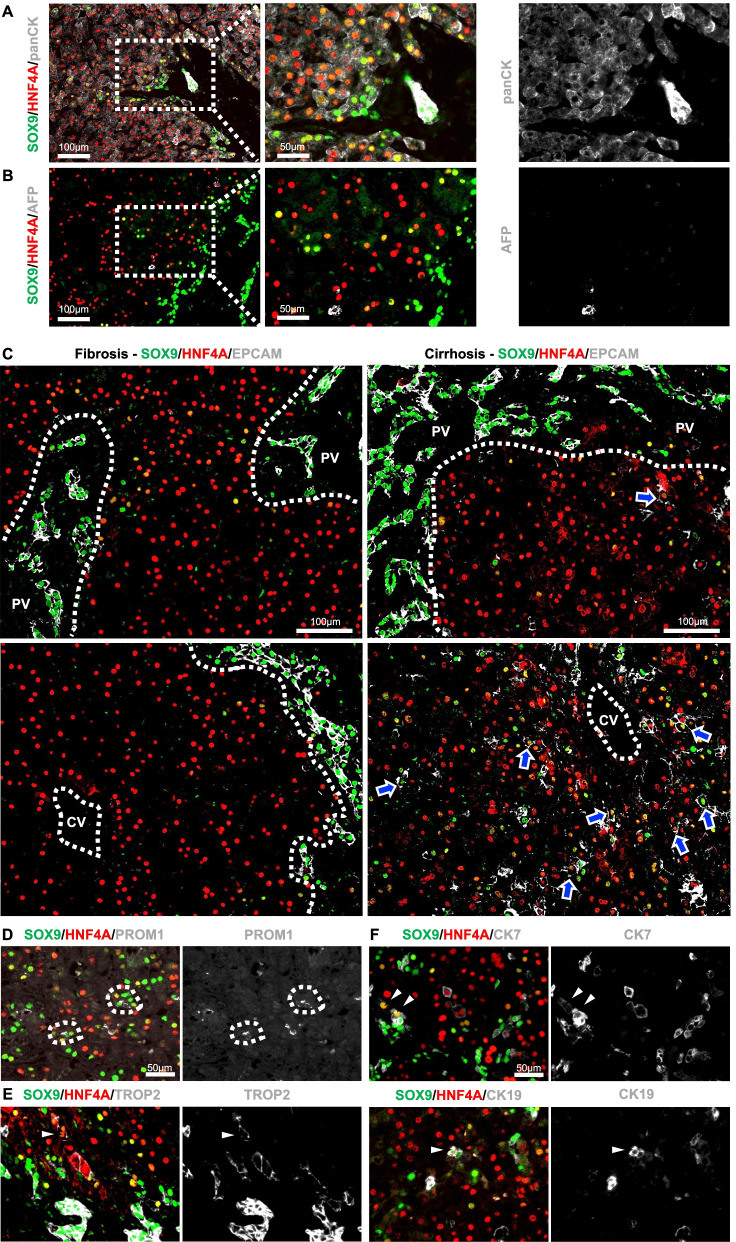
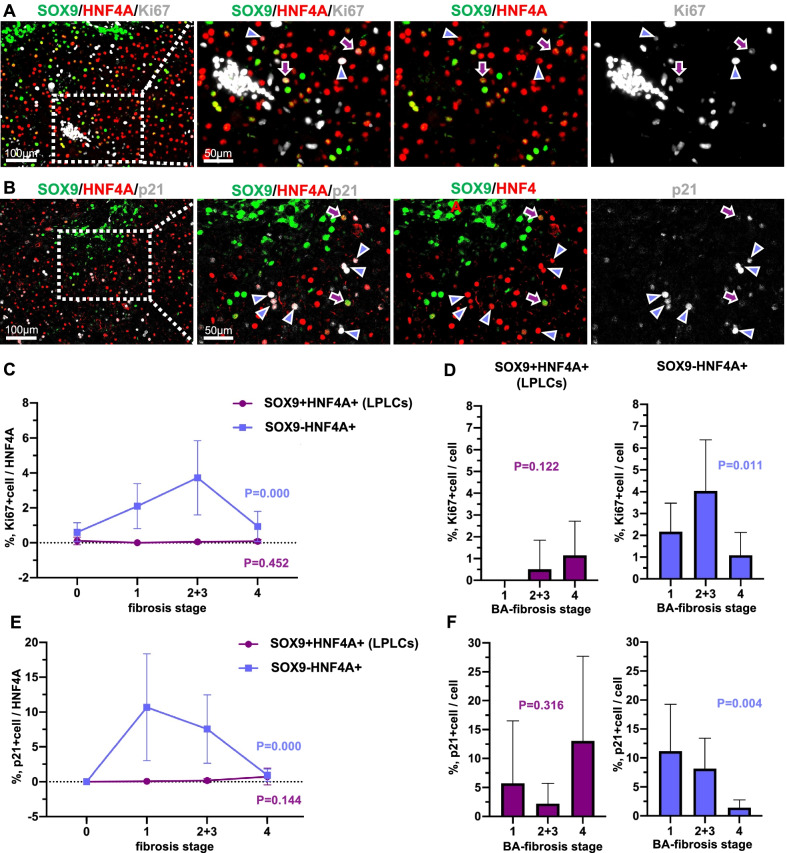
The prognostic predictors of BA, namely total bile acid (TBA), RDCs, and fibrosis, were correlated to the emergence of LPLCs. SOX9 and HNF4A double-positive LPLCs co-stained rarely with relevant markers of portal hepatic progenitor cells (portal-HPCs), including CK19, CK7, EPCAM, PROM1 (CD133), TROP2, and AFP. Under cholestasis conditions, LPLCs acquired superior proliferation and anti-senescence ability among hepatocytes. Moreover, LPLCs arranged as a pseudo-rosette structure appeared from the periportal parenchyma to the portal region, which implied the differentiation from hepatocyte-reprogrammed LPLCs to RDCs with the progression of cholestasis.
LPLCs are associated with disease progression and prognostic factors of BA. The bipotent characteristics of LPLCs are different from those of portal-HPCs. As cholestasis progresses, LPLCs appear to gain superior proliferation and anti-senescence ability and continually differentiate to RDCs.
先天性胆道闭锁(BA)的进展与反应性胆管细胞(RDC)的数量有关,但其在人类中的起源和演变的异质性尚不清楚。在动物模型中,SOX9 阳性肝祖细胞样细胞(LPLC)已被证明参与 RDC 和胆汁淤积性肝再生中新的肝细胞形成,这意味着肝重编程的 LPLC 可能是 BA 中 RDC 的来源。本研究旨在通过操纵 LPLC 的双分化过程来预防疾病进展,以探索新的可能治疗靶点,从而阐明 BA 中 SOX9 阳性 LPLC 的特征。
回顾性招募了 28 名患者,包括 24 名 BA 患者和 4 名先天性胆总管囊肿患者作为对照组。根据纤维化严重程度,采用 4 分制对肝活检样本进行组织学分类。通过 SOX9 和 HNF4A 双阳性染色检测 LPLC。采用单免疫组化、双免疫组化和多免疫荧光染色确定 LPLC 的不同细胞类型和特征。
BA 的预后预测因子,即总胆汁酸(TBA)、RDC 和纤维化,与 LPLC 的出现相关。SOX9 和 HNF4A 双阳性 LPLC 很少与门脉肝祖细胞(portal-HPC)的相关标志物共染色,包括 CK19、CK7、EPCAM、PROM1(CD133)、TROP2 和 AFP。在胆汁淤积的情况下,LPLC 在肝细胞中获得了更好的增殖和抗衰老能力。此外,LPLC 从门脉周围实质排列成假玫瑰花结结构,表明随着胆汁淤积的进展,LPLC 从肝重编程的 LPLC 分化为 RDC。
LPLC 与 BA 的疾病进展和预后因素有关。LPLC 的双能特征与 portal-HPC 不同。随着胆汁淤积的进展,LPLC 似乎获得了更好的增殖和抗衰老能力,并不断分化为 RDC。