Department of Hematology, Japanese Red Cross Nagasaki Genbaku Hospital, Nagasaki, Japan.
Department of Laboratory, Japanese Red Cross Nagasaki Genbaku Hospital, Nagasaki, Japan.
Cancer Med. 2022 Sep;11(17):3238-3250. doi: 10.1002/cam4.4689. Epub 2022 Mar 22.
Adult T-cell leukemia/lymphoma (ATLL) is a relatively refractory peripheral T-cell lymphoma caused by human T-cell lymphotropic virus type 1 (HTLV-1). The objective of this study was to investigate the characteristics of long-term survivors with ATLL.
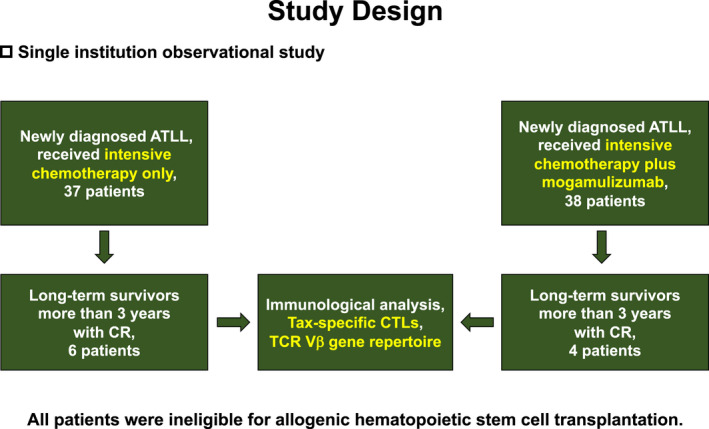
We conducted an observational study of 75 aggressive-type ATLL patients. Flow cytometry was conducted to analyze HTLV-1 Tax-specific cytotoxic T-lymphocytes (CTLs) and T-cell receptor Vβ gene repertoire.
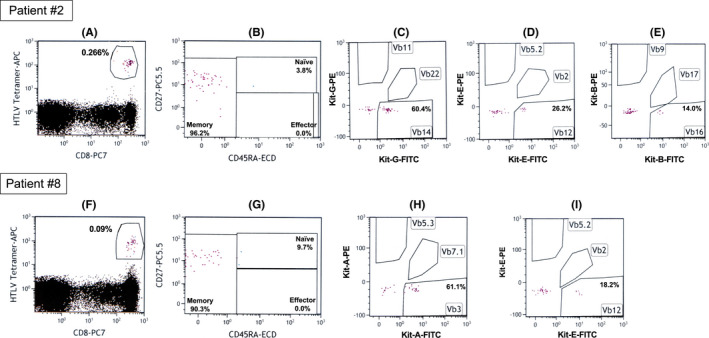
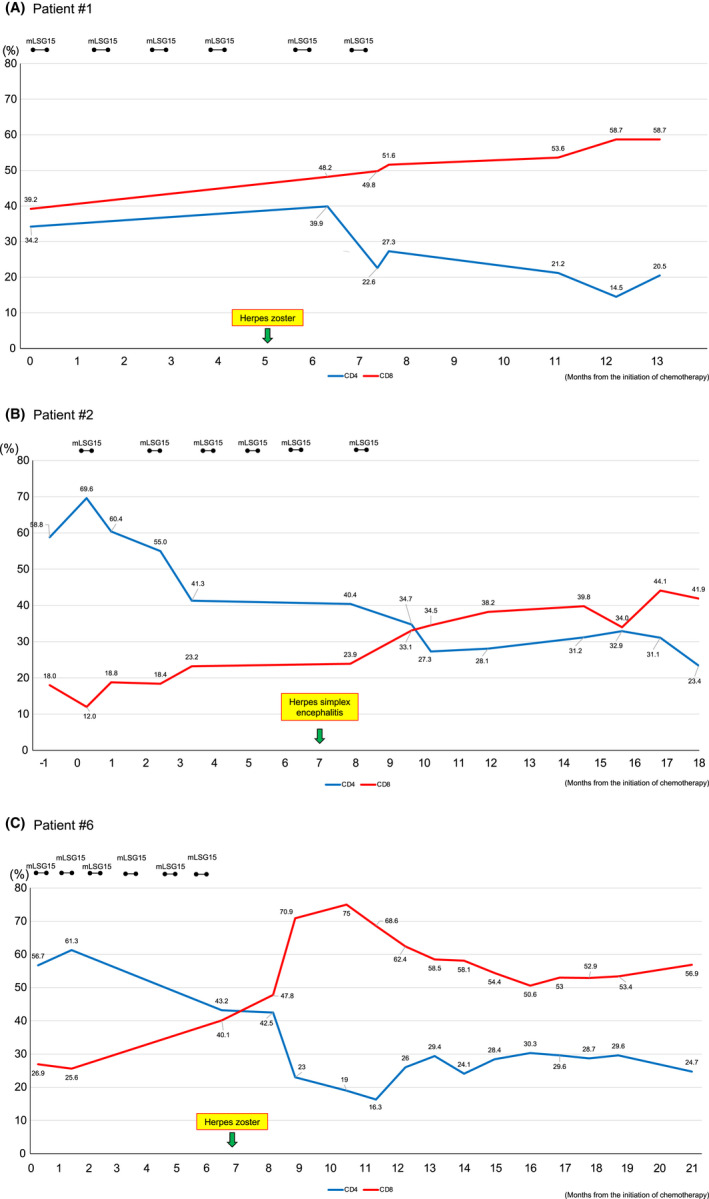
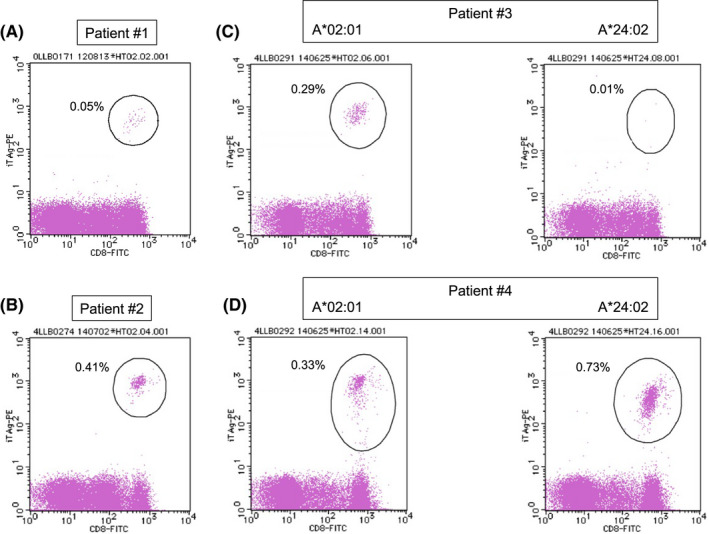
We first evaluated six long-term survivors among 37 patients who were newly diagnosed with ATLL and then treated with intensive chemotherapy without mogamulizumab, a monoclonal antibody for C-C chemokine receptor four antigen. Reversal of the CD4-to-CD8 ratio (CD4/CD8) in peripheral mononuclear cells was observed in all six patients. Three of these six patients showed reversed CD4/CD8 immediately after herpes virus infection. Four of these six patients who could be examined demonstrated long-term maintenance of HTLV-1 Tax-specific CTLs. We subsequently identified four long-term survivors among 38 patients who were newly diagnosed with ATLL and then treated with intensive chemotherapy plus mogamulizumab. All four patients showed reversed CD4/CD8, and three of the four patients contracted herpes virus infection during immunochemotherapy. Six of the total 10 patients were subjected to CTL analyses. Tax-specific CTLs were observed, and the CTLs that were almost entirely composed of memory CTLs in all patients were recorded. HTLV-1 provirus was also detected in all six patients.
These data suggest that Tax-specific memory CTLs probably, together with anticancer agents, eradicate ATLL cells and exhibit long-term preventive effects from relapse ATLL. Thus, the strong activation of cellular immunity, such as herpes virus infection, seems to be necessary to induce such a potent number of Tax-specific CTLs.
成人 T 细胞白血病/淋巴瘤(ATLL)是一种由人类 T 细胞白血病病毒 1(HTLV-1)引起的相对难治性外周 T 细胞淋巴瘤。本研究的目的是探讨 ATLL 长期幸存者的特征。
我们对 75 例侵袭性 ATLL 患者进行了观察性研究。采用流式细胞术分析 HTLV-1 Tax 特异性细胞毒性 T 淋巴细胞(CTL)和 T 细胞受体 Vβ 基因库。
我们首先评估了 37 例新诊断为 ATLL 且未接受 mogamulizumab(一种针对 C-C 趋化因子受体 4 抗原的单克隆抗体)强化化疗的患者中的 6 例长期幸存者。外周血单个核细胞中 CD4/CD8 比值(CD4/CD8)逆转见于所有 6 例患者。这 6 例患者中有 3 例在疱疹病毒感染后立即出现 CD4/CD8 逆转。这 6 例患者中有 4 例可检测到长期维持 HTLV-1 Tax 特异性 CTL。随后,我们在 38 例新诊断为 ATLL 且接受强化化疗加 mogamulizumab 治疗的患者中发现了 4 例长期幸存者。所有 4 例患者均出现 CD4/CD8 逆转,其中 3 例在免疫化疗期间感染疱疹病毒。在总共 10 例患者中有 6 例进行了 CTL 分析。在所有患者中均观察到 Tax 特异性 CTL,并且 CTL 几乎完全由记忆 CTL 组成。在所有 6 例患者中均检测到 HTLV-1 前病毒。
这些数据表明,Tax 特异性记忆 CTL 可能与抗癌药物一起根除 ATLL 细胞,并从复发的 ATLL 中表现出长期的预防作用。因此,细胞免疫的强烈激活,如疱疹病毒感染,似乎是诱导如此大量 Tax 特异性 CTL 所必需的。