STD Institute, Shanghai Skin Disease Hospital, Tongji University School of Medicine, Shanghai, People's Republic of China.
Microbiol Spectr. 2022 Apr 27;10(2):e0177221. doi: 10.1128/spectrum.01772-21. Epub 2022 Mar 22.
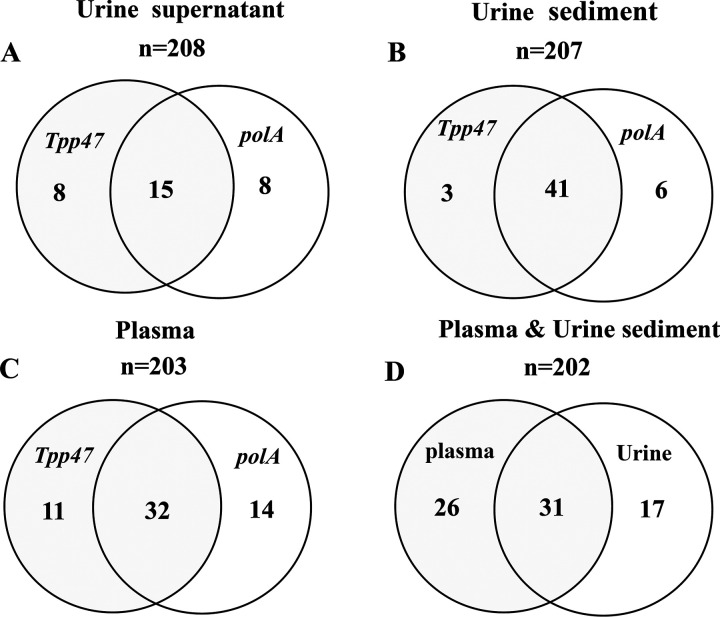
Treponema pallidum can invade any organ, and T. pallidum DNA can be detected in various tissues and fluids. However, the knowledge of the presence and loads of T. pallidum DNA in urine is limited. For this study, we enrolled 208 syphilis patients (34 primary syphilis, 61 secondary syphilis, 68 latent syphilis, and 45 symptomatic neurosyphilis) and collected urine and plasma samples from them. and genes were amplified in urine supernatant, urine sediment, and plasma using nested PCR and droplet digital PCR assays. The detection rates were 14.9% (31 of 208) and 24.2% (50 of 207) in urine supernatant and sediment, respectively ( = 0.017). The detection rates of T. pallidum DNA in urine sediment were 47.1, 47.5, 4.4, and 4.5% for primary, secondary, latent, and symptomatic neurosyphilis, respectively. After treatment, T. pallidum DNA in urine in 20 syphilis patients turned negative. Loads of T. pallidum DNA in urine sediment were significantly higher than those in plasma and urine supernatant (both < 0.05). Our study indicated that T. pallidum DNA in urine could be found in patients at all stages of syphilis and showed high loads in urine sediment. Though it is unlikely to improve the routine diagnostic algorithm, the detection of T. pallidum DNA in urine may play certain roles in cases difficult to diagnose. In addition, urine is abundant and convenient to collect; therefore, urine sediment could be an ideal specimen for acquiring an amount of T. pallidum DNA that can be supplement samples for the detection of molecular typing of T. pallidum. Syphilis is a sexually transmitted disease caused by Treponema pallidum sub. T. pallidum can invade many organs, and T. pallidum DNA can be detected in various tissues and fluids. The results reported here demonstrated that T. pallidum DNA could be detected in urine in patients at all stages of syphilis. The detection rate and loads of T. pallidum DNA in urine sediment were significantly higher than those in urine supernatant. Urine is abundant, and its collection is noninvasive and convenient; therefore, urine is an ideal sample for acquiring a large amount of T. pallidum DNA, which can be supplement samples for the detection of molecular typing of T. pallidum.
梅毒螺旋体可侵犯任何器官,在各种组织和体液中均可检测到梅毒螺旋体 DNA。然而,尿液中梅毒螺旋体 DNA 的存在和载量知之甚少。在这项研究中,我们招募了 208 例梅毒患者(34 例早期梅毒、61 例二期梅毒、68 例潜伏梅毒和 45 例症状性神经梅毒),并从他们那里采集了尿液和血浆样本。使用巢式 PCR 和液滴数字 PCR 检测方法,在尿液上清液、尿液沉淀物和血浆中扩增 和 基因。尿液上清液和沉淀物的检测率分别为 14.9%(208 例中的 31 例)和 24.2%(207 例中的 50 例)(=0.017)。梅毒螺旋体 DNA 在尿液沉淀物中的检出率分别为早期、二期、潜伏和症状性神经梅毒的 47.1%、47.5%、4.4%和 4.5%。经过治疗,20 例梅毒患者的尿液中梅毒螺旋体 DNA 转为阴性。尿液沉淀物中的梅毒螺旋体 DNA 载量明显高于血浆和尿液上清液(均 <0.05)。本研究表明,在梅毒各期患者的尿液中均可检测到梅毒螺旋体 DNA,且尿液沉淀物中载量较高。虽然不太可能改善常规诊断算法,但检测尿液中的梅毒螺旋体 DNA 可能在诊断困难的病例中发挥一定作用。此外,尿液丰富且易于采集;因此,尿液沉淀物可能是获取大量可补充梅毒螺旋体分子分型检测的样本的理想标本。梅毒是由梅毒螺旋体亚种引起的性传播疾病。梅毒螺旋体可侵犯许多器官,在各种组织和体液中均可检测到梅毒螺旋体 DNA。本研究结果表明,在梅毒各期患者的尿液中均可检测到梅毒螺旋体 DNA。尿液沉淀物中梅毒螺旋体 DNA 的检测率和载量明显高于尿液上清液。尿液丰富,采集无创且方便;因此,尿液是获取大量梅毒螺旋体 DNA 的理想样本,可作为补充梅毒螺旋体分子分型检测的样本。