Department of Respiratory Medicine, Kishiwada City Hospital, 1001 Gakuhara-cho, Kishiwada-shi, Osaka, 586-8501, Japan.
Department of Respiratory Medicine, Kyoto University Graduate School of Medicine, 54 Kawahara-cho Shogoin Sakyoku, Kyoto, 606-8507, Japan.
Respir Med Res. 2022 May;81:100903. doi: 10.1016/j.resmer.2022.100903. Epub 2022 Mar 19.
Remdesivir with dexamethasone and remdesivir with baricitinib are effective in coronavirus disease 2019 (COVID-19) patients. However, there has been few evidence regarding the efficacy of the combination of baricitinib, remdesivir, and dexamethasone in hypoxic COVID-19 patients.
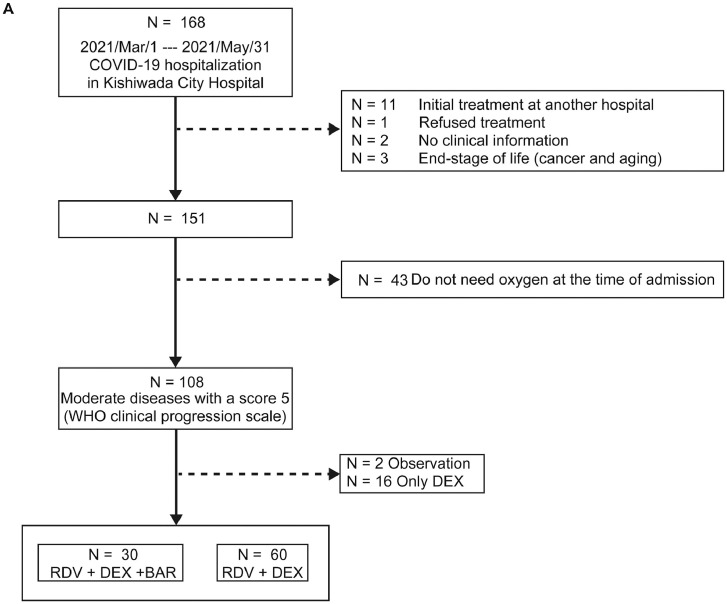
Consecutive patients who required oxygen therapy at the time of admission and received remdesivir and dexamethasone at Kishiwada City Hospital between March 1, 2021 and May 31, 2021 were retrospectively analyzed.
A total of 90 patients were investigated, including 30 receiving a combination of remdesivir, dexamethasone, and baricitinib (baricitinib group) and 60 receiving remdesivir and dexamethasone (control group). The use of direct oral anticoagulants, the level of C-reactive protein, and chest X-ray abnormalities were significantly higher in the baricitinib group than in the control group. Patients in the baricitinib group recovered a median of four days faster than those in the control group (median, 7 days vs. 11 days; Gray's test, p < 0.001). The recovery rate was 90.0% in the baricitinib group and 63.3% in the control group (p = 0.011). Fine and Gray regression analysis showed that adjusted rate ratio for recovery with the baricitinib combination therapy was 5.26 (95% confidential interval, 1.99-13.9; p < 0.001). The incidence of new onset of bacterial infection was 6.7% in the baricitinib group and 16.7% in the control group (p = 0.324).
Our study suggests that the combination of baricitinib, dexamethasone, and remdesivir is effective and tolerable in hypoxic patients with COVID-19.
瑞德西韦联合地塞米松和瑞德西韦联合巴瑞替尼对新型冠状病毒病 2019(COVID-19)患者有效。然而,关于在缺氧 COVID-19 患者中联合使用巴瑞替尼、瑞德西韦和地塞米松的疗效的证据很少。
回顾性分析 2021 年 3 月 1 日至 2021 年 5 月 31 日在岸和田市医院接受瑞德西韦和地塞米松治疗且入院时需要氧疗的连续患者。
共调查了 90 例患者,其中 30 例接受瑞德西韦、地塞米松和巴瑞替尼联合治疗(巴瑞替尼组),60 例接受瑞德西韦和地塞米松治疗(对照组)。与对照组相比,巴瑞替尼组患者更常使用直接口服抗凝剂、C 反应蛋白水平和胸部 X 线异常。巴瑞替尼组患者中位恢复时间比对照组快 4 天(中位数,7 天比 11 天;Gray 检验,p < 0.001)。巴瑞替尼组的恢复率为 90.0%,对照组为 63.3%(p = 0.011)。Fine 和 Gray 回归分析显示,巴瑞替尼联合治疗恢复的调整后比率比为 5.26(95%置信区间,1.99-13.9;p < 0.001)。巴瑞替尼组新发细菌感染的发生率为 6.7%,对照组为 16.7%(p = 0.324)。
我们的研究表明,巴瑞替尼、地塞米松和瑞德西韦联合治疗在 COVID-19 缺氧患者中是有效且耐受良好的。