Koot Emily M, Morgan-Richards Mary, Trewick Steven A
Wildlife and Ecology Group, Massey University, Palmerston North, New Zealand.
R Soc Open Sci. 2022 Mar 2;9(3):211596. doi: 10.1098/rsos.211596. eCollection 2022 Mar.
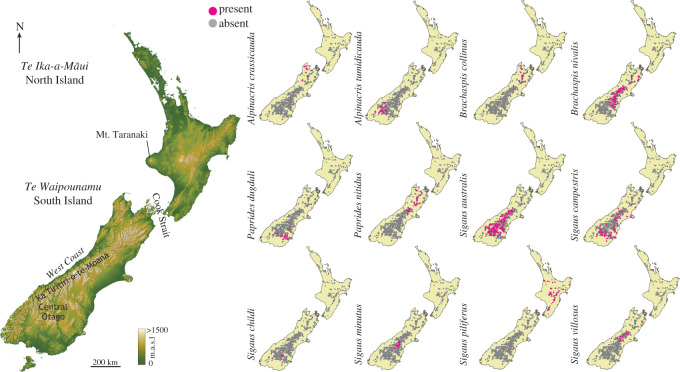
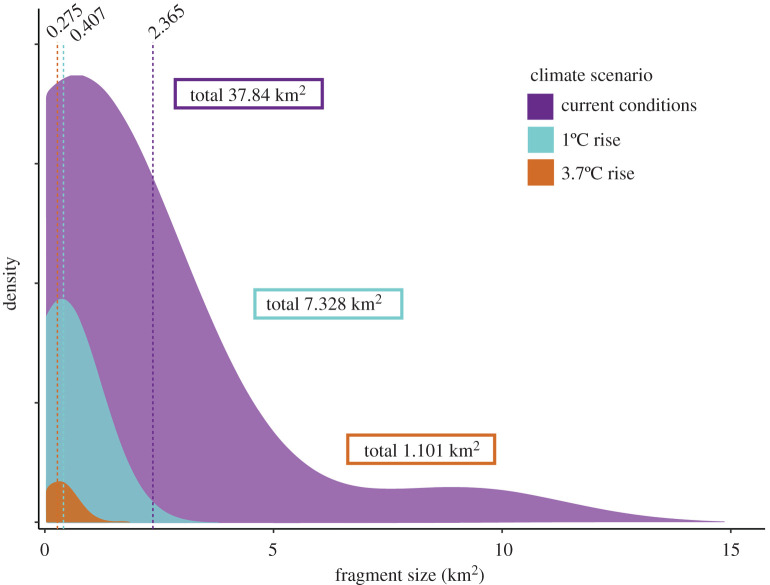
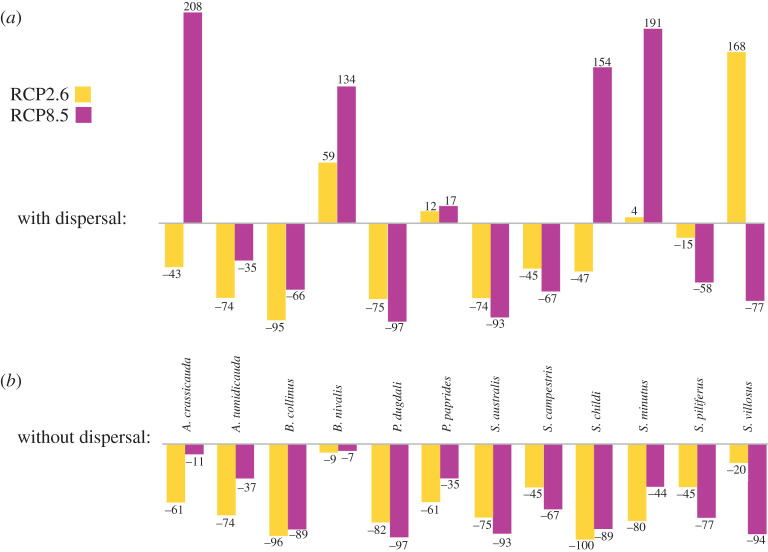
Mountains create steep environmental gradients that are sensitive barometers of climate change. We calibrated 10 statistical models to formulate ensemble ecological niche models for 12 predominantly alpine, flightless grasshopper species in New Zealand, using their current distributions and current conditions. Niche models were then projected for two future global climate scenarios: representative concentration pathway (RCP) 2.6 (1.0°C rise) and RCP8.5 (3.7°C rise). Results were species specific, with two-thirds of our models suggesting a reduction in potential range for nine species by 2070, but surprisingly, for six species, we predict an increase in potential suitable habitat under mild (+1.0°C) or severe global warming (+3.7°C). However, when the limited dispersal ability of these flightless grasshoppers is taken into account, all 12 species studied are predicted to suffer extreme reductions in range, with a quarter likely to go extinct due to a 96-100% reduction in suitable habitat. Habitat loss is associated with habitat fragmentation that is likely to escalate stochastic vulnerability of remaining populations. Here, we present the predicted outcomes for an endemic radiation of alpine taxa as an exemplar of the challenges that alpine species, both in New Zealand and internationally, are subject to by anthropogenic climate change.
山脉形成了陡峭的环境梯度,而这些梯度是气候变化的敏感指标。我们校准了10种统计模型,利用12种主要分布在新西兰的高山无翅蝗虫物种的当前分布和当前环境条件,构建了综合生态位模型。然后,针对两种未来全球气候情景预测了生态位模型:代表性浓度路径(RCP)2.6(升温1.0°C)和RCP8.5(升温3.7°C)。结果因物种而异,三分之二的模型表明,到2070年,9个物种的潜在分布范围将缩小,但令人惊讶的是,对于6个物种,我们预测在温和(+1.0°C)或严重全球变暖(+3.7°C)情况下,潜在适宜栖息地会增加。然而,考虑到这些无翅蝗虫有限的扩散能力,预计所有12个研究物种的分布范围都将大幅缩小,四分之一的物种可能因适宜栖息地减少96 - 100%而灭绝。栖息地丧失与栖息地破碎化相关,这可能会增加剩余种群的随机脆弱性。在这里,我们展示了高山类群特有辐射的预测结果,以此作为新西兰和国际上高山物种面临人为气候变化挑战的一个例证。