Stanford Cardiovascular Institute, Stanford University School of Medicine, Stanford, CA, 94305, USA.
Institute for Stem Cell Biology and Regenerative Medicine, Stanford University School of Medicine, Stanford, CA, 94305, USA.
BMC Cardiovasc Disord. 2022 Mar 22;22(1):122. doi: 10.1186/s12872-022-02543-7.
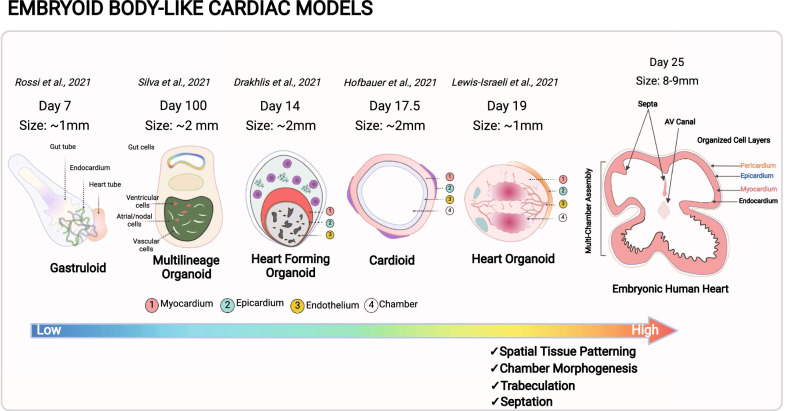
Stem-cell derived in vitro cardiac models have provided profound insights into mechanisms in cardiac development and disease. Efficient differentiation of specific cardiac cell types from human pluripotent stem cells using a three-step Wnt signaling modulation has been one of the major discoveries that has enabled personalized cardiovascular disease modeling approaches. Generation of cardiac cell types follow key development stages during embryogenesis, they intuitively are excellent models to study cardiac tissue patterning in primitive cardiac structures. Here, we provide a brief overview of protocols that have laid the foundation for derivation of stem-cell derived three-dimensional cardiac models. Further this article highlights features and utility of the models to distinguish the advantages and trade-offs in modeling embryonic development and disease processes. Finally, we discuss the challenges in improving robustness in the current models and utilizing developmental principles to bring higher physiological relevance. In vitro human cardiac models are complimentary tools that allow mechanistic interrogation in a reductionist way. The unique advantage of utilizing patient specific stem cells and continued improvements in generating reliable organoid mimics of the heart will boost predictive power of these tools in basic and translational research.
基于干细胞的体外心脏模型为心脏发育和疾病的机制研究提供了深刻的见解。使用三步 Wnt 信号调节有效地将特定的人心肌细胞类型从多能干细胞中分化出来,这是能够实现个性化心血管疾病建模方法的主要发现之一。生成的心肌细胞类型遵循胚胎发生过程中的关键发育阶段,它们直观上是研究原始心脏结构中心脏组织模式形成的优秀模型。在这里,我们简要概述了为衍生基于干细胞的三维心脏模型奠定基础的方案。此外,本文还强调了这些模型的特点和用途,以区分在模拟胚胎发育和疾病过程中的优势和权衡。最后,我们讨论了提高当前模型稳健性并利用发育原理提高生理相关性的挑战。体外人心肌模型是互补工具,可以以简化的方式进行机制研究。利用患者特异性干细胞的独特优势以及在生成可靠的心脏类器官模拟物方面的持续改进,将提高这些工具在基础和转化研究中的预测能力。