University of Gothenburg, Sahlgrenska Academy, Institute of Health and Care Sciences and Centre for Person-Centred Care, and Palliative Centre at the Sahlgrenska University Hospital Region Västra Götaland, Gothenburg, Sweden.
University of Gothenburg, Sahlgrenska Academy, Institute of Health and Care Sciences, Gothenburg, Sweden.
BMC Palliat Care. 2022 Mar 22;21(1):39. doi: 10.1186/s12904-022-00929-0.
Research suggests palliative care to be translated and integrated in non-specialized palliative care services throughout the palliative care continuum across populations and settings. A need has been identified to build on the existing research literature in order to design strong knowledge translation strategies that can be evaluated in future research. The aim was to map strategies for knowledge translation of a palliative approach to care into non-specialized palliative care services for adult patients. The objectives were to explore the primary research activities, the specific type of knowledge translation strategies used, the research designs and study settings for such evaluations along with the major results thereof, and to identify major research gaps in this area.
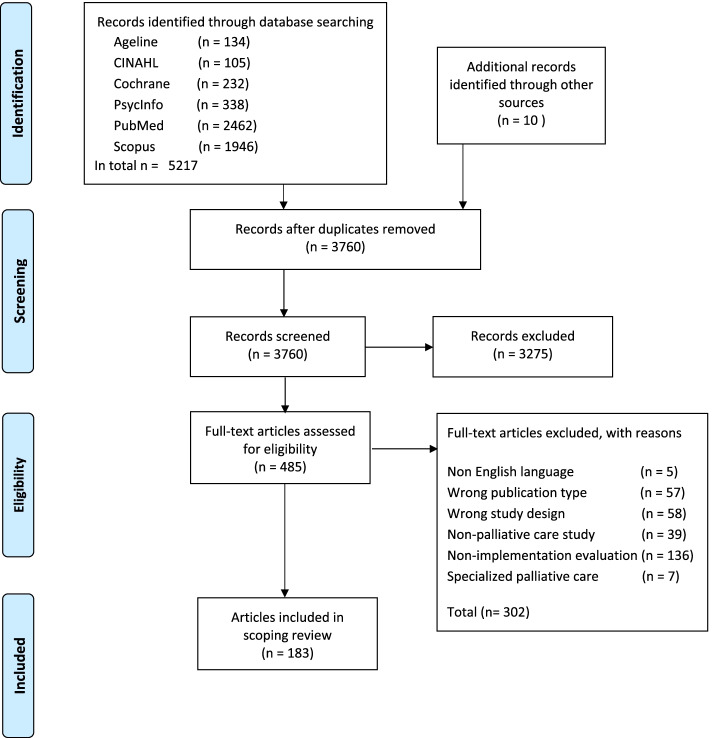
A scoping review was performed to map the volume and characteristics of research literature (project registered in PROSPERO #2018 CRD42018100663). The ten-year period 2010 to 2019 was searched in six major databases for original articles published in English in which the knowledge translation of a palliative approach for adult patients was evaluated in non-specialized palliative healthcare settings, and all type of empirical data-based research designs. We excluded non-English, non-empirical articles, non-evaluation of knowledge translations, specialized palliative care settings, and other types of publications (i.e. non-original articles).
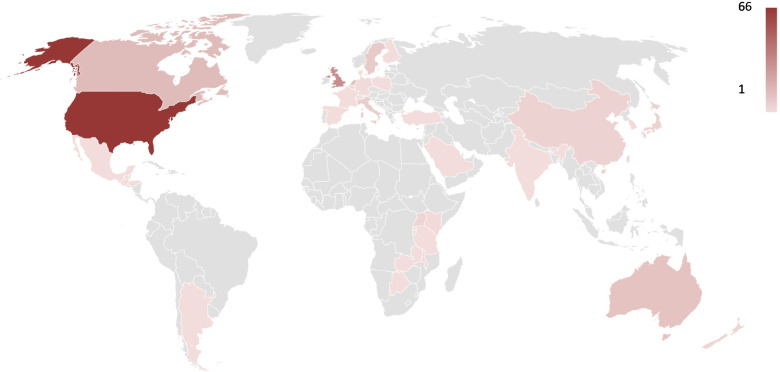
Most of the 183 included articles focused on patients with cancer who were dying in hospitals and in high income countries. Only 13 articles focused on early palliative care. A palette of different strategies was used to implement palliative care in non-specialist palliative settings; no strategy was identified as outstanding. The majority of the articles had unspecified essential components of the research designs.
Previous suggestions for utilization of implementation science for knowledge translation of a palliative approach to care into non-specialized palliative care services are confirmed, and established knowledge translation theories can strengthen the field. To advance this specific field of knowledge, meticulously detailed reporting of studies is required as related to research designs, clarifications of contextual influences and mechanisms at work. Specific systematic reviews and meta-syntheses in the field are merited.
研究表明,姑息治疗需要在整个姑息治疗连续体中,在不同人群和环境下,将其翻译并整合到非专业姑息治疗服务中。为了制定可以在未来研究中进行评估的强大知识转化策略,需要在现有研究文献的基础上进一步研究。本研究旨在针对将姑息治疗方法应用于非专业姑息治疗服务以治疗成年患者的知识转化策略进行绘制。目标是探索将姑息治疗方法应用于非专业姑息治疗服务的主要研究活动、使用的具体类型的知识转化策略、此类评估的研究设计和研究环境以及主要结果,并确定该领域的主要研究空白。
采用范围综述的方法,对在非专业姑息治疗环境中评估成年患者姑息治疗方法的知识转化的研究文献进行绘制。检索了 2010 年至 2019 年十年间六个主要数据库中以英文发表的原始文章,纳入评估非专业姑息医疗环境中成年患者姑息治疗方法的知识转化的研究,所有类型的基于实证数据的研究设计均被排除非英语、非实证文章、非知识转化评估、专业姑息治疗环境以及其他类型的出版物(即非原始文章)。
183 篇纳入文章中,大多数都集中在在医院死亡的癌症患者和高收入国家的患者。只有 13 篇文章关注早期姑息治疗。为在非专业人员姑息治疗环境中实施姑息治疗,使用了不同的策略;没有一种策略被认为是杰出的。大多数文章未明确研究设计的基本要素。
先前关于利用实施科学将姑息治疗方法的知识转化为非专业姑息治疗服务的建议得到了证实,并且已建立的知识转化理论可以加强这一领域。为了推进这一特定领域的知识,需要对研究设计、对相关影响因素和作用机制的澄清等方面进行详细、具体的报告。该领域值得进行具体的系统综述和荟萃分析。