International Observatory on End of Life Care, Lancaster University, Lancaster, UK.
VUB-UGhent End of Life Care Research Group, Vrije Universiteit Brussel (VUB), Brussels, Belgium.
Palliat Med. 2020 May;34(5):558-570. doi: 10.1177/0269216319893635. Epub 2020 Feb 3.
The number of older people dying in long-term care facilities is increasing; however, care at the end of life can be suboptimal. Interventions to improve palliative care delivery within these settings have been shown to be effective in improving care, but little is known about their implementation.
The aim of this study was to describe the nature of implementation strategies and to identify facilitators and/or barriers to implementing palliative care interventions in long-term care facilities.
Scoping review with a thematic synthesis, following the ENTREQ guidelines.
Published literature was identified from electronic databases, including MEDLINE, EMBASE, PsycINFO and CINAHL. Controlled, non-controlled and qualitative studies and evaluations of interventions to improve palliative care in long-term care facilities were included. Studies that met the inclusion criteria were sourced and data extracted on the study characteristics, the implementation of the intervention, and facilitators and/or barriers to implementation.
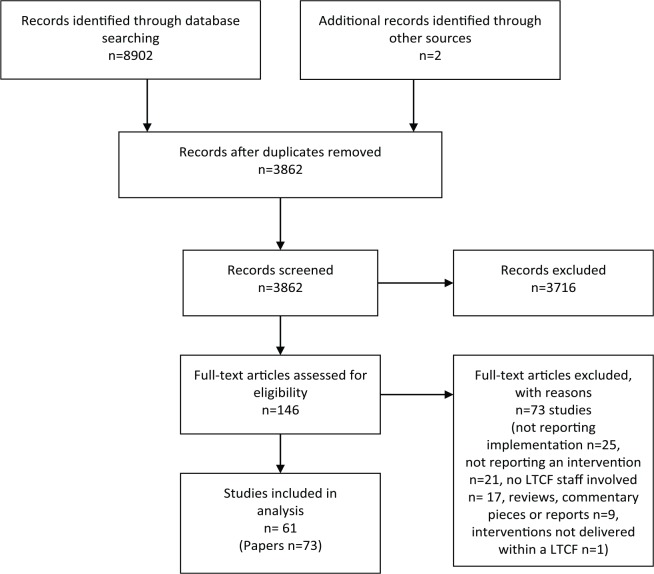
The review identified 8902 abstracts, from which 61 studies were included in the review. A matrix of implementation was developed with four implementation strategies (facilitation, education/training, internal engagement and external engagement) and three implementation stages (conditions to introduce the intervention, embedding the intervention within day-to-day practice and sustaining ongoing change).
Incorporating an implementation strategy into the development and delivery of an intervention is integral in embedding change in practice. The review has shown that the four implementation strategies identified varied considerably across interventions; however, similar facilitators and barriers were encountered across the studies identified. Further research is needed to understand the extent to which different implementation strategies can facilitate the uptake of palliative care interventions in long-term care facilities.
在长期护理机构中死亡的老年人人数正在增加;然而,临终关怀的质量可能并不理想。在这些环境中实施改善姑息治疗服务的干预措施已被证明可以有效改善护理,但对于其实施情况知之甚少。
本研究旨在描述实施策略的性质,并确定在长期护理机构中实施姑息治疗干预措施的促进因素和/或障碍。
按照 ENTREQ 指南进行的范围综述和主题综合。
从电子数据库(包括 MEDLINE、EMBASE、PsycINFO 和 CINAHL)中确定已发表的文献。纳入了旨在改善长期护理机构姑息治疗的干预措施的对照、非对照和定性研究和评估。符合纳入标准的研究被确定,并提取了关于研究特征、干预措施实施以及实施的促进因素和/或障碍的数据。
该综述共确定了 8902 篇摘要,其中 61 篇研究被纳入综述。制定了一个实施矩阵,其中包含四个实施策略(促进、教育/培训、内部参与和外部参与)和三个实施阶段(引入干预的条件、将干预嵌入日常实践中以及维持持续的变化)。
在干预措施的制定和实施中纳入实施策略是将实践中的变革融入其中的关键。该综述表明,所确定的四个实施策略在干预措施中差异很大;然而,在所确定的研究中遇到了类似的促进因素和障碍。需要进一步研究以了解不同实施策略在多大程度上可以促进长期护理机构中姑息治疗干预措施的采用。