Robinson Tessa, Ali Muhammad Usman, Easterbrook Bethany, Hall Wayne, Jutras-Aswad Didier, Fischer Benedikt
Faculty of Health Sciences, Centre for Applied Research in Mental Health and Addiction, Simon Fraser University, Vancouver, British Columbia, Canada.
Department of Health Research Methods, Evidence & Impact, Faculty of Health Sciences, McMaster University, Hamilton, Ontario, Canada.
Psychol Med. 2023 Jul;53(9):3858-3868. doi: 10.1017/S0033291722000502. Epub 2022 Mar 24.
Epidemiological studies show a dose-response association between cannabis use and the risk of psychosis. This review aimed to determine whether there are identifiable risk-thresholds between the frequency of cannabis use and psychosis development.
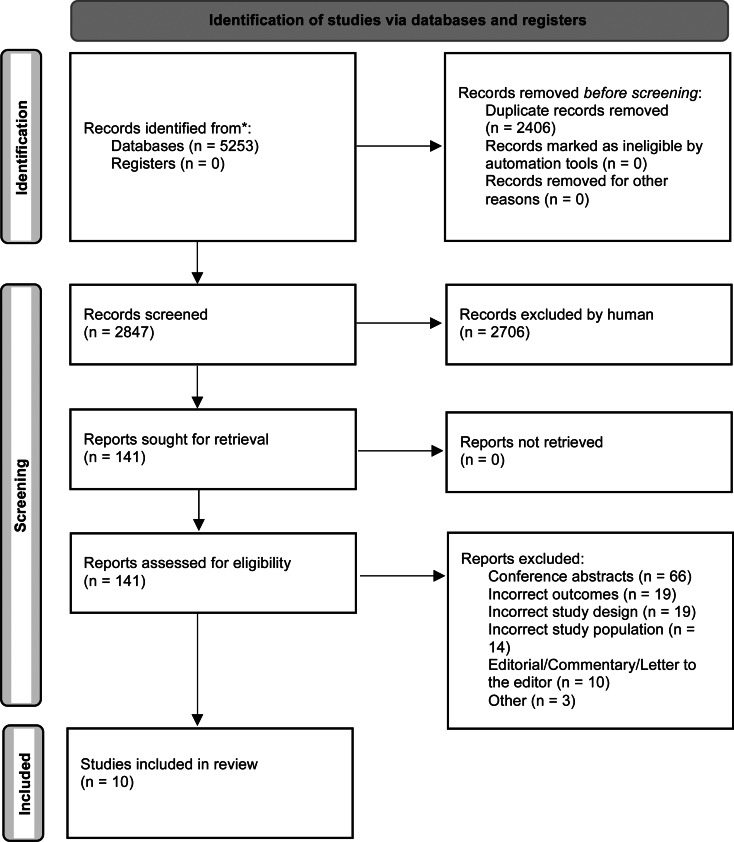
Systematic search of Embase, MEDLINE, PsycINFO, CINAHL, and Web of Science for relevant studies (1 January 2010-26 April 2021). Case-control or cohort studies that investigated the relationship between cannabis use and the risk of psychosis development that reported effect estimates [odds ratios (OR), hazard ratios (HR), risk ratios (RR)] or the raw data to calculate them, with information on the frequency of cannabis consumption were included. Effect estimates were extracted from individual studies and converted to RR. Two-stage dose-response multivariable meta-analytic models were utilized and sensitivity analyses conducted. The Newcastle Ottawa Scale was used to assess the risk of bias of included studies.
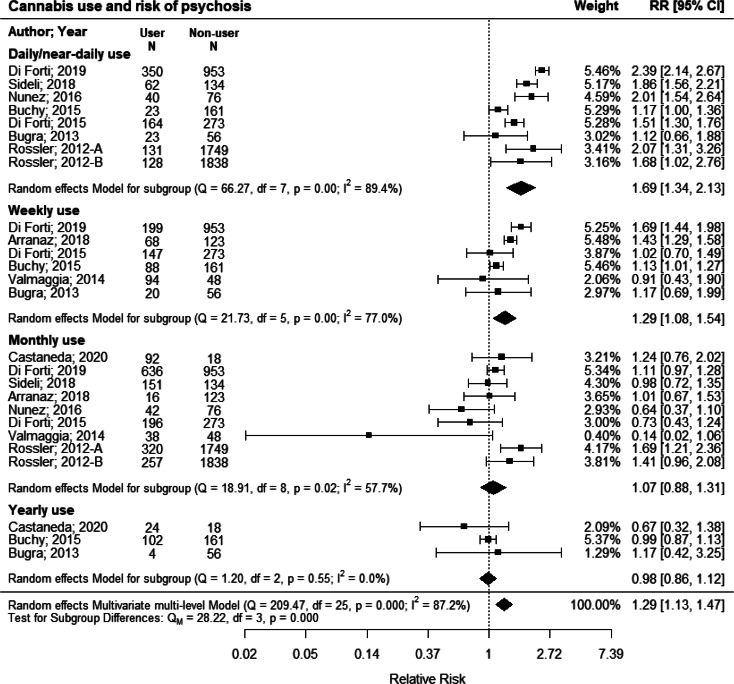
Ten original (three cohorts, seven case-control) studies were included, including 7390 participants with an age range of 12-65 years. Random-effect model meta-analyses showed a significant log-linear dose-response association between cannabis use frequency and psychosis development. A restricted cubic-splines model provided the best fit for the data, with the risk of psychosis significantly increasing for weekly or more frequent cannabis use [RR = 1.01, 95% confidence interval (CI) 0.93-1.11 yearly; RR = 1.10, 95% CI 0.97-1.25 monthly; RR = 1.35, 95% CI 1.19-1.52 weekly; RR = 1.76, 95% CI 1.47-2.12 daily].
Individuals using cannabis frequently are at increased risk of psychosis, with no significant risk associated with less frequent use. Public health prevention messages should convey these risk-thresholds, which should be refined through further work.
流行病学研究表明,使用大麻与患精神病风险之间存在剂量反应关系。本综述旨在确定大麻使用频率与精神病发生之间是否存在可识别的风险阈值。
系统检索Embase、MEDLINE、PsycINFO、CINAHL和Web of Science数据库中相关研究(2010年1月1日至2021年4月26日)。纳入调查大麻使用与精神病发生风险之间关系的病例对照或队列研究,这些研究报告了效应估计值[比值比(OR)、风险比(HR)、率比(RR)]或用于计算这些值的原始数据,以及大麻消费频率信息。从个体研究中提取效应估计值并转换为RR。采用两阶段剂量反应多变量荟萃分析模型并进行敏感性分析。使用纽卡斯尔渥太华量表评估纳入研究的偏倚风险。
纳入10项原始研究(3项队列研究,7项病例对照研究),包括7390名年龄在12至65岁之间的参与者。随机效应模型荟萃分析显示,大麻使用频率与精神病发生之间存在显著的对数线性剂量反应关系。限制立方样条模型最适合该数据,每周或更频繁使用大麻时,患精神病的风险显著增加[每年RR = 1.01,95%置信区间(CI)0.93 - 1.11;每月RR = 1.10,95% CI 0.97 - 1.25;每周RR = 1.35,95% CI 1.19 - 1.52;每天RR = 1.76,95% CI 1.47 - 2.12]。
频繁使用大麻的个体患精神病的风险增加,使用频率较低则无显著风险。公共卫生预防信息应传达这些风险阈值,这些阈值应通过进一步研究加以完善。