Department of Civil Engineering, Behbahan Khatam Alanbia University of Technology, Behbahan, Iran.
Department of Chemical Engineering, Science and Research Branch, Islamic Azad University, Tehran, Iran.
Sci Rep. 2022 Mar 23;12(1):4934. doi: 10.1038/s41598-022-08875-w.
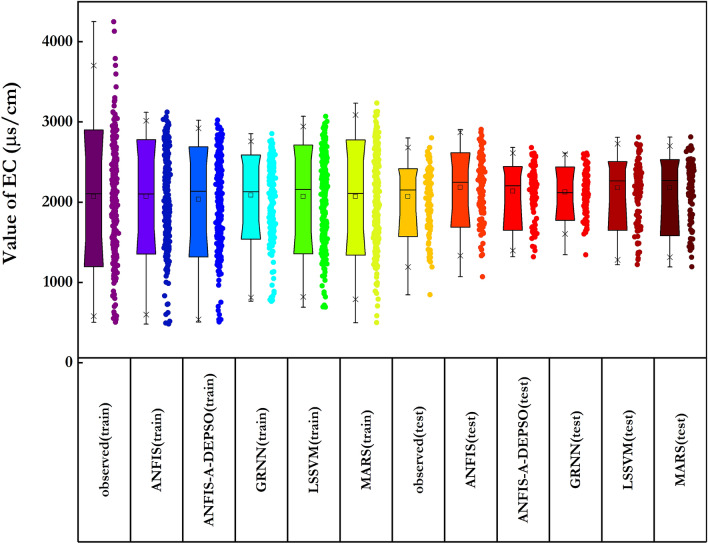
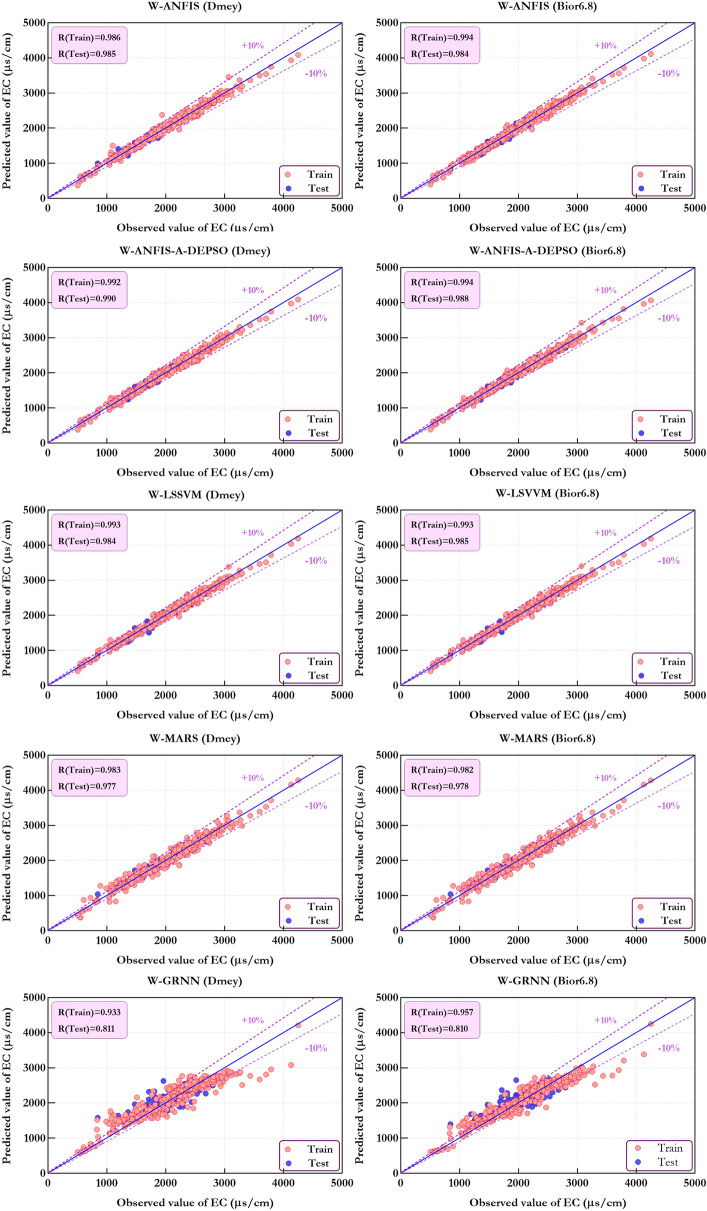
Precise prediction of water quality parameters plays a significant role in making an early alert of water pollution and making better decisions for the management of water resources. As one of the influential indicative parameters, electrical conductivity (EC) has a crucial role in calculating the proportion of mineralization. In this study, the integration of an adaptive hybrid of differential evolution and particle swarm optimization (A-DEPSO) with adaptive neuro fuzzy inference system (ANFIS) model is adopted for EC prediction. The A-DEPSO method uses unique mutation and crossover processes to correspondingly boost global and local search mechanisms. It also uses a refreshing operator to prevent the solution from being caught inside the local optimal solutions. This study uses A-DEPSO optimizer for ANFIS training phase to eliminate defects and predict accurately the EC water quality parameter every month at the Maroon River in the southwest of Iran. Accordingly, the recorded dataset originated from the Tange-Takab station from 1980 to 2016 was operated to develop the ANFIS-A-DEPSO model. Besides, the wavelet analysis was jointed to the proposed algorithm in which the original time series of EC was disintegrated into the sub-time series through two mother wavelets to boost the prediction certainty. In the following, the comparison between statistical metrics of the standalone ANFIS, least-square support vector machine (LSSVM), multivariate adaptive regression spline (MARS), generalized regression neural network (GRNN), wavelet-LSSVM (WLSSVM), wavelet-MARS (W-MARS), wavelet-ANFIS (W-ANFIS) and wavelet-GRNN (W-GRNN) models was implemented. As a result, it was apparent that not only was the W-ANFIS-A-DEPSO model able to rise remarkably the EC prediction certainty, but W-ANFIS-A-DEPSO (R = 0.988, RMSE = 53.841, and PI = 0.485) also had the edge over other models with Dmey mother in terms of EC prediction. Moreover, the W-ANFIS-A-DEPSO can improve the RMSE compared to the standalone ANFIS-DEPSO model, accounting for 80%. Hence, this model can create a closer approximation of EC value through W-ANFIS-A-DEPSO model, which is likely to act as a promising procedure to simulate the prediction of EC data.
精确预测水质参数对于水污染预警和水资源管理决策具有重要意义。电导率 (EC) 作为一种有影响力的指示性参数,在计算矿化度比例方面起着至关重要的作用。在这项研究中,采用差分进化和粒子群优化 (DEPSO) 的自适应混合与自适应神经模糊推理系统 (ANFIS) 模型相结合,用于 EC 预测。A-DEPSO 方法使用独特的变异和交叉过程,相应地增强全局和局部搜索机制。它还使用刷新运算符来防止解决方案陷入局部最优解。本研究在伊朗西南部的马伦河使用 A-DEPSO 优化器进行 ANFIS 训练阶段,以消除缺陷,并准确预测每月的 EC 水质参数。因此,使用来自 1980 年至 2016 年的 Tange-Takab 站的记录数据集来开发 ANFIS-A-DEPSO 模型。此外,联合使用小波分析,将原始 EC 时间序列通过两个母小波分解为子时间序列,以提高预测确定性。接下来,对独立的 ANFIS、最小二乘支持向量机 (LSSVM)、多元自适应回归样条 (MARS)、广义回归神经网络 (GRNN)、小波-LSSVM (WLSSVM)、小波-MARS (W-MARS)、小波-ANFIS (W-ANFIS) 和小波-GRNN (W-GRNN) 模型的统计指标进行了比较。结果表明,不仅 W-ANFIS-A-DEPSO 模型能够显著提高 EC 预测的确定性,而且在 EC 预测方面,W-ANFIS-A-DEPSO 模型(R=0.988、RMSE=53.841 和 PI=0.485)也优于其他使用 Dmey 母波的模型。此外,与独立的 ANFIS-DEPSO 模型相比,W-ANFIS-A-DEPSO 可以改善 RMSE,占 80%。因此,该模型可以通过 W-ANFIS-A-DEPSO 模型更接近地逼近 EC 值,这可能是一种很有前途的程序来模拟 EC 数据的预测。