Department of Biomedical Engineering, School of Engineering, King Mongkut's Institute of Technology Ladkrabang, Bangkok 10520, Thailand.
College of Biomedical Engineering, Rangsit University, Pathum Thani 12000, Thailand.
Biosensors (Basel). 2022 Mar 4;12(3):159. doi: 10.3390/bios12030159.
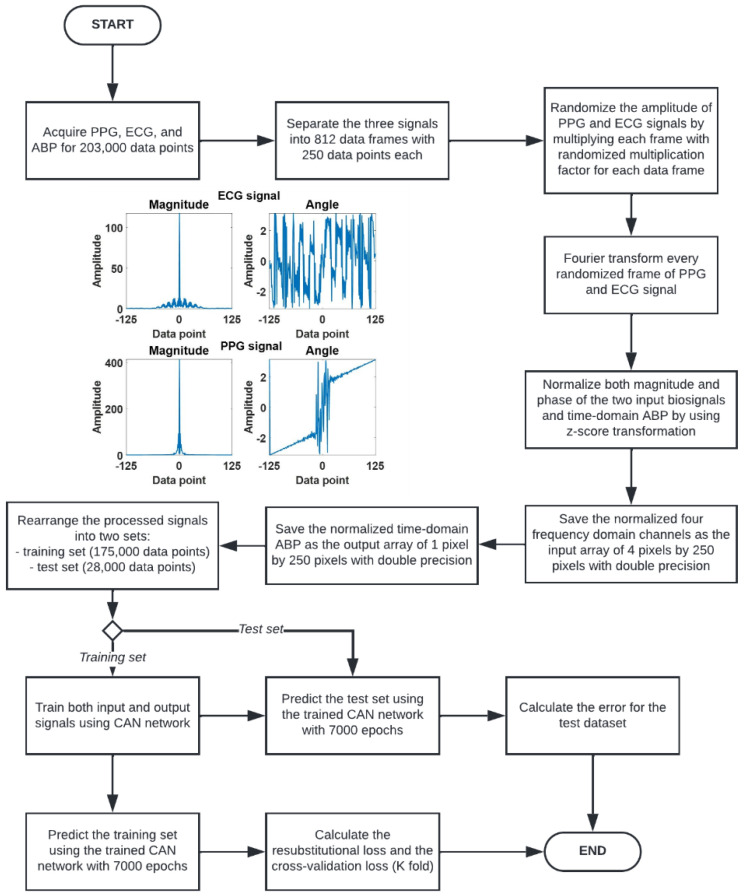
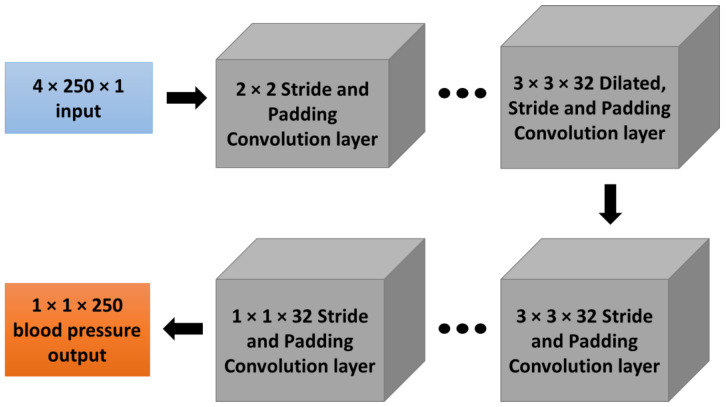
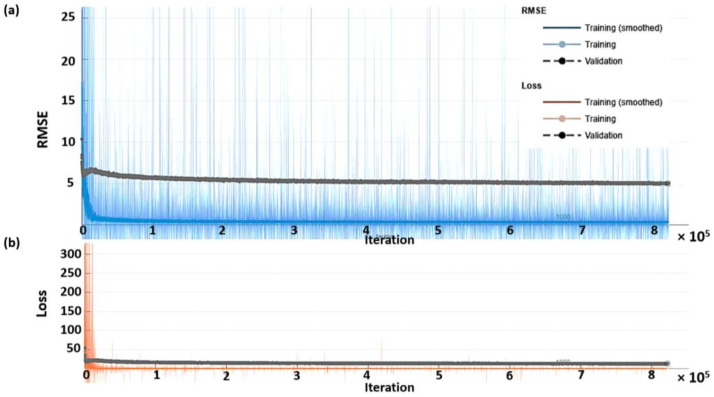
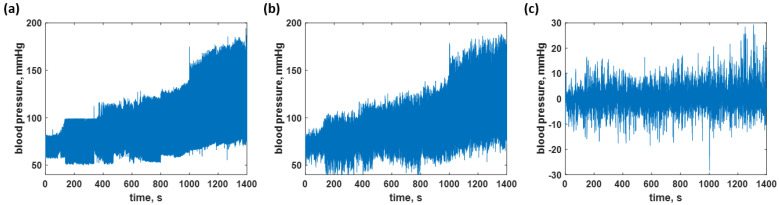
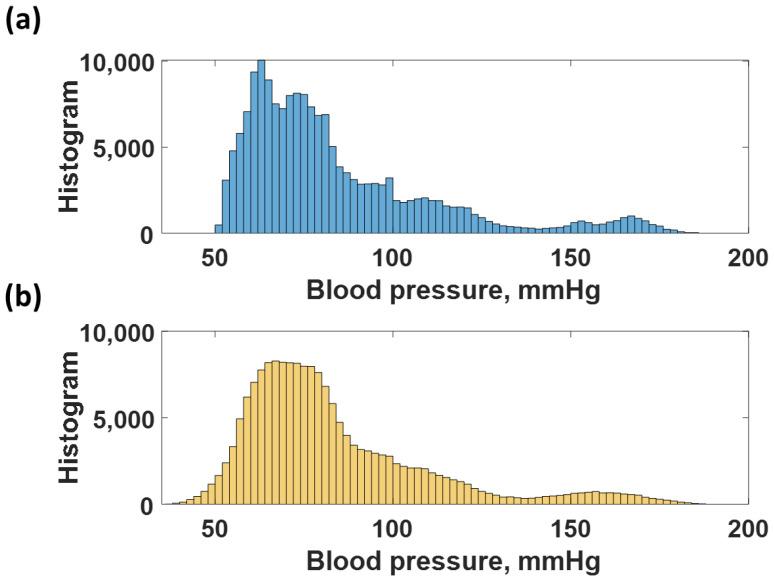
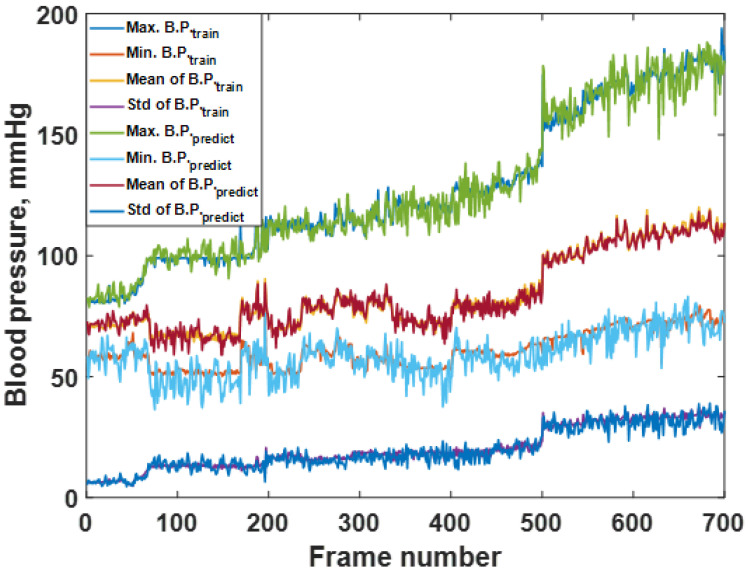
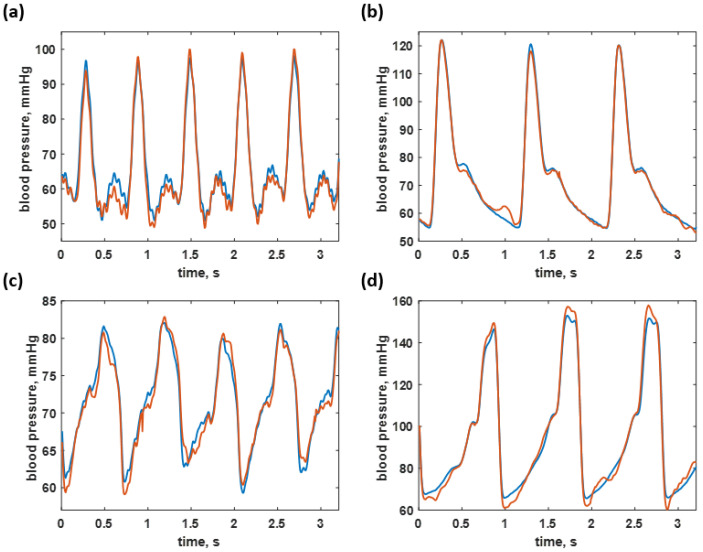
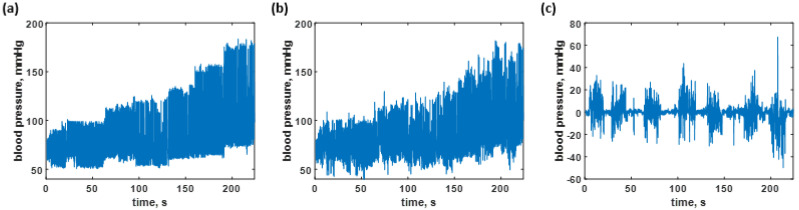
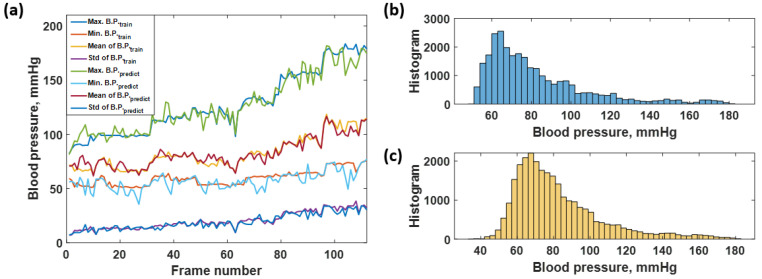
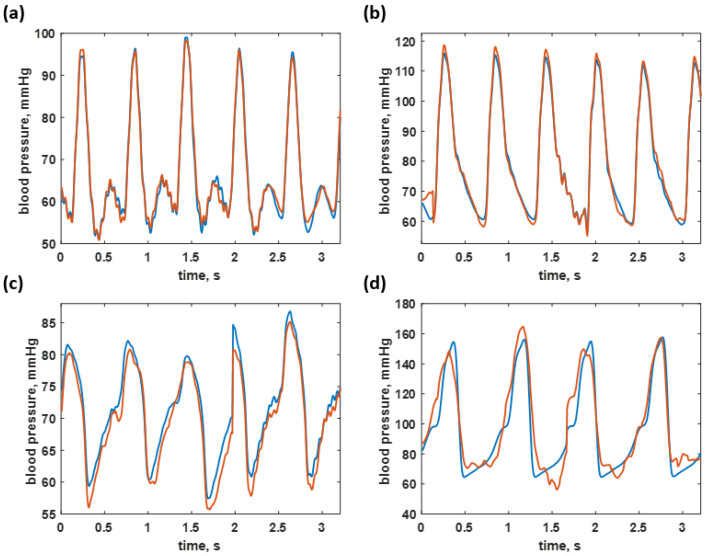
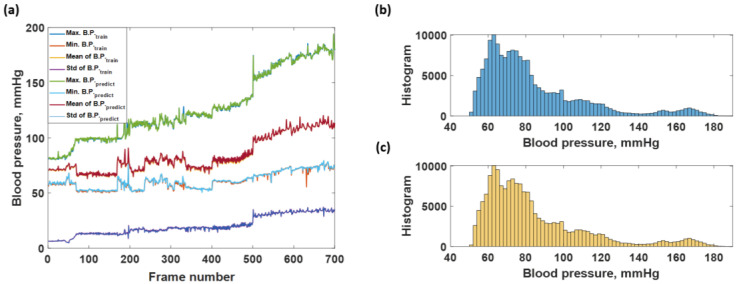
This research proposes an algorithm to preprocess photoplethysmography (PPG) and electrocardiogram (ECG) signals and apply the processed signals to the context aggregation network-based deep learning to achieve higher accuracy of continuous systolic and diastolic blood pressure monitoring than other reported algorithms. The preprocessing method consists of the following steps: (1) acquiring the PPG and ECG signals for a two second window at a sampling rate of 125 Hz; (2) separating the signals into an array of 250 data points corresponding to a 2 s data window; (3) randomizing the amplitude of the PPG and ECG signals by multiplying the 2 s frames by a random amplitude constant to ensure that the neural network can only learn from the frequency information accommodating the signal fluctuation due to instrument attachment and installation; (4) Fourier transforming the windowed PPG and ECG signals obtaining both amplitude and phase data; (5) normalizing both the amplitude and the phase of PPG and ECG signals using z-score normalization; and (6) training the neural network using four input channels (the amplitude and the phase of PPG and the amplitude and the phase of ECG), and arterial blood pressure signal in time-domain as the label for supervised learning. As a result, the network can achieve a high continuous blood pressure monitoring accuracy, with the systolic blood pressure root mean square error of 7 mmHg and the diastolic root mean square error of 6 mmHg. These values are within the error range reported in the literature. Note that other methods rely only on mathematical models for the systolic and diastolic values, whereas the proposed method can predict the continuous signal without degrading the measurement performance and relying on a mathematical model.
本研究提出了一种算法,用于预处理光电容积脉搏波(PPG)和心电图(ECG)信号,并将处理后的信号应用于基于上下文聚合网络的深度学习中,以实现比其他报道的算法更高的连续收缩压和舒张压监测精度。预处理方法包括以下步骤:(1)以 125Hz 的采样率获取两秒窗口的 PPG 和 ECG 信号;(2)将信号分为对应于 2s 数据窗口的 250 个数据点的数组;(3)通过将 2s 帧乘以随机幅度常数随机化 PPG 和 ECG 信号的幅度,以确保神经网络只能从适应信号波动的频率信息中学习,这些波动是由于仪器附着和安装引起的;(4)对窗口化的 PPG 和 ECG 信号进行傅里叶变换,获得幅度和相位数据;(5)使用 z 分数归一化对 PPG 和 ECG 信号的幅度和相位进行归一化;(6)使用四个输入通道(PPG 的幅度和相位以及 ECG 的幅度和相位)和时域中的动脉血压信号作为监督学习的标签来训练神经网络。结果,该网络可以实现高精度的连续血压监测,收缩压均方根误差为 7mmHg,舒张压均方根误差为 6mmHg。这些值在文献报道的误差范围内。需要注意的是,其他方法仅依赖于收缩压和舒张压的数学模型,而所提出的方法可以在不降低测量性能和依赖数学模型的情况下预测连续信号。