Siokatas Georgios, Papatheodorou Ioanna, Daiou Angeliki, Lazou Antigone, Hatzistergos Konstantinos E, Kararigas Georgios
School of Biology, Faculty of Sciences, Aristotle University of Thessaloniki, 54124 Thessaloniki, Greece.
Department of Cell Biology, Miller School of Medicine, University of Miami, Miami, Fl 33136, USA.
J Cardiovasc Dev Dis. 2022 Mar 19;9(3):90. doi: 10.3390/jcdd9030090.
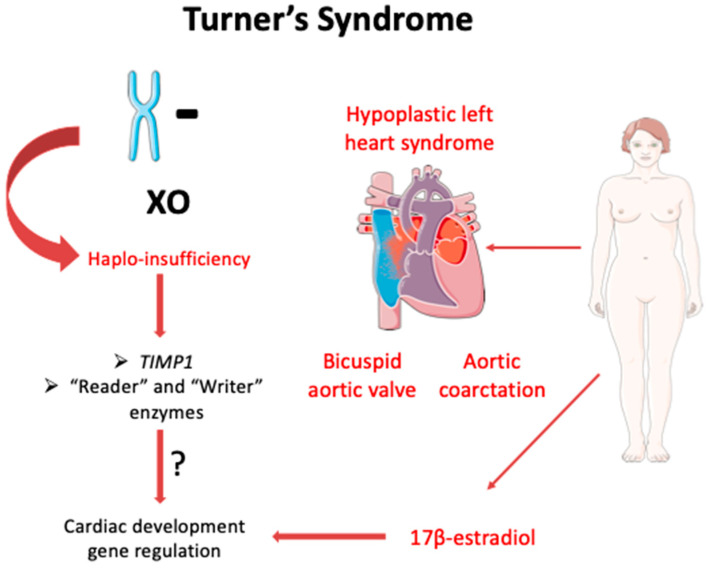
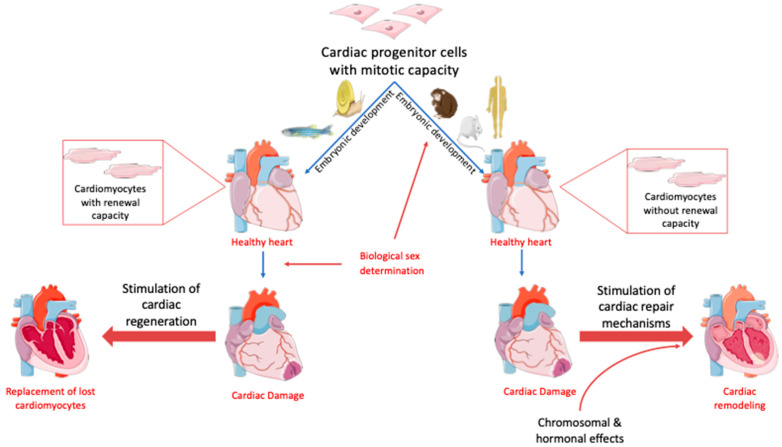
Cardiovascular diseases (CVD) are the leading cause of morbidity and mortality. Interestingly, male and female patients with CVD exhibit distinct epidemiological and pathophysiological characteristics, implying a potentially important role for primary and secondary sex determination factors in heart development, aging, disease and therapeutic responses. Here, we provide a concise review of the field and discuss current gaps in knowledge as a step towards elucidating the "sex determination-heart axis". We specifically focus on cardiovascular manifestations of abnormal sex determination in humans, such as in Turner and Klinefelter syndromes, as well as on the differences in cardiac regenerative potential between species with plastic and non-plastic sexual phenotypes. Sex-biased cardiac repair mechanisms are also discussed with a focus on the role of the steroid hormone 17β-estradiol. Understanding the "sex determination-heart axis" may offer new therapeutic possibilities for enhanced cardiac regeneration and/or repair post-injury.
心血管疾病(CVD)是发病和死亡的主要原因。有趣的是,患有心血管疾病的男性和女性患者表现出不同的流行病学和病理生理特征,这意味着原发性和继发性性别决定因素在心脏发育、衰老、疾病和治疗反应中可能发挥重要作用。在此,我们对该领域进行简要综述,并讨论当前知识空白,以此作为阐明“性别决定-心脏轴”的一步。我们特别关注人类性别决定异常的心血管表现,如特纳综合征和克兰费尔特综合征,以及具有可塑性和非可塑性性别表型的物种之间心脏再生潜力的差异。还讨论了性别偏向的心脏修复机制,重点是类固醇激素17β-雌二醇的作用。了解“性别决定-心脏轴”可能为损伤后增强心脏再生和/或修复提供新的治疗可能性。