Laboratory of Brain and Cognition, National Institute of Mental Health, NIH, Bethesda, MD, USA.
J Vis. 2022 Mar 2;22(4):11. doi: 10.1167/jov.22.4.11.
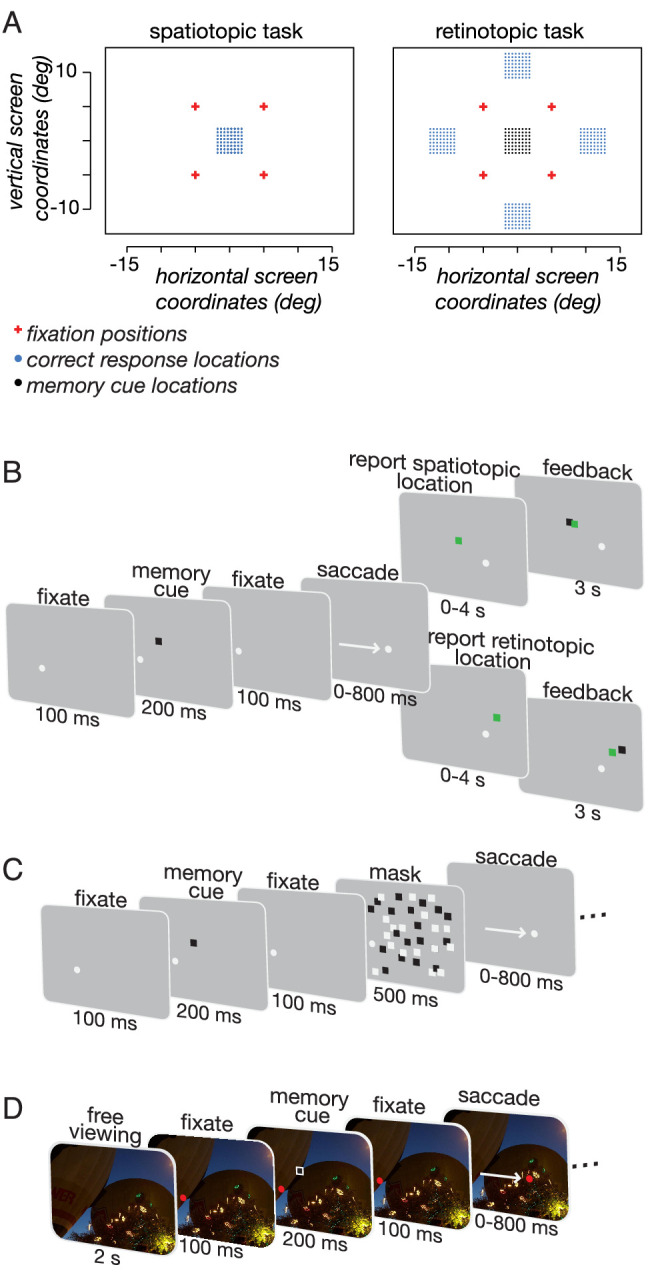
Neural responses throughout the visual cortex encode stimulus location in a retinotopic (i.e., eye-centered) reference frame, and memory for stimulus position is most precise in retinal coordinates. Yet visual perception is spatiotopic: objects are perceived as stationary, even though eye movements cause frequent displacement of their location on the retina. Previous studies found that, after a single saccade, memory of retinotopic locations is more accurate than memory of spatiotopic locations. However, it is not known whether various aspects of natural viewing affect the retinotopic reference frame advantage. We found that the retinotopic advantage may in part depend on a retinal afterimage, which can be effectively nullified through backwards masking. Moreover, in the presence of natural scenes, spatiotopic memory is more accurate than retinotopic memory, but only when subjects are provided sufficient time to process the scene before the eye movement. Our results demonstrate that retinotopic memory is not always more accurate than spatiotopic memory and that the fidelity of memory traces in both reference frames are sensitive to the presence of contextual cues.
整个视觉皮层的神经反应以视网膜为中心(即与眼睛相关)的参考系来编码刺激位置,而对刺激位置的记忆在视网膜坐标中最为精确。然而,视觉感知是空间的:即使眼睛运动导致其在视网膜上的位置经常发生位移,物体仍被感知为静止的。先前的研究发现,在单次眼跳后,对视网膜位置的记忆比对空间位置的记忆更准确。然而,目前尚不清楚自然观察的各个方面是否会影响视网膜参考系优势。我们发现,视网膜优势可能部分取决于视网膜后像,通过后向掩蔽可以有效地消除这种后像。此外,在存在自然场景的情况下,空间位置的记忆比视网膜位置的记忆更准确,但只有在眼动之前为受试者提供足够的时间来处理场景时才会如此。我们的结果表明,视网膜位置的记忆并不总是比空间位置的记忆更准确,并且两个参考系中的记忆痕迹的保真度都对上下文线索的存在敏感。