Dermatology Unit and Skin Bank Unit, Department of Clinical Surgical and Neuro-sciences, University of Siena, Siena, Italy.
Laboratory of Molecular Microbiology and Biotechnology, Department of Medical Biotechnologies, University of Siena, Siena, Italy.
Photodermatol Photoimmunol Photomed. 2022 Nov;38(6):531-540. doi: 10.1111/phpp.12786. Epub 2022 Apr 3.
BACKGROUND/PURPOSE: Localized scleroderma (LS) is a rare disease leading to progressive hardening and induration of the skin and subcutaneous tissues. LS is responsive to UVA-1 phototherapy, though its exact mechanism of action dermal fibrosis is yet to be fully elucidated. We aimed to investigate the molecular changes induced by UVA-1 rays in human primary fibroblasts cultures.
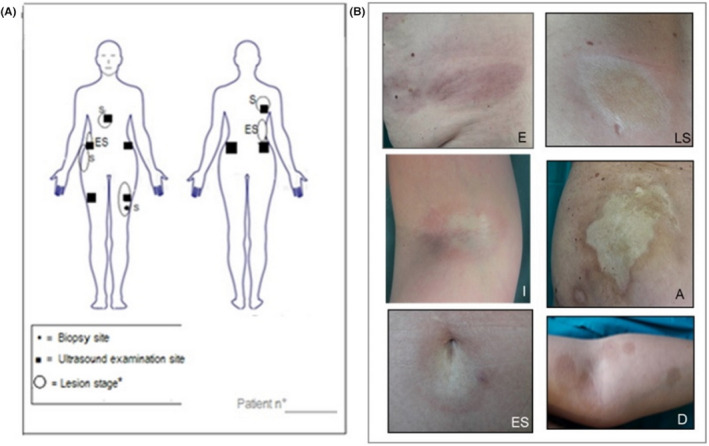
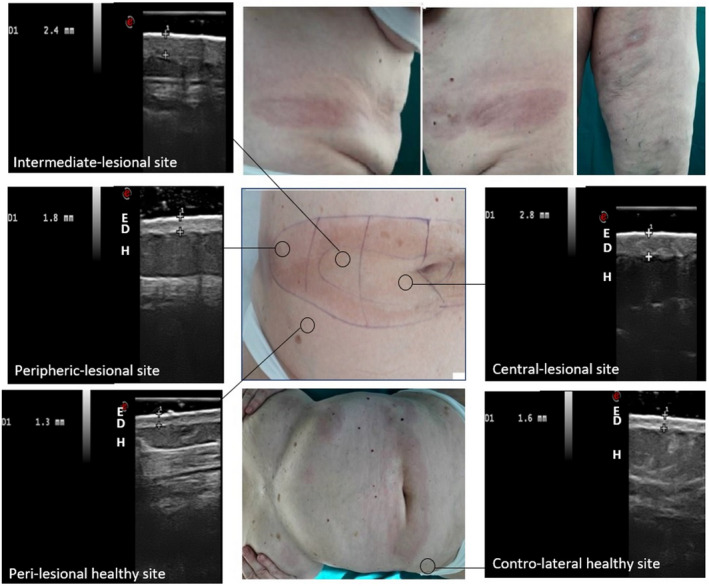
A total of 16 LS patients were treated with medium-dose UVA-1 phototherapy. At baseline, during and after therapy, Localized Scleroderma Assessment Tool, Dermatology Life Quality Index and lesions' staging and mapping were performed along with high-frequency ultrasound (HFUS) examination for dermal thickness assessment. Gene expression analysis for 23 mRNA transcripts, in vitro UVA-1 irradiation and viability tests were realized on lesional fibroblasts' primary cultures, before and 3 months after therapy.
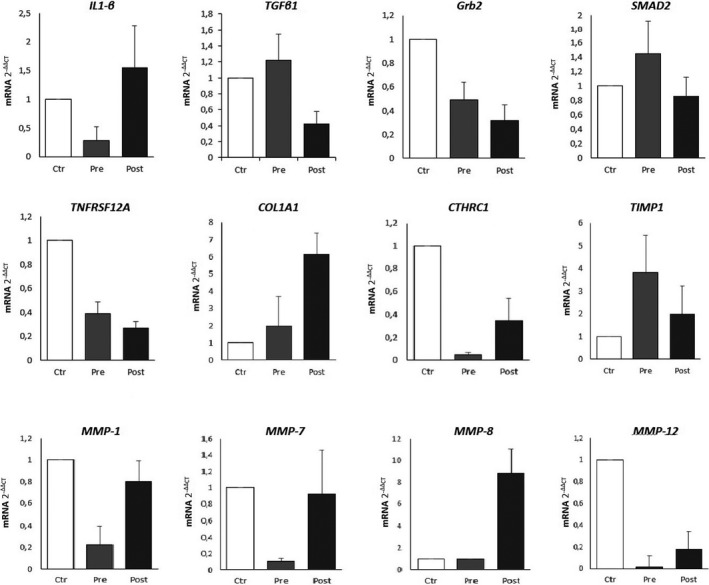
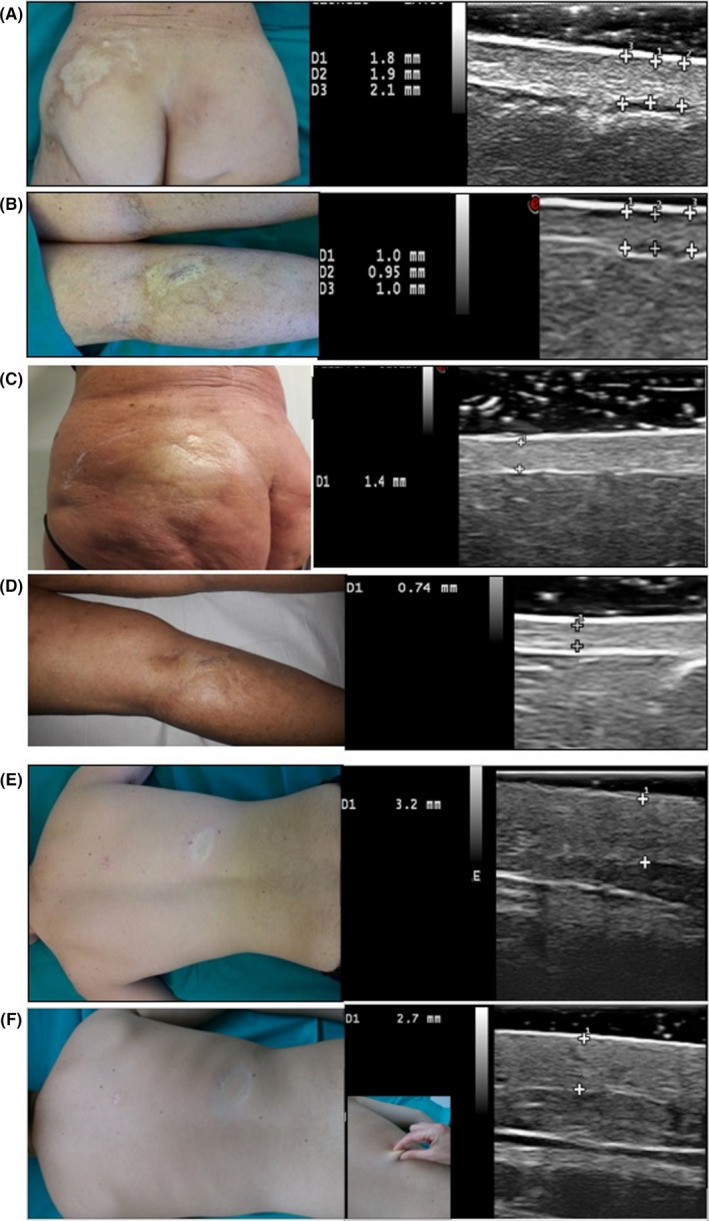
The dermal thickness, the LoSCAT and the DLQI progressively decreased starting from the last phototherapy session up to the 6 and 9 month follow-ups (-57% and -60%, respectively). Molecular gene analysis (rt-PCR) revealed that UVA-1 phototherapy exerts multiple effects: the activation of specific anti-fibrotic pathways (e.g., overexpression of CTHRC1 and metalloproteases 1, 2, 7, 8, 9, 12, suppression of TIMP-1), the downregulation of peculiar pro-fibrotic pathways (e.g., downregulation of TGF-ß, TGF-ßrII, Grb2, SMAD 2/3, TNRSF12A, CTGF) through a significant overexpression of IL-1ß; the stabilization of collagen synthesis acting on genes COL1A1, COL3A1, COL8A1, COL10A1, COL12A1.
UVA-1 phototherapy adds significant benefits in local tissue remodeling, rebalancing the alteration between pro-fibrotic and anti-fibrotic pathways; these changes can be well monitored by HFUS.
背景/目的:局限性硬皮病(LS)是一种罕见的疾病,会导致皮肤和皮下组织逐渐变硬和硬化。LS 对 UVA-1 光疗有反应,尽管其确切的作用机制——真皮纤维化尚未完全阐明。我们旨在研究 UVA-1 射线在人原代成纤维细胞培养物中诱导的分子变化。
共有 16 名 LS 患者接受中剂量 UVA-1 光疗。在基线、治疗期间和治疗后,进行局部硬皮病评估工具、皮肤病生活质量指数和病变分期和绘图,以及高频超声(HFUS)检查评估真皮厚度。对病变成纤维细胞原代培养物进行 23 种 mRNA 转录物的基因表达分析,在治疗前和治疗后 3 个月进行体外 UVA-1 照射和活力测试。
从最后一次光疗开始,直到 6 个月和 9 个月的随访,真皮厚度、LoSCAT 和 DLQI 逐渐下降(分别为-57%和-60%)。分子基因分析(rt-PCR)显示,UVA-1 光疗具有多种作用:激活特定的抗纤维化途径(例如,CTHRC1 和金属蛋白酶 1、2、7、8、9、12 的过度表达,TIMP-1 的抑制),下调特定的促纤维化途径(例如,TGF-ß、TGF-ßrII、Grb2、SMAD 2/3、TNRSF12A、CTGF 的下调),通过 IL-1ß 的显著过度表达;通过对 COL1A1、COL3A1、COL8A1、COL10A1、COL12A1 基因的作用稳定胶原合成。
UVA-1 光疗在局部组织重塑方面有显著的益处,重新平衡了促纤维化和抗纤维化途径之间的变化;这些变化可以通过 HFUS 很好地监测。