Henan Institute of Science and Technology, College of Animal Science and Veterinary Medicine, Xinxiang 453003, China.
Faculty of Veterinary Medicine, Sumy National Agrarian University, 40021 Sumy, Ukraine.
Toxins (Basel). 2022 Mar 17;14(3):220. doi: 10.3390/toxins14030220.
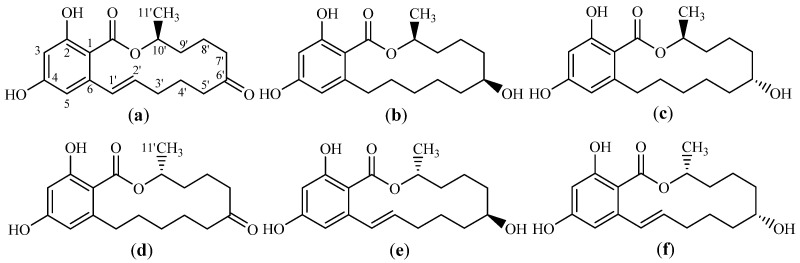
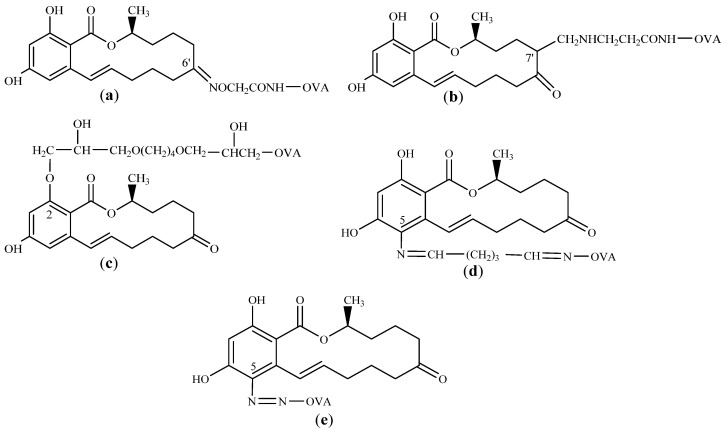
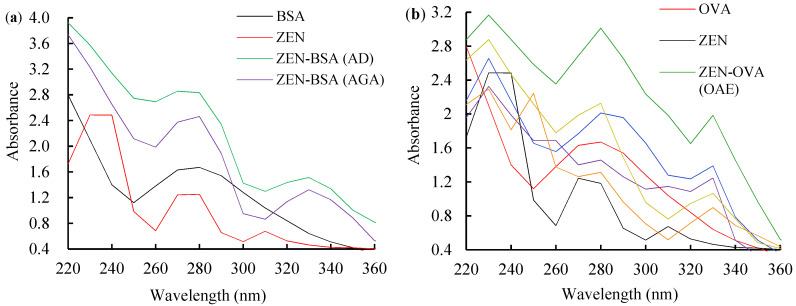
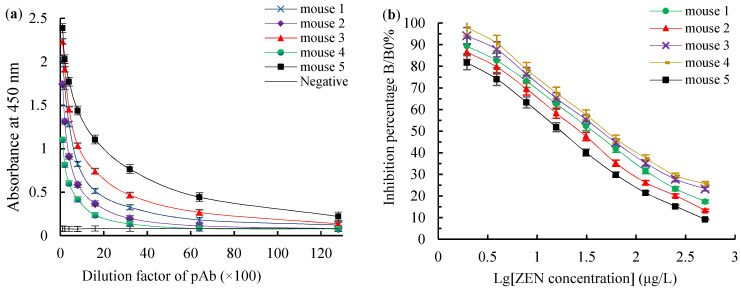
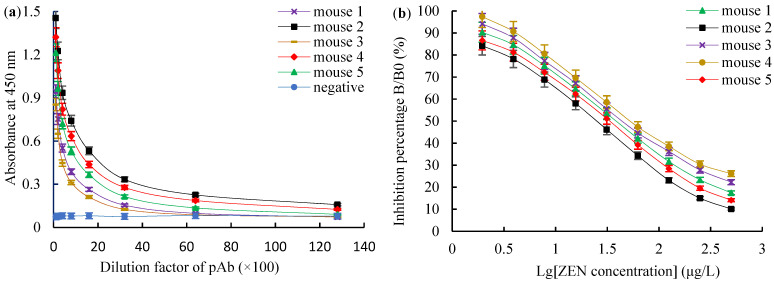
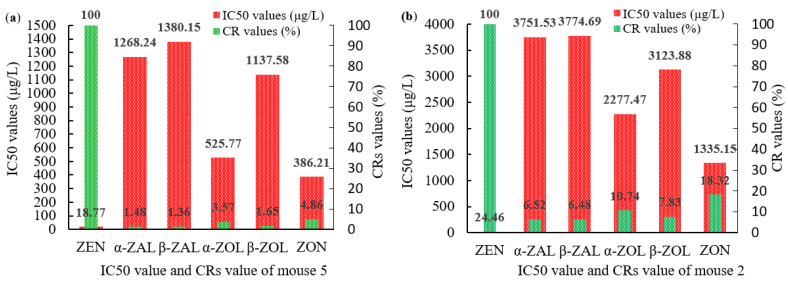
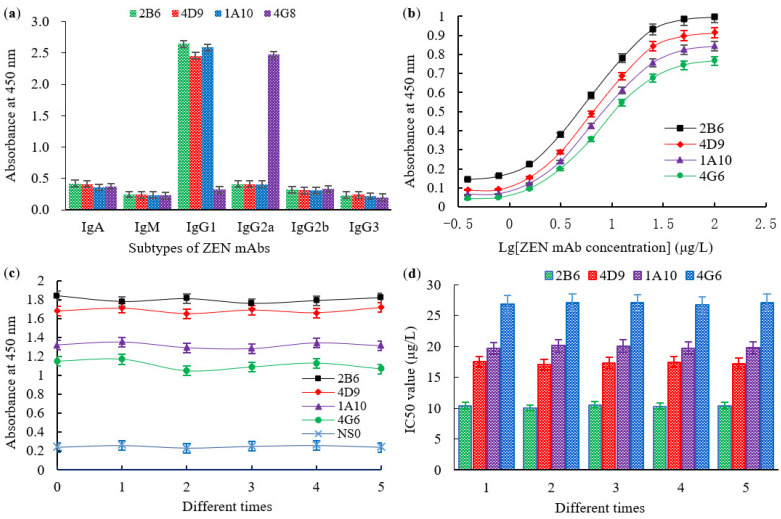
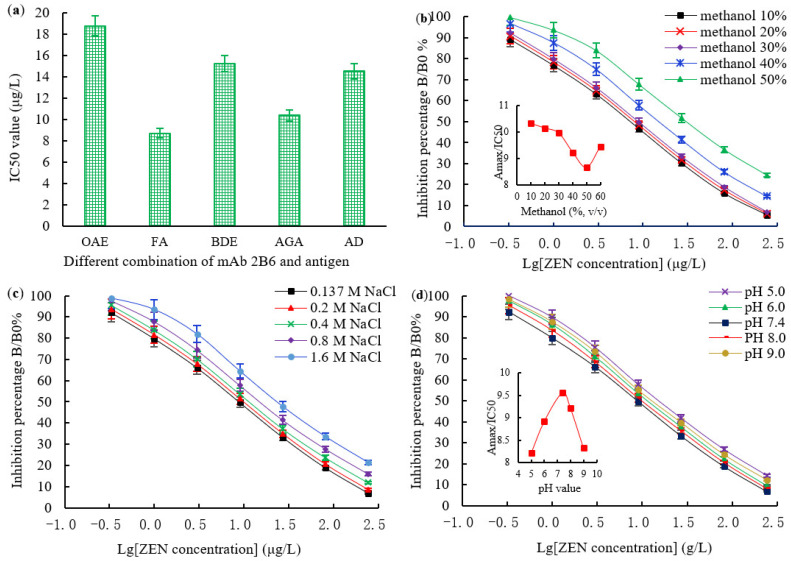
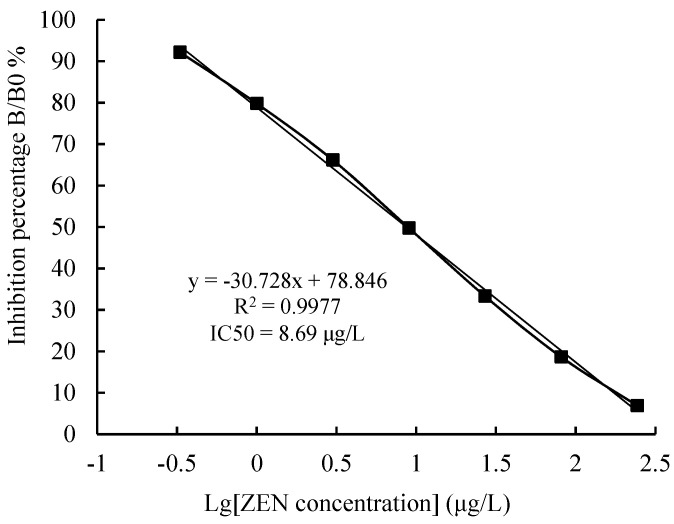
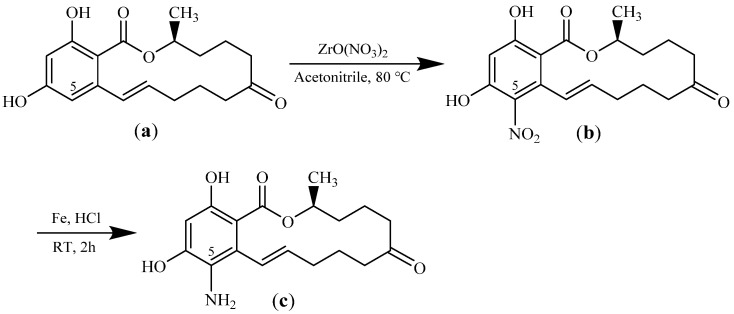
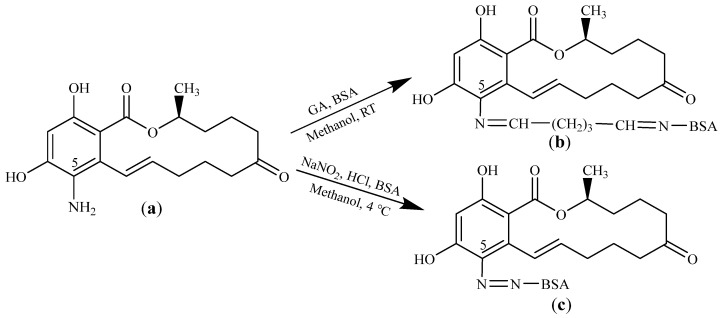
Zearalenone (ZEN) contamination in food and feed is prevalent and has severe effects on humans and animals post-consumption. Therefore, a sensitive, specific, rapid, and reliable method for detecting a single residue of ZEN is necessary. This study aimed to establish a highly sensitive and specific ZEN monoclonal antibody (mAb) and an indirect competitive enzyme-linked immunosorbent assay (icELISA) for the detection of ZEN residues in food and feed. The immunogen ZEN-BSA was synthesized via the amino glutaraldehyde (AGA) and amino diazotization (AD) methods and identified using 1H nuclear magnetic resonance (1H NMR), a high-resolution mass spectrometer (HRMS), and an ultraviolet spectrometer (UV). The coating antigens ZEN-OVA were synthesized via the oxime active ester (OAE), formaldehyde (FA), 1,4-butanediol diglycidyl ether (BDE), AGA, and AD methods. These methods were used to screen the best antibody/antigen combination of a heterologous icELISA. Balb/c mice were immunized with a low ZEN-BSA dose at long intervals and multiple sites. Suitable cell fusion mice and positive hybridoma cell lines were screened using a homologous indirect non-competitive ELISA (inELISA) and an icELISA. The ZEN mAbs were prepared by inducing ascites in vivo. The immunological characteristics of ZEN mAbs were then assessed. The standard curves of the icELISA for ZEN were constructed under optimal experimental conditions, and the performance of the icELISA was validated. The two ZEN-BSA immunogens (conjugation ratios, 11.6:1 (AGA) and 9.2:1 (AD)) were successfully synthesized. Four hybridoma cell lines (2B6, 4D9, 1A10, and 4G8) were filtered, of which 2B6 had the best sensitivity and specificity. The mAb 2B6-based icELISA was then developed. The limit of detection (LOD), the 50% inhibitive concentration (IC50), and the linear working range (IC20 to IC80) values of the icELISA were 0.76 μg/L, 8.69 μg/L, and 0.92-82.24 μg/L, respectively. The cross-reactivity (CR) of the icELISA with the other five analogs of ZEN was below 5%. Three samples were spiked with different concentrations of ZEN and detected using the icELISA. The average intra-assay recoveries, inter-assay recoveries, intra-assay coefficients of variations (CVs), and inter-assay CVs were 93.48-99.48%, 94.18-96.13%, 12.55-12.98%, and 12.53-13.58%, respectively. The icELISA was used to detect ZEN in various samples. The results were confirmed using high-performance liquid chromatography/tandem mass spectrometry (HPLC-MS/MS) (correlation coefficient, 0.984). The proposed icELISA was highly sensitive, specific, rapid, and reliable for the detection of ZEN in food and feed samples.
玉米赤霉烯酮(ZEN)在食品和饲料中的污染普遍存在,食用后对人类和动物有严重影响。因此,有必要建立一种用于检测 ZEN 单一残留的灵敏、特异、快速、可靠的方法。本研究旨在建立一种高灵敏度和特异性的 ZEN 单克隆抗体(mAb)和间接竞争酶联免疫吸附试验(icELISA),用于检测食品和饲料中的 ZEN 残留。免疫原 ZEN-BSA 通过氨基戊二醛(AGA)和氨基重氮(AD)方法合成,并通过 1H 核磁共振(1H NMR)、高分辨率质谱(HRMS)和紫外光谱(UV)进行鉴定。包被抗原 ZEN-OVA 通过肟活性酯(OAE)、甲醛(FA)、1,4-丁二醇二缩水甘油醚(BDE)、AGA 和 AD 方法合成。这些方法用于筛选异源 icELISA 的最佳抗体/抗原组合。用低剂量的 ZEN-BSA 长时间间隔多次免疫 Balb/c 小鼠。使用同源间接非竞争 ELISA(inELISA)和 icELISA 筛选合适的细胞融合小鼠和阳性杂交瘤细胞系。通过体内诱导腹水制备 ZEN mAb。然后评估 ZEN mAb 的免疫学特性。在最佳实验条件下构建 icELISA 的 ZEN 标准曲线,并验证 icELISA 的性能。成功合成了两种 ZEN-BSA 免疫原(偶联比,11.6:1(AGA)和 9.2:1(AD))。筛选出 4 株杂交瘤细胞系(2B6、4D9、1A10 和 4G8),其中 2B6 的灵敏度和特异性最好。然后开发了基于 mAb 2B6 的 icELISA。icELISA 的检测限(LOD)、半数抑制浓度(IC50)和线性工作范围(IC20 至 IC80)值分别为 0.76 μg/L、8.69 μg/L 和 0.92-82.24 μg/L。icELISA 与 ZEN 的其他五种类似物的交叉反应(CR)均低于 5%。用 icELISA 检测三种不同浓度 ZEN 加标样品。icELISA 的平均批内回收率、批间回收率、批内变异系数(CV)和批间 CV 分别为 93.48-99.48%、94.18-96.13%、12.55-12.98%和 12.53-13.58%。该 icELISA 用于检测各种样品中的 ZEN,并使用高效液相色谱/串联质谱(HPLC-MS/MS)进行验证(相关系数为 0.984)。该提出的 icELISA 用于检测食品和饲料样品中的 ZEN 残留,具有高灵敏度、特异性、快速和可靠的特点。