Centre for Modern Interdisciplinary Technologies, Nicolaus Copernicus University, Ul. Wilenska 4, 87-100 Torun, Poland.
Faculty of Biological and Veterinary Sciences, Nicolaus Copernicus University, Ul. Lwowska 1, 87-100 Torun, Poland.
Cells. 2022 Mar 16;11(6):1008. doi: 10.3390/cells11061008.
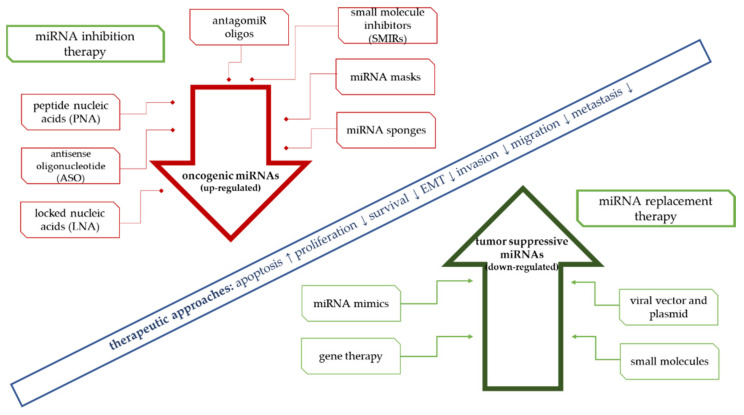
Small noncoding RNAs, as post-translational regulators of many target genes, are not only markers of neoplastic disease initiation and progression, but also markers of response to anticancer therapy. Hundreds of miRNAs have been identified as biomarkers of drug resistance, and many have demonstrated the potential to sensitize cancer cells to therapy. Their properties of modulating the response of cells to therapy have made them a promising target for overcoming drug resistance. Several methods have been developed for the delivery of miRNAs to cancer cells, including introducing synthetic miRNA mimics, DNA plasmids containing miRNAs, and small molecules that epigenetically alter endogenous miRNA expression. The results of studies in animal models and preclinical studies for solid cancers and hematological malignancies have confirmed the effectiveness of treatment protocols using microRNA. Nevertheless, the use of miRNAs in anticancer therapy is not without limitations, including the development of a stable nanoconstruct, delivery method choices, and biodistribution. The aim of this review was to summarize the role of miRNAs in cancer treatment and to present new therapeutic concepts for these molecules. Supporting anticancer therapy with microRNA molecules has been verified in numerous clinical trials, which shows great potential in the treatment of cancer.
小非编码 RNA 作为许多靶基因的翻译后调控因子,不仅是肿瘤疾病发生和进展的标志物,也是抗癌治疗反应的标志物。已经鉴定出数百种 miRNA 作为耐药性的生物标志物,许多 miRNA 已经证明了使癌细胞对治疗敏感的潜力。它们调节细胞对治疗反应的特性使它们成为克服耐药性的有前途的靶标。已经开发了几种将 miRNA 递送至癌细胞的方法,包括引入合成 miRNA 模拟物、包含 miRNA 的 DNA 质粒和表观遗传改变内源性 miRNA 表达的小分子。针对实体瘤和血液恶性肿瘤的动物模型和临床前研究的结果证实了使用 microRNA 的治疗方案的有效性。然而,miRNA 在抗癌治疗中的应用并非没有局限性,包括稳定的纳米结构的开发、递送方法的选择和生物分布。本综述的目的是总结 miRNA 在癌症治疗中的作用,并提出这些分子的新治疗概念。许多临床试验证实了 microRNA 分子对癌症治疗的支持作用,这表明其在癌症治疗方面具有巨大的潜力。