Lee Amy H, Mejia Peña Carolina, Dawson Michelle R
Center for Biomedical Engineering, Brown University, Providence, RI 02912, USA.
Department of Molecular Biology, Cell Biology and Biochemistry, Brown University, Providence, RI 02912, USA.
Cancers (Basel). 2022 Mar 10;14(6):1418. doi: 10.3390/cancers14061418.
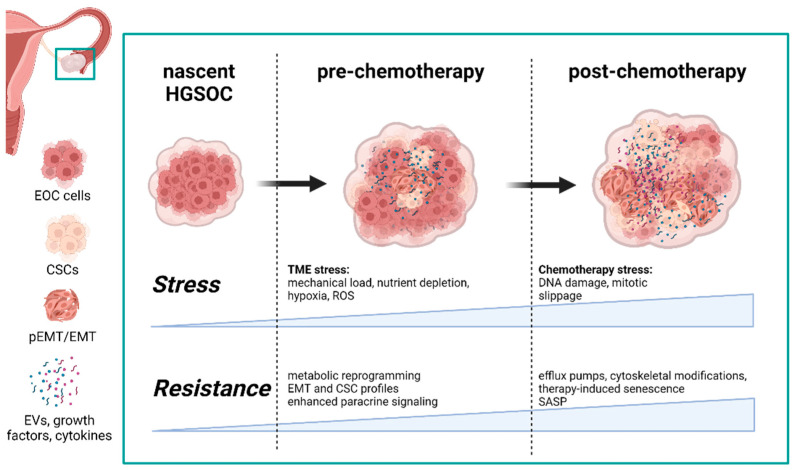
High-grade serous ovarian cancer (HGSOC) constitutes the majority of all ovarian cancer cases and has staggering rates of both refractory and recurrent disease. While most patients respond to the initial treatment with paclitaxel and platinum-based drugs, up to 25% do not, and of the remaining that do, 75% experience disease recurrence within the subsequent two years. Intrinsic resistance in refractory cases is driven by environmental stressors like tumor hypoxia which alter the tumor microenvironment to promote cancer progression and resistance to anticancer drugs. Recurrent disease describes the acquisition of chemoresistance whereby cancer cells survive the initial exposure to chemotherapy and develop adaptations to enhance their chances of surviving subsequent treatments. Of the environmental stressors cancer cells endure, exposure to hypoxia has been identified as a potent trigger and priming agent for the development of chemoresistance. Both in the presence of the stress of hypoxia or the therapeutic stress of chemotherapy, cancer cells manage to cope and develop adaptations which prime populations to survive in future stress. One adaptation is the modification in the secretome. Chemoresistance is associated with translational reprogramming for increased protein synthesis, ribosome biogenesis, and vesicle trafficking. This leads to increased production of soluble proteins and extracellular vesicles (EVs) involved in autocrine and paracrine signaling processes. Numerous studies have demonstrated that these factors are largely altered between the secretomes of chemosensitive and chemoresistant patients. Such factors include cytokines, growth factors, EVs, and EV-encapsulated microRNAs (miRNAs), which serve to induce invasive molecular, biophysical, and chemoresistant phenotypes in neighboring normal and cancer cells. This review examines the modifications in the secretome of distinct chemoresistant ovarian cancer cell populations and specific secreted factors, which may serve as candidate biomarkers for aggressive and chemoresistant cancers.
高级别浆液性卵巢癌(HGSOC)占所有卵巢癌病例的大多数,其难治性和复发性疾病的发生率惊人。虽然大多数患者对紫杉醇和铂类药物的初始治疗有反应,但仍有高达25%的患者无反应,而在其余有反应的患者中,75%会在随后两年内出现疾病复发。难治性病例中的内在抗性是由肿瘤缺氧等环境应激因素驱动的,这些因素会改变肿瘤微环境,促进癌症进展和对抗癌药物的抗性。复发性疾病描述的是获得化学抗性,即癌细胞在初次接触化疗后存活下来,并产生适应性变化以增加其在后续治疗中存活的机会。在癌细胞所承受的环境应激因素中,缺氧已被确定为化学抗性发展的有力触发因素和启动剂。无论是在缺氧应激还是化疗治疗应激的情况下,癌细胞都能设法应对并产生适应性变化,使细胞群体能够在未来的应激中存活。一种适应性变化是分泌组的改变。化学抗性与翻译重编程有关,可增加蛋白质合成、核糖体生物发生和囊泡运输。这导致参与自分泌和旁分泌信号过程的可溶性蛋白质和细胞外囊泡(EVs)产量增加。大量研究表明,这些因素在化疗敏感和化疗耐药患者的分泌组之间有很大差异。这些因素包括细胞因子、生长因子、EVs和EV包裹的微小RNA(miRNAs),它们可诱导邻近正常细胞和癌细胞的侵袭性分子、生物物理和化学抗性表型。本综述探讨了不同化学抗性卵巢癌细胞群体分泌组的变化以及特定的分泌因子,这些可能作为侵袭性和化学抗性癌症的候选生物标志物。