Spence Rosalind R, Sandler Carolina X, Singh Benjamin, Tanner Jodie, Pyke Christopher, Eakin Elizabeth, Vagenas Dimitrios, Hayes Sandra C
Menzies Health Institute Queensland, Griffith University, Brisbane, QLD 4222, Australia.
School of Health Sciences, Western Sydney University, Campbelltown, NSW 2560, Australia.
Cancers (Basel). 2022 Mar 16;14(6):1528. doi: 10.3390/cancers14061528.
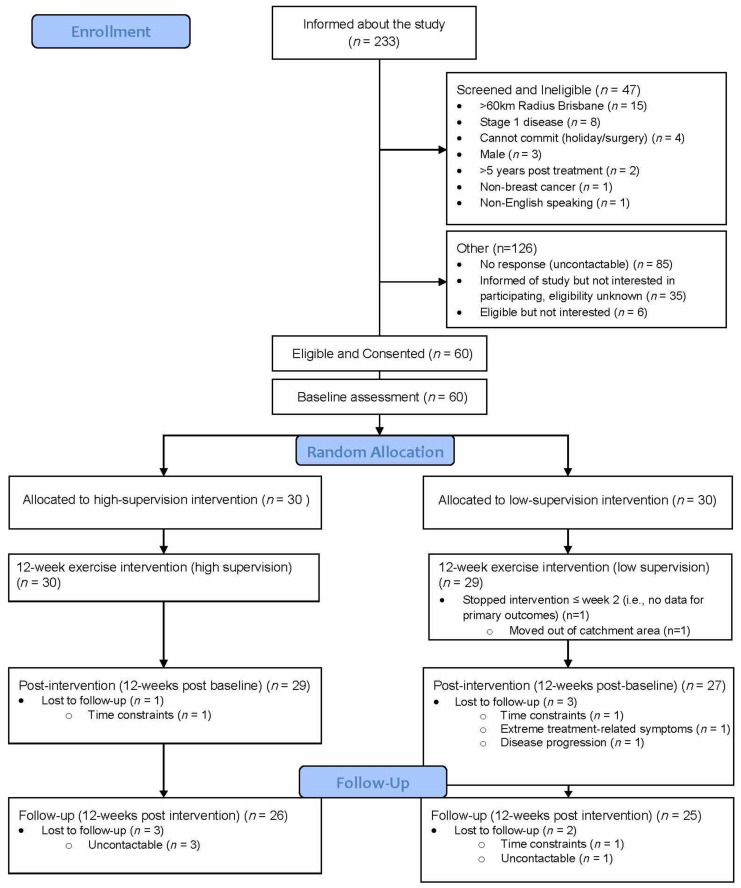
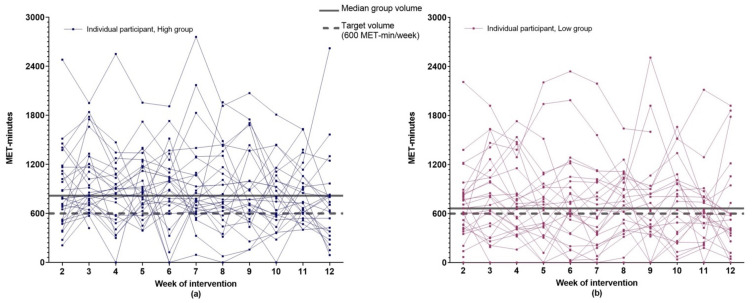
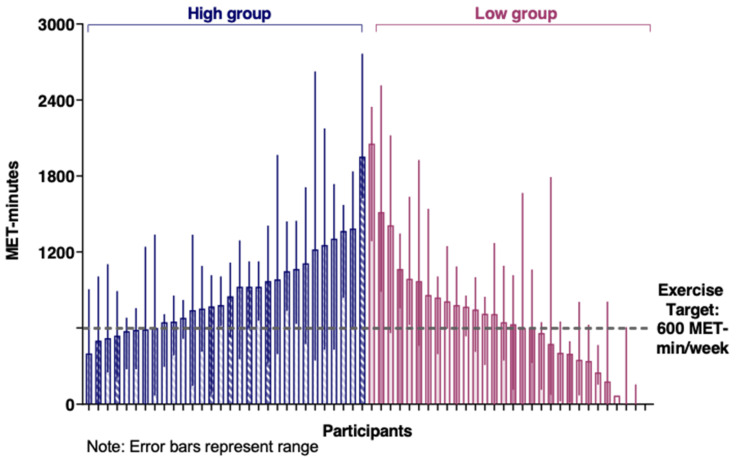
The aim of this comparative, effectiveness trial was to evaluate the safety, feasibility and effect of an exercise intervention delivered via low-level versus high-level supervision. The target population were women who were diagnosed with ≥stage II breast cancer, had ≥ one comorbidity and/or persistent treatment-related side-effects, and were insufficiently physically active. Sixty women (50 ± 9 years) were randomized to the low-supervision group (n = 30) or high-supervision group (n = 30). The low-supervision group participated in a 12-week, individually-tailored exercise intervention supported by five supervised sessions with an exercise professional. The high-supervision group participated in the same exercise intervention but received 20 supervised sessions across the 12-week period. The target weekly dosage of 600 metabolic equivalent minutes of exercise per week (MET-mins/wk) and the session content, such as safety and behaviour change topics, were standardized between the groups. The primary outcomes were intervention safety, defined as the number, type, and severity of exercise-related adverse events (e.g., musculoskeletal injury or exacerbated treatment-related side effects), and feasibility, which was defined as compliance to target exercise dosage. The effect of the intervention on quality of life, physical activity, self-efficacy, fitness, and strength was also assessed (pre- and post-intervention, and at 12-week follow-up). The intervention was safe, with no exercise-related adverse events of grade 3 or above in either group. Both groups reported high compliance to the target exercise dosage (median MET-mins/wk: High = 817; Low = 663), suggesting the exercise intervention was feasible, irrespective of supervision level. Improvements in quality of life, physical activity and fitness were observed post-intervention and maintained at follow-up for both groups (p < 0.05). Only the high-supervision group showed clinically-relevant improvements in strength and self-efficacy at post-intervention (p < 0.05). Individually-targeted exercise delivered under high- or low-levels of supervision is safe, feasible and beneficial for women with stage II+ breast cancer. Future research needs to assess whether the greater gains observed in the group who received higher supervision may contribute to longer term maintenance of physical activity levels and overall health benefits. Australian and New Zealand Clinical Trials Registry: ACTRN12616000547448.
这项比较性有效性试验的目的是评估在低水平与高水平监督下进行的运动干预的安全性、可行性和效果。目标人群为被诊断患有≥II期乳腺癌、有≥一种合并症和/或持续的治疗相关副作用且身体活动不足的女性。60名女性(50±9岁)被随机分为低监督组(n = 30)或高监督组(n = 30)。低监督组参加了一项为期12周、由一名运动专业人员进行五次监督课程支持的个性化运动干预。高监督组参加相同的运动干预,但在12周期间接受20次监督课程。两组之间每周运动目标剂量600代谢当量分钟(MET-分钟/周)以及课程内容(如安全和行为改变主题)均标准化。主要结局为干预安全性,定义为运动相关不良事件的数量、类型和严重程度(如肌肉骨骼损伤或加重的治疗相关副作用),以及可行性,定义为对目标运动剂量的依从性。还评估了干预对生活质量、身体活动、自我效能、体能和力量的影响(干预前和干预后,以及12周随访时)。干预是安全的,两组均未出现3级或以上的运动相关不良事件。两组均报告对目标运动剂量的依从性较高(中位数MET-分钟/周:高监督组 = 817;低监督组 = 663),这表明无论监督水平如何,运动干预都是可行的。两组在干预后均观察到生活质量、身体活动和体能的改善,并在随访时得以维持(p < 0.05)。仅高监督组在干预后显示出力量和自我效能有临床相关的改善(p < 0.05)。在高或低水平监督下进行的个性化运动对II期及以上乳腺癌女性是安全、可行且有益的。未来的研究需要评估在接受更高监督的组中观察到的更大收益是否可能有助于身体活动水平的长期维持和整体健康益处。澳大利亚和新西兰临床试验注册中心:ACTRN12616000547448。