Sulaiman Andrew, Chambers Jason, Chilumula Sai Charan, Vinod Vishak, Kandunuri Rohith, McGarry Sarah, Kim Sung
Department of Basic Science, Kansas City University, 1750 Independence Ave, Kansas City, MO 64106, USA.
Schulich School of Medicine, Western University, London, ON N6A5C1, Canada.
Cancers (Basel). 2022 Mar 19;14(6):1577. doi: 10.3390/cancers14061577.
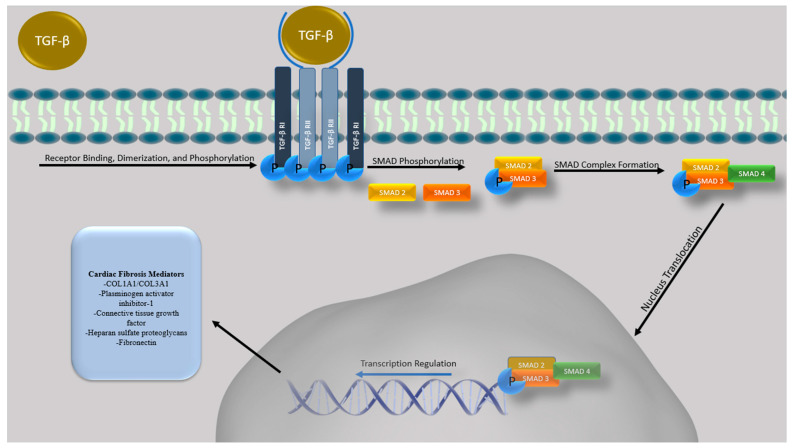
Triple-negative breast cancer (TNBC) is a subtype of breast cancer that accounts for the majority of breast cancer-related deaths due to the lack of specific targets for effective treatments. While there is immense focus on the development of novel therapies for TNBC treatment, a persistent and critical issue is the rate of heart failure and cardiomyopathy, which is a leading cause of mortality and morbidity amongst cancer survivors. In this review, we highlight mechanisms of post-chemotherapeutic cardiotoxicity exposure, evaluate how this is assessed clinically and highlight the transforming growth factor-beta family (TGF-β) pathway and its significance as a mediator of cardiomyopathy. We also highlight recent findings demonstrating TGF-β inhibition as a potent method to prevent cardiac remodeling, fibrosis and cardiomyopathy. We describe how dysregulation of the TGF-β pathway is associated with negative patient outcomes across 32 types of cancer, including TNBC. We then highlight how TGF-β modulation may be a potent method to target mesenchymal (CD44/CD24) and epithelial (ALDH) cancer stem cell (CSC) populations in TNBC models. CSCs are associated with tumorigenesis, metastasis, relapse, resistance and diminished patient prognosis; however, due to plasticity and differential regulation, these populations remain difficult to target and continue to present a major barrier to successful therapy. TGF-β inhibition represents an intersection of two fields: cardiology and oncology. Through the inhibition of cardiomyopathy, cardiac damage and heart failure may be prevented, and through CSC targeting, patient prognoses may be improved. Together, both approaches, if successfully implemented, would target the two greatest causes of cancer-related morbidity in patients and potentially lead to a breakthrough therapy.
三阴性乳腺癌(TNBC)是乳腺癌的一种亚型,由于缺乏有效的治疗靶点,它在与乳腺癌相关的死亡中占大多数。尽管人们高度关注TNBC治疗新疗法的开发,但一个持续且关键的问题是心力衰竭和心肌病的发生率,这是癌症幸存者死亡和发病的主要原因。在本综述中,我们强调化疗后心脏毒性暴露的机制,评估其临床评估方法,并强调转化生长因子-β家族(TGF-β)途径及其作为心肌病介质的重要性。我们还强调了最近的研究结果,表明抑制TGF-β是预防心脏重塑、纤维化和心肌病的有效方法。我们描述了TGF-β途径的失调如何与包括TNBC在内的32种癌症患者的不良预后相关。然后,我们强调TGF-β调节可能是在TNBC模型中靶向间充质(CD44/CD24)和上皮(ALDH)癌症干细胞(CSC)群体的有效方法。CSC与肿瘤发生、转移、复发、耐药性以及患者预后不良有关;然而,由于其可塑性和差异调节,这些群体仍然难以靶向,并且仍然是成功治疗的主要障碍。TGF-β抑制代表了心脏病学和肿瘤学两个领域的交叉点。通过抑制心肌病,可以预防心脏损伤和心力衰竭,通过靶向CSC,可以改善患者的预后。如果这两种方法都能成功实施,将针对患者癌症相关发病的两个最大原因,并可能带来突破性治疗。