Zhou Huimin, Wang Kexin, Wang Mengyan, Zhao Wenxia, Zhang Conghui, Cai Meilian, Qiu Yuhan, Zhang Tianshu, Shao Rongguang, Zhao Wuli
Key Laboratory of Antibiotic Bioengineering, Ministry of Health, Laboratory of Oncology, Institute of Medicinal Biotechnology, Chinese Academy of Medical Sciences and Peking Union Medical College, Beijing 100050, China.
Biomedicines. 2022 Mar 18;10(3):707. doi: 10.3390/biomedicines10030707.
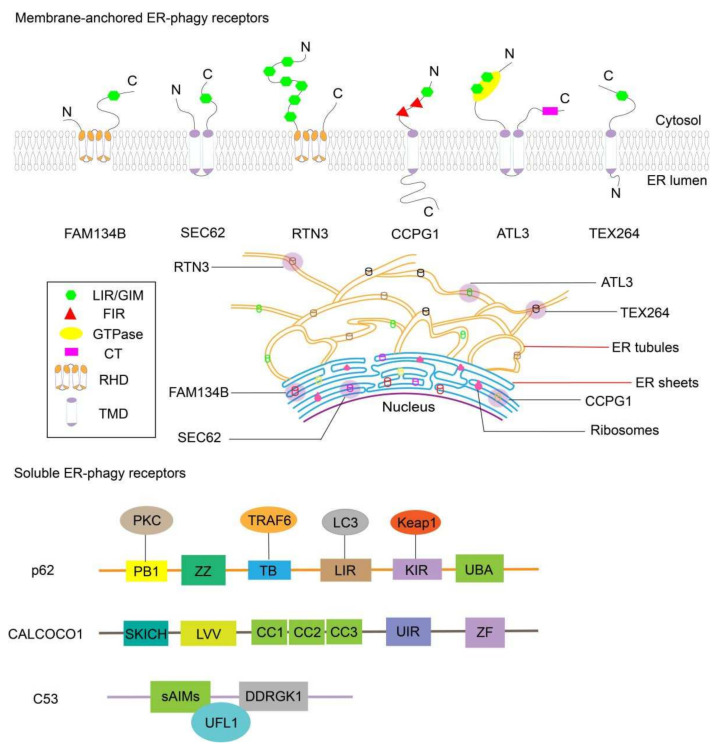
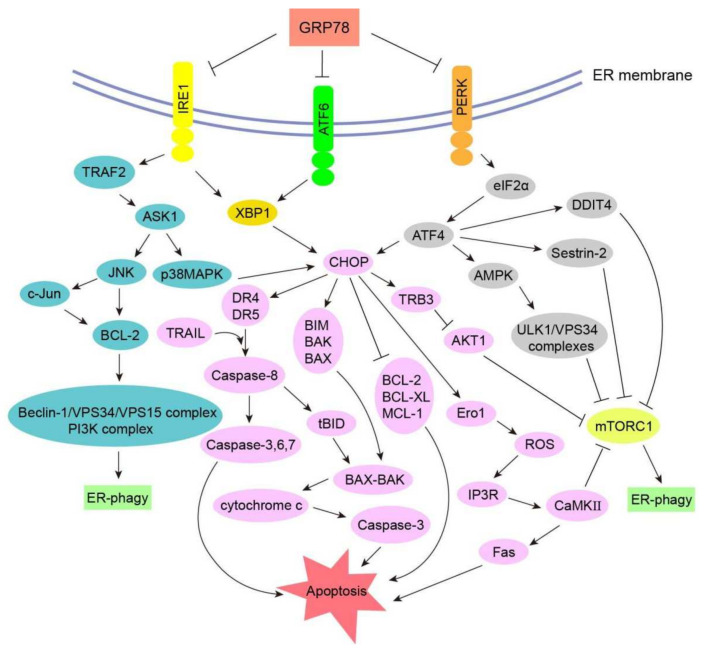
As an organelle, the endoplasmic reticulum (ER) is closely related to protein synthesis and modification. When physiological or pathological stimuli induce disorders of ER function, misfolded proteins trigger ER-phagy, which is beneficial for restoring cell homeostasis or promoting cell apoptosis. As a double-edged sword, ER-phagy actively participates in various stages of development and progression in tumor cells, regulating tumorigenesis and maintaining tumor cell homeostasis. Through the unfolded protein response (UPR), the B cell lymphoma 2 (BCL-2) protein family, the Caspase signaling pathway, and others, ER-phagy plays an initiating role in tumor occurrence, migration, stemness, and proliferation. At the same time, many vital proteins strongly associated with ER-phagy, such as family with sequence similarity 134 member B (FAM134B), translocation protein SEC62 (SEC62), and C/EBP-homologous protein (CHOP), can produce a marked effect in many complex environments, which ultimately lead to entirely different tumor fates. Our article comprehensively focused on introducing the relationship and interaction between ER-phagy and cancers, as well as their molecular mechanism and regulatory pathways. Via these analyses, we tried to clarify the possibility of ER-phagy as a potential target for cancer therapy and provide ideas for further research.
作为一种细胞器,内质网(ER)与蛋白质合成及修饰密切相关。当生理或病理刺激引发内质网功能紊乱时,错误折叠的蛋白质会触发内质网自噬,这有利于恢复细胞稳态或促进细胞凋亡。内质网自噬作为一把双刃剑,积极参与肿瘤细胞发育和进展的各个阶段,调节肿瘤发生并维持肿瘤细胞稳态。通过未折叠蛋白反应(UPR)、B细胞淋巴瘤2(BCL-2)蛋白家族、半胱天冬酶信号通路等,内质网自噬在肿瘤发生、迁移、干性和增殖中发挥起始作用。同时,许多与内质网自噬密切相关的重要蛋白,如序列相似性家族134成员B(FAM134B)、转运蛋白SEC62(SEC62)和C/EBP同源蛋白(CHOP),在许多复杂环境中都能产生显著影响,最终导致截然不同的肿瘤命运。我们的文章全面聚焦于介绍内质网自噬与癌症之间的关系及相互作用,以及它们的分子机制和调控途径。通过这些分析,我们试图阐明内质网自噬作为癌症治疗潜在靶点的可能性,并为进一步研究提供思路。