Mastromoro Gioia, Guadagnolo Daniele, Khaleghi Hashemian Nader, Marchionni Enrica, Traversa Alice, Pizzuti Antonio
Department of Experimental Medicine, Policlinico Umberto I Hospital, Sapienza University of Rome, 00161 Rome, Italy.
Diagnostics (Basel). 2022 Feb 23;12(3):575. doi: 10.3390/diagnostics12030575.
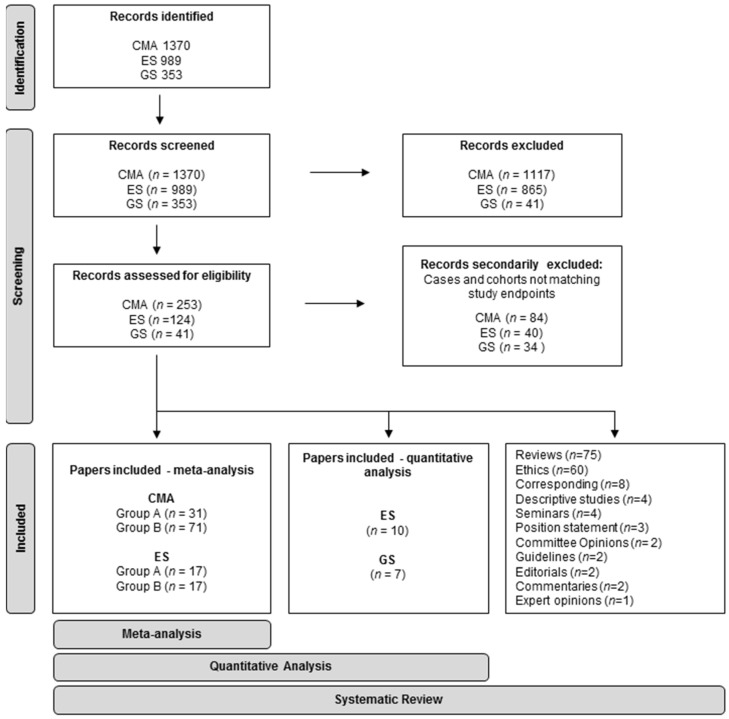
Fetal malformations occur in 2-3% of pregnancies. They require invasive procedures for cytogenetics and molecular testing. "Structural anomalies" include non-transient anatomic alterations. "Soft markers" are often transient minor ultrasound findings. Anomalies not fitting these definitions are categorized as "dynamic". This meta-analysis aims to evaluate the diagnostic yield and the rates of variants of uncertain significance (VUSs) in fetuses undergoing molecular testing (chromosomal microarray (CMA), exome sequencing (ES), genome sequencing (WGS)) due to ultrasound findings. The CMA diagnostic yield was 2.15% in single soft markers (vs. 0.79% baseline risk), 3.44% in multiple soft markers, 3.66% in single structural anomalies and 8.57% in multiple structural anomalies. Rates for specific subcategories vary significantly. ES showed a diagnostic rate of 19.47%, reaching 27.47% in multiple structural anomalies. WGS data did not allow meta-analysis. In fetal structural anomalies, CMA is a first-tier test, but should be integrated with karyotype and parental segregations. In this class of fetuses, ES presents a very high incremental yield, with a significant VUSs burden, so we encourage its use in selected cases. Soft markers present heterogeneous CMA results from each other, some of them with risks comparable to structural anomalies, and would benefit from molecular analysis. The diagnostic rate of multiple soft markers poses a solid indication to CMA.
胎儿畸形在2%至3%的妊娠中出现。它们需要进行侵入性操作以进行细胞遗传学和分子检测。“结构异常”包括非暂时性的解剖学改变。“软指标”通常是暂时性的轻微超声检查结果。不符合这些定义的异常被归类为“动态性”。这项荟萃分析旨在评估因超声检查结果而接受分子检测(染色体微阵列(CMA)、外显子组测序(ES)、基因组测序(WGS))的胎儿的诊断率和意义不明确的变异(VUS)发生率。单一软指标时CMA的诊断率为2.15%(相比基线风险0.79%),多个软指标时为3.44%,单一结构异常时为3.66%,多个结构异常时为8.57%。特定亚类的发生率差异显著。ES的诊断率为19.47%,在多个结构异常时达到27.47%。WGS数据无法进行荟萃分析。在胎儿结构异常中,CMA是一线检测方法,但应与核型分析和父母遗传分离分析相结合。在这类胎儿中,ES具有非常高的额外诊断率,伴有显著的VUS负担,因此我们鼓励在特定病例中使用。软指标之间的CMA结果具有异质性,其中一些的风险与结构异常相当,分子分析对其有益。多个软指标的诊断率为CMA提供了有力的应用指征。