
根据样本采集时间和病毒载量,通过快速抗原检测评估鼻腔和鼻咽拭子样本对SARS-CoV-2检测的诊断准确性
Evaluation of the Diagnostic Accuracy of Nasal Cavity and Nasopharyngeal Swab Specimens for SARS-CoV-2 Detection via Rapid Antigen Test According to Specimen Collection Timing and Viral Load.
作者信息
Lee Seungjun, Widyasari Kristin, Yang Hye-Ryun, Jang Jieun, Kang Taejoon, Kim Sunjoo
机构信息
Department of Laboratory Medicine, Gyeongsang National University Changwon Hospital, Changwon 51472, Korea.
Gyeongnam Center for Infectious Disease Control and Prevention, Changwon 51154, Korea.
出版信息
Diagnostics (Basel). 2022 Mar 14;12(3):710. doi: 10.3390/diagnostics12030710.
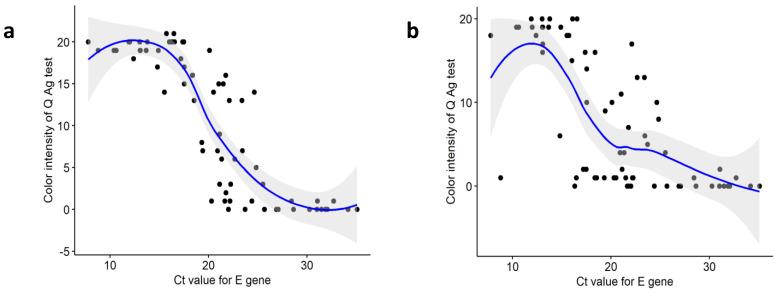
The rapid diagnosis of SARS-CoV-2 is an essential aspect in the detection and control of the spread of COVID-19. We evaluated the accuracy of the rapid antigen test (RAT) using samples from the nasal cavity and nasopharynx based on sample collection timing and viral load. We enrolled 175 patients, of which 71 patients and 104 patients had tested positive and negative, respectively, based on real time-PCR. Nasal cavity and nasopharyngeal swab samples were tested using STANDARD Q COVID-19 Ag tests (Q Ag, SD Biosensor, Korea). The sensitivity of the Q Ag test was 77.5% (95% confidence interval [CI], 67.8−87.2%) for the nasal cavity and 81.7% (95% [CI, 72.7−90.7%) for the nasopharyngeal specimens. The RAT results showed a substantial agreement between the nasal cavity and nasopharyngeal specimens (Cohen’s kappa index = 0.78). The sensitivity of the RAT for nasal cavity specimens exceeded 89% for <5 days after symptom onset (DSO) and 86% for Ct of E and RdRp < 25. The Q Ag test performed fairly well, especially in the early DSO when a high viral load was present, and the nasal cavity swab can be considered an alternative site for the rapid diagnosis of COVID-19.
严重急性呼吸综合征冠状病毒2(SARS-CoV-2)的快速诊断是检测和控制2019冠状病毒病(COVID-19)传播的一个重要方面。我们根据样本采集时间和病毒载量,使用来自鼻腔和鼻咽的样本评估了快速抗原检测(RAT)的准确性。我们招募了175名患者,其中根据实时荧光定量聚合酶链反应(real time-PCR)检测,分别有71名患者呈阳性,104名患者呈阴性。使用标准Q COVID-19抗原检测(Q Ag,韩国SD生物传感器公司)对鼻腔和鼻咽拭子样本进行检测。Q Ag检测对鼻腔样本的敏感性为77.5%(95%置信区间[CI],67.8−87.2%),对鼻咽样本的敏感性为81.7%(95%[CI,72.7−90.7%])。RAT结果显示鼻腔和鼻咽样本之间有高度一致性(科恩kappa指数=0.78)。症状出现后<5天(DSO),RAT对鼻腔样本的敏感性超过89%,E和RdRp的Ct值<25时敏感性为86%。Q Ag检测表现相当不错,尤其是在症状出现早期病毒载量较高时,鼻腔拭子可被视为COVID-19快速诊断的替代采样部位。

 Zotero 插件