Department of Internal Medicine, Seoul National University College of Medicine, Seoul, Korea.
Department of Laboratory Medicine, Seoul National University College of Medicine, Seoul, Korea.
J Korean Med Sci. 2021 Apr 12;36(14):e101. doi: 10.3346/jkms.2021.36.e101.
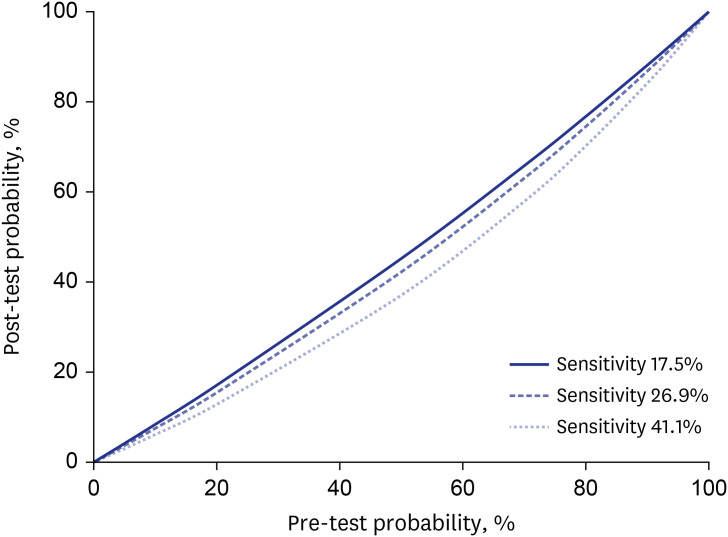
We evaluated the Standard Q COVID-19 Ag test for the diagnosis of coronavirus disease 2019 (COVID-19) compared to the reverse transcription-polymerase chain reaction (RT-PCR) test. We applied both tests to patients who were about to be hospitalized, had visited an emergency room, or had been admitted due to COVID-19 confirmed by RT-PCR. Two nasopharyngeal swabs were obtained; one was tested by RT-PCR and the other by the Standard Q COVID-19 Ag test. A total of 118 pairs of tests from 98 patients were performed between January 5 and 11, 2021. The overall sensitivity and specificity for detecting severe acute respiratory syndrome coronavirus 2 (SARS-CoV-2) for the Standard Q COVID-19 Ag test compared to RT-PCR were 17.5% (95% confidence interval [CI], 8.8-32.0%) and 100% (95% CI, 95.3-100.0%). Analysis of the results using RT-PCR cycle thresholds of ≤ 30 or ≤ 25 increased the sensitivity to 26.9% (95% CI, 13.7-46.1%), and 41.1% (95% CI, 21.6-64.0%), respectively.
我们评估了 Standard Q COVID-19 Ag 检测在诊断 2019 冠状病毒病(COVID-19)方面与逆转录-聚合酶链反应(RT-PCR)检测的比较。我们将这两种检测应用于即将住院、去过急诊室或因 RT-PCR 确诊 COVID-19 而住院的患者。采集了两个鼻咽拭子;一个通过 RT-PCR 检测,另一个通过 Standard Q COVID-19 Ag 检测。2021 年 1 月 5 日至 11 日,对 98 例患者的 118 对检测结果进行了检测。与 RT-PCR 相比,Standard Q COVID-19 Ag 检测对严重急性呼吸综合征冠状病毒 2(SARS-CoV-2)的总体敏感性和特异性分别为 17.5%(95%置信区间[CI],8.8-32.0%)和 100%(95%CI,95.3-100.0%)。使用 RT-PCR 循环阈值≤30 或≤25 对结果进行分析,可将敏感性分别提高至 26.9%(95%CI,13.7-46.1%)和 41.1%(95%CI,21.6-64.0%)。