Center for Medical Research, Faculty of Medicine, University Clinic for Ophthalmology and Optometry, Johannes Kepler University Linz, 4020 Linz, Austria.
Int J Mol Sci. 2022 Mar 8;23(6):2922. doi: 10.3390/ijms23062922.
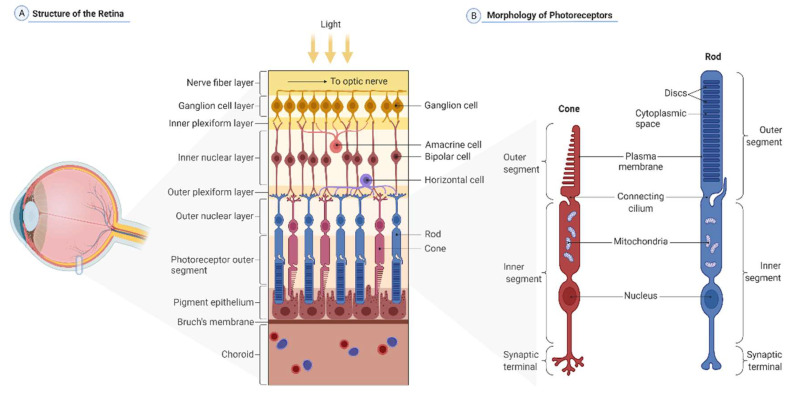
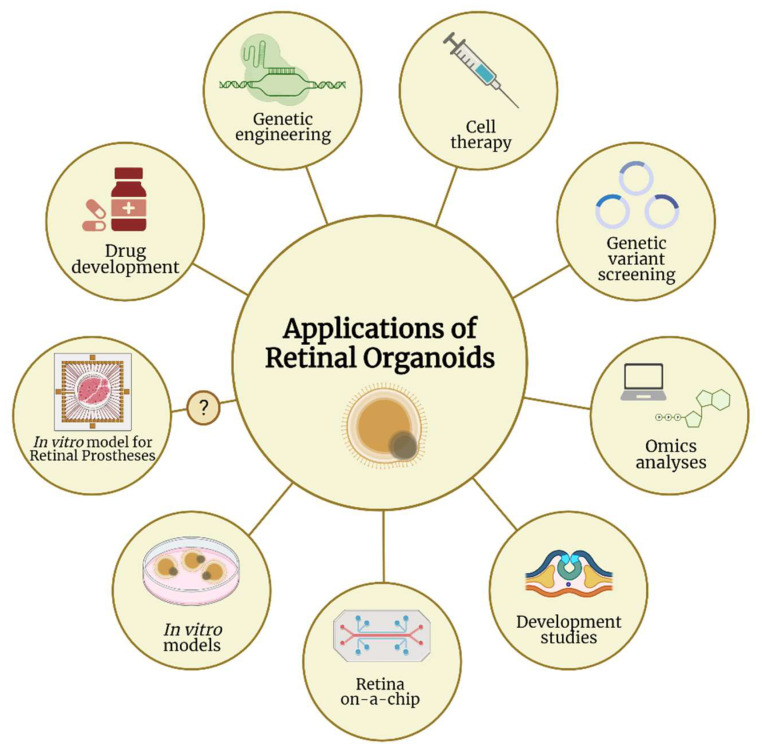
Despite the progress of modern medicine in the last decades, millions of people diagnosed with retinal dystrophies (RDs), such as retinitis pigmentosa, or age-related diseases, such as age-related macular degeneration, are suffering from severe visual impairment or even legal blindness. On the one hand, the reprogramming of somatic cells into induced pluripotent stem cells (iPSCs) and the progress of three-dimensional (3D) retinal organoids (ROs) technology provide a great opportunity to study, understand, and even treat retinal diseases. On the other hand, research advances in the field of electronic retinal prosthesis using inorganic photovoltaic polymers and the emergence of organic semiconductors represent an encouraging therapeutical strategy to restore vision to patients at the late onset of the disease. This review will provide an overview of the latest advancement in both fields. We first describe the retina and the photoreceptors, briefly mention the most used RD animal models, then focus on the latest RO differentiation protocols, carry out an overview of the current technology on inorganic and organic retinal prostheses to restore vision, and finally summarize the potential utility and applications of ROs.
尽管在过去几十年中现代医学取得了进步,但仍有数百万人被诊断患有视网膜营养不良(RDs),例如色素性视网膜炎,或与年龄相关的疾病,例如年龄相关性黄斑变性,他们正遭受严重的视力障碍甚至法定失明。一方面,体细胞重编程为诱导多能干细胞(iPSCs)和三维(3D)视网膜类器官(ROs)技术的进步为研究、理解甚至治疗视网膜疾病提供了巨大的机会。另一方面,使用无机光伏聚合物的电子视网膜假体领域的研究进展和有机半导体的出现代表了一种有希望的治疗策略,可以为疾病晚期的患者恢复视力。本综述将介绍这两个领域的最新进展。我们首先描述了视网膜和光感受器,简要提及了最常用的 RD 动物模型,然后重点介绍了最新的 RO 分化方案,对无机和有机视网膜假体恢复视力的当前技术进行了概述,最后总结了 RO 的潜在用途和应用。