Mycobacteria Research Laboratories, Department of Microbiology, Immunology and Pathology, Colorado State University, Fort Collins, CO 80523, USA.
Department of Microbiology, Immunology and Pathology, Colorado State University, Fort Collins, CO 80523, USA.
Int J Mol Sci. 2022 Mar 9;23(6):2950. doi: 10.3390/ijms23062950.
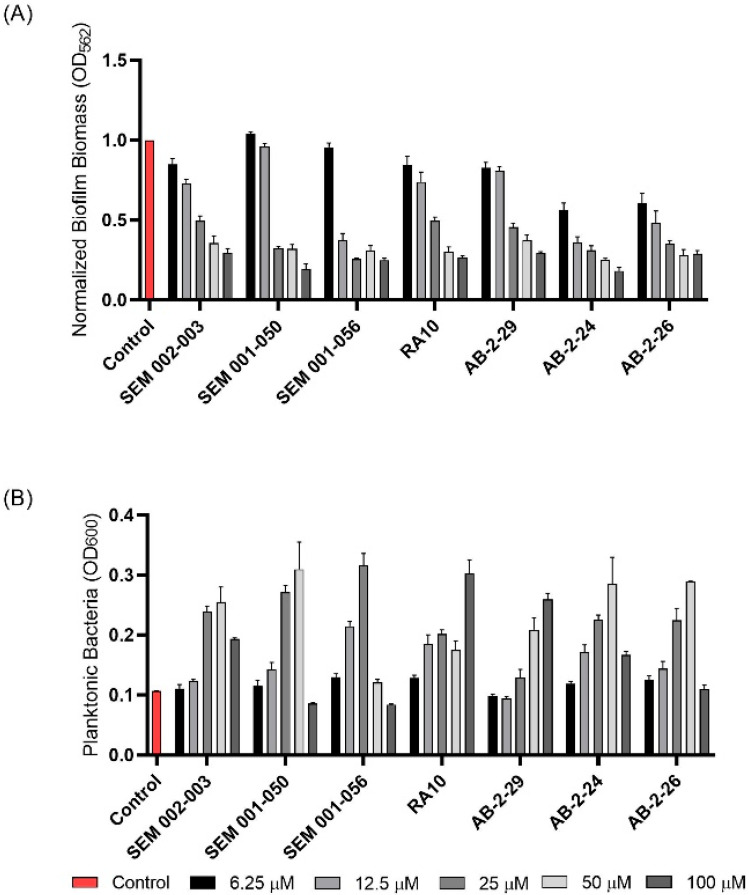
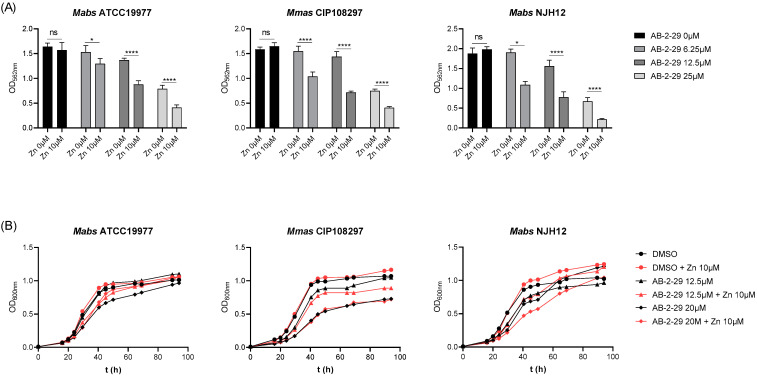
Biofilm growth is thought to be a significant obstacle to the successful treatment of infections. A search for agents capable of inhibiting biofilms led to our interest in 2-aminoimidazoles and related scaffolds, which have proven to display antibiofilm properties against a number of Gram-negative and Gram-positive bacteria, including and . The screening of a library of 30 compounds led to the identification of a compound, AB-2-29, which inhibits the formation of biofilms with an IC (the concentration required to inhibit 50% of biofilm formation) in the range of 12.5 to 25 μM. Interestingly, AB-2-29 appears to chelate zinc, and its antibiofilm activity is potentiated by the addition of zinc to the culture medium. Preliminary mechanistic studies indicate that AB-2-29 acts through a distinct mechanism from those reported to date for 2-aminoimidazole compounds.
生物膜的生长被认为是成功治疗感染的重大障碍。寻找能够抑制生物膜的药物,促使我们对 2-氨基咪唑及其相关支架产生了兴趣,这些化合物已被证明对许多革兰氏阴性和革兰氏阳性细菌具有抗生物膜特性,包括 和 。对 30 种化合物库的筛选,确定了一种名为 AB-2-29 的化合物,其对生物膜形成的抑制浓度(IC50)范围为 12.5 至 25 μM。有趣的是,AB-2-29 似乎螯合锌,并且向培养基中添加锌可增强其抗生物膜活性。初步的机制研究表明,AB-2-29 的作用机制与迄今为止报道的 2-氨基咪唑化合物不同。