Department of Biomolecular Sciences, University of Urbino Carlo Bo, 61029 Urbino, Italy.
AcZon s.r.l., 40050 Monte San Pietro, Italy.
Int J Mol Sci. 2022 Mar 12;23(6):3069. doi: 10.3390/ijms23063069.
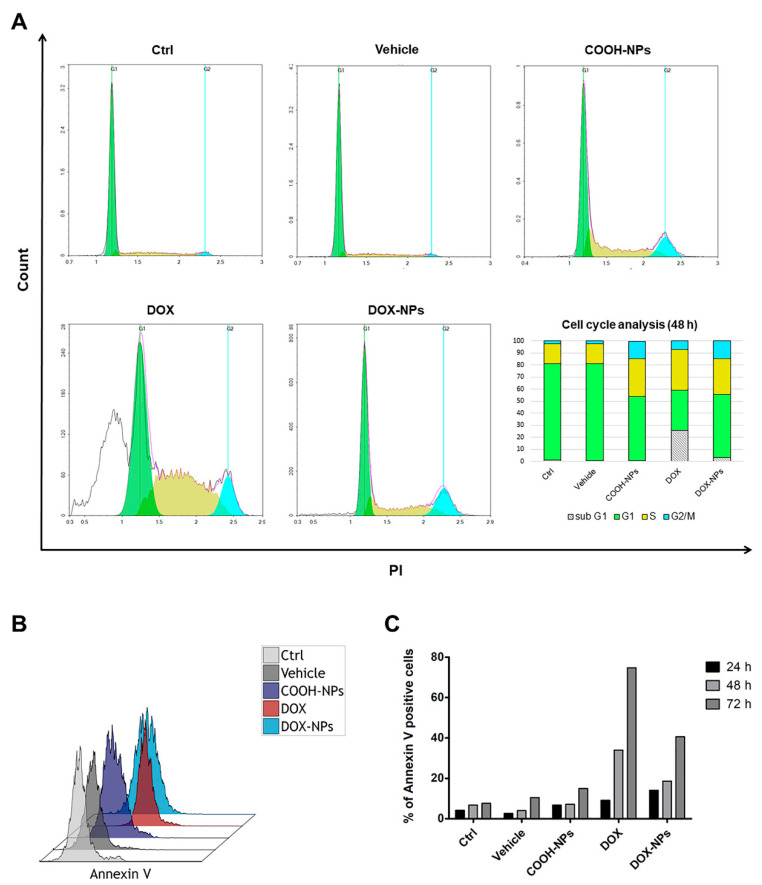
Fluorescent silica nanoparticles (SiNPs) appear to be a promising imaging platform, showing a specific subcellular localization. In the present study, we first investigated their preferential mitochondrial targeting in myeloid cells, by flow cytometry, confocal microscopy and TEM on both cells and isolated mitochondria, to acquire knowledge in imaging combined with therapeutic applications. Then, we conjugated SiNPs to one of the most used anticancer drugs, doxorubicin (DOX). As an anticancer agent, DOX has high efficacy but also an elevated systemic toxicity, causing multiple side effects. Nanostructures are usually employed to increase the drug circulation time and accumulation in target tissues, reducing undesired cytotoxicity. We tested these functionalized SiNPs (DOX-NPs) on breast cancer cell line MCF-7. We evaluated DOX-NP cytotoxicity, the effect on the cell cycle and on the expression of CD44 antigen, a molecule involved in adhesion and in tumor invasion, comparing DOX-NP to free DOX and stand-alone SiNPs. We found a specific ability to release a minor amount of CD44+ extracellular vesicles (EVs), from both CD81 negative and CD81 positive pools. Modulating the levels of CD44 at the cell surface in cancer cells is thus of great importance for disrupting the signaling pathways that favor tumor progression.
荧光硅纳米颗粒(SiNPs)似乎是一种很有前途的成像平台,具有特定的亚细胞定位。在本研究中,我们首先通过流式细胞术、共聚焦显微镜和细胞和分离的线粒体的 TEM 研究了它们在髓样细胞中优先靶向线粒体的情况,以获取与成像相结合的治疗应用的知识。然后,我们将 SiNPs 与最常用的抗癌药物之一阿霉素(DOX)偶联。作为一种抗癌药物,DOX 具有很高的疗效,但也有很高的系统毒性,导致多种副作用。纳米结构通常用于增加药物在靶组织中的循环时间和积累,从而降低不必要的细胞毒性。我们在乳腺癌细胞系 MCF-7 上测试了这些功能化的 SiNPs(DOX-NPs)。我们评估了 DOX-NP 的细胞毒性、对细胞周期的影响以及对 CD44 抗原表达的影响,将 DOX-NP 与游离 DOX 和独立的 SiNPs 进行了比较。我们发现它们具有从 CD81 阴性和 CD81 阳性池中释放少量 CD44+细胞外囊泡(EVs)的特定能力。因此,调节癌细胞表面 CD44 的水平对于破坏促进肿瘤进展的信号通路非常重要。