Fertilys Fertility Center, 1950 Rue Maurice-Gauvin #103, Laval, QC H7S 1Z5, Canada.
CHU de Rennes, Département de Gynécologie Obstétrique et Reproduction Humaine-CECOS, Hôpital Sud, 16 Boulevard de Bulgarie, 35000 Rennes, France.
Int J Mol Sci. 2022 Mar 20;23(6):3350. doi: 10.3390/ijms23063350.
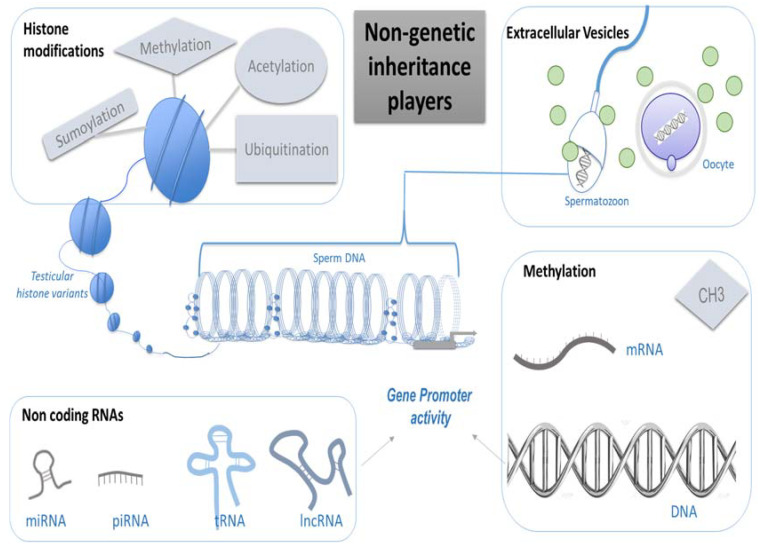
Similar to environmental factors, EDCs (endocrine-disrupting chemicals) can influence gene expression without modifying the DNA sequence. It is commonly accepted that the transgenerational inheritance of parentally acquired traits is conveyed by epigenetic alterations also known as "epimutations". DNA methylation, acetylation, histone modification, RNA-mediated effects and extracellular vesicle effects are the mechanisms that have been described so far to be responsible for these epimutations. They may lead to the transgenerational inheritance of diverse phenotypes in the progeny when they occur in the germ cells of an affected individual. While EDC-induced health effects have dramatically increased over the past decade, limited effects on sperm epigenetics have been described. However, there has been a gain of interest in this issue in recent years. The gametes (sperm and oocyte) represent targets for EDCs and thus a route for environmentally induced changes over several generations. This review aims at providing an overview of the epigenetic mechanisms that might be implicated in this transgenerational inheritance.
类似于环境因素,内分泌干扰物(EDCs)可以在不改变 DNA 序列的情况下影响基因表达。人们普遍认为,通过表观遗传改变(也称为“表观突变”)来传递亲代获得的特征的跨代遗传。迄今为止,已经描述了 DNA 甲基化、乙酰化、组蛋白修饰、RNA 介导的效应和细胞外囊泡效应等机制来负责这些表观突变。当它们发生在受影响个体的生殖细胞中时,它们可能导致后代中多种表型的跨代遗传。尽管过去十年中 EDC 引起的健康影响显著增加,但对精子表观遗传学的影响描述有限。然而,近年来人们对这个问题的兴趣有所增加。配子(精子和卵子)是 EDC 的靶标,因此是环境诱导的几代变化的途径。本综述旨在概述可能涉及这种跨代遗传的表观遗传机制。