Graduate Institute of Sports Training, University of Taipei, Taipei 11153, Taiwan.
Institute of Sports Sciences, University of Taipei, Taipei 11153, Taiwan.
Int J Environ Res Public Health. 2022 Mar 9;19(6):3206. doi: 10.3390/ijerph19063206.
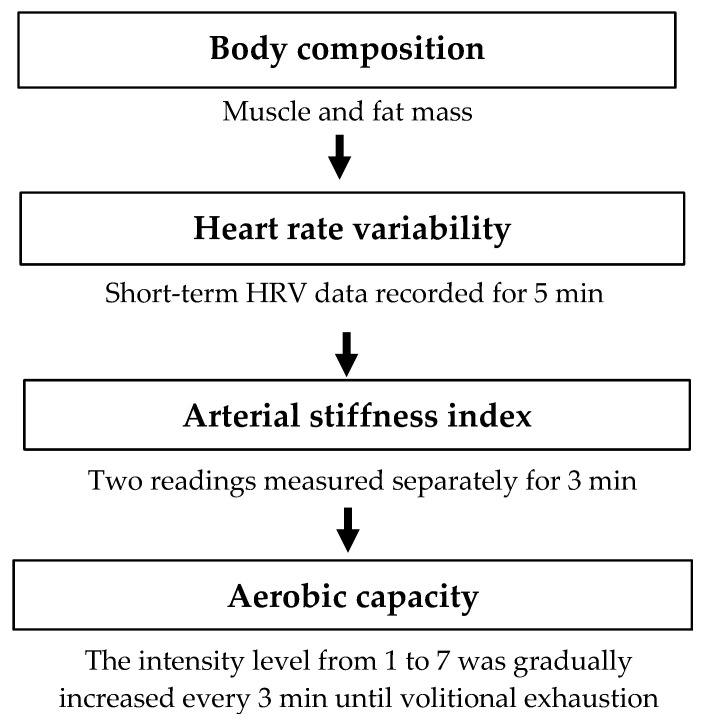
Cardiovascular health and aerobic capacity play crucial roles in determining the performance of athletes in the highly competitive sport of badminton. Few studies have directly compared heart rate variability (HRV), arterial stiffness, and aerobic capacity between male and female athletes, especially among badminton athletes. This study investigated sex differences in HRV, arterial stiffness, and aerobic capacity in badminton athletes. Elite badminton athletes were recruited and divided into male (n = 20, 21.0 ± 1.8 years old) and female (n = 16, 21.2 ± 2.3 years old) groups. Both groups performed an incremental treadmill running test for the evaluation of maximal oxygen consumption (V.O2max), anaerobic threshold, and time to exhaustion. They started exercising at a treadmill speed of 2.7 km/h and an inclination of 10% gradient for 3 min, and the speed and inclination were gradually increased every 3 min until they were exhausted or fatigued volitionally. HRV was examined using the Polar heart rate monitor over a period of 5 min at rest in the supine position. Subsequently, the index of arterial stiffness was examined under the same condition. Our results revealed significant differences between the male and female athletes in V.O2max (men: 60.38 ± 8.98 mL/kg/min, women: 48.13 ± 7.72 mL/kg/min, p < 0.05), anaerobic threshold (men: 41.50 ± 7.26 mL/kg/min, women: 32.51 ± 6.19 mL/kg/min, p < 0.05), time to exhaustion (men: 902.15 ± 120.15 s, women: 780.56 ± 67.63 s, p < 0.05), systolic blood pressure (men: 125.27 ± 7.76 mmHg, women: 107.16 ± 11.09 mmHg, p < 0.05), and arterial stiffness index (men: 63.56 ± 12.55, women: 53.83 ± 8.03, p < 0.05). However, no significant differences in HRV measures were observed between the two groups. These findings suggested that the male badminton athletes demonstrated significantly higher aerobic capacity than did the female athletes, but there were no significant differences in HRV measures. The female athletes exhibited superior arterial function, compared with their male counterparts.
心血管健康和有氧能力在确定羽毛球这项竞争激烈的运动中运动员的表现方面起着至关重要的作用。很少有研究直接比较男性和女性运动员之间的心率变异性(HRV)、动脉僵硬和有氧能力,尤其是在羽毛球运动员中。本研究调查了羽毛球运动员中 HRV、动脉僵硬和有氧能力的性别差异。招募了精英羽毛球运动员,并将他们分为男性组(n = 20,21.0 ± 1.8 岁)和女性组(n = 16,21.2 ± 2.3 岁)。两组均进行递增跑步机跑步测试,以评估最大摄氧量(V.O2max)、无氧阈和力竭时间。他们以 2.7 公里/小时的跑步机速度和 10%坡度开始运动 3 分钟,然后每 3 分钟逐渐增加速度和坡度,直到他们自愿耗尽或疲劳。使用 Polar 心率监测器在仰卧位休息期间监测 5 分钟的 HRV。随后,在相同条件下检查动脉僵硬指数。我们的结果显示,男性和女性运动员在 V.O2max(男性:60.38 ± 8.98 mL/kg/min,女性:48.13 ± 7.72 mL/kg/min,p < 0.05)、无氧阈(男性:41.50 ± 7.26 mL/kg/min,女性:32.51 ± 6.19 mL/kg/min,p < 0.05)、力竭时间(男性:902.15 ± 120.15 s,女性:780.56 ± 67.63 s,p < 0.05)、收缩压(男性:125.27 ± 7.76 mmHg,女性:107.16 ± 11.09 mmHg,p < 0.05)和动脉僵硬指数(男性:63.56 ± 12.55,女性:53.83 ± 8.03,p < 0.05)方面存在显著差异。然而,两组之间的 HRV 测量值没有显著差异。这些发现表明,男性羽毛球运动员的有氧能力明显高于女性运动员,但 HRV 测量值没有差异。与男性相比,女性运动员表现出更好的动脉功能。