Fuchs Anna, Szul Mateusz, Dulska Agnieszka, Bodziony Jakub, Matonóg Aleksandra, Pilarska Joanna, Sieradzka Paulina, Stojko Rafał, Drosdzol-Cop Agnieszka
Chair and Department of Gynecology, Obstetrics and Oncological Gynecology, Medical University of Silesia in Katowice, 40-211 Katowice, Poland.
Int J Environ Res Public Health. 2022 Mar 12;19(6):3349. doi: 10.3390/ijerph19063349.
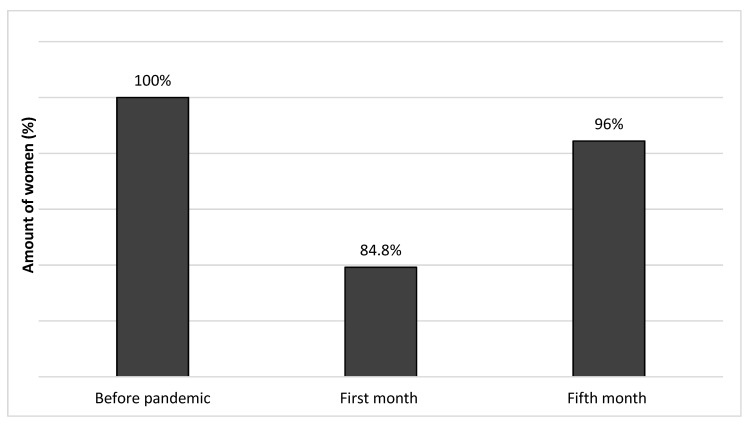
Introduction: The outbreak of the COVID-19 pandemic affected many aspects of life involving sexual functioning. Methods: This prospective, noninterventional, observational research was performed from July 2020 to August 2020, involving a total of 644 patients. Female sexual function index (FSFI) scores of those women were compared in relation to results of our research from April 2020. Questionnaires were collected concerning socio-demographic characteristics of patients as well as the impact of the COVID-19 pandemic on their lives. Results: Every domain significantly decreased in the first month of the lockdown. Before the pandemic, the total FSFI was reported at 30.1 ± 4.4, while in the first month of the pandemic it was at 25.8 ± 9.7 (p < 0.001). The lowest FSFI score was reported by women who lived in average conditions. There was a statistically significant increase in the overall FSFI score in the fifth month of the pandemic (27.5 ± 6.8) when compared to the FSFI score in the first month of the pandemic (25.8 ± 9.7). The scores in arousal, lubrication, orgasm and pain were reported as higher (respectively p < 0.001, p < 0.001, p < 0.001, p < 0.05), while desire was reported lower (p < 0.001). The satisfaction score remained almost the same (p < 0.05). Conclusions: Our study indicates a significant decrease in FSFI scores across all domains. There are still many questions whether the statue from the vaccinated person or convalescents affects the sense of security and, thus, increases sexual satisfaction.
新冠疫情的爆发影响了包括性功能在内的生活诸多方面。方法:这项前瞻性、非干预性观察性研究于2020年7月至2020年8月进行,共纳入644例患者。将这些女性的女性性功能指数(FSFI)得分与我们2020年4月的研究结果进行比较。收集了有关患者社会人口学特征以及新冠疫情对其生活影响的问卷。结果:封锁的第一个月,每个领域的得分均显著下降。疫情前,FSFI总分报告为30.1±4.4,而疫情第一个月为25.8±9.7(p<0.001)。生活条件一般的女性FSFI得分最低。与疫情第一个月的FSFI得分(25.8±9.7)相比,疫情第五个月的总体FSFI得分(27.5±6.8)有统计学显著升高。兴奋、润滑、性高潮和疼痛方面的得分较高(分别为p<0.001、p<0.001、p<0.001、p<0.05),而性欲得分较低(p<0.001)。满意度得分几乎保持不变(p<0.05)。结论:我们的研究表明所有领域的FSFI得分均显著下降。接种疫苗者或康复者的状况是否会影响安全感,进而提高性满意度,仍有许多问题。