Chair of Endocrinology and Medical Sexology (ENDOSEX), Department of Systems Medicine, University of Rome Tor Vergata, Rome, Italy.
Department of Dynamic and Clinical Psychology, Sapienza University of Rome, Rome, Italy.
J Sex Med. 2021 Jan;18(1):35-49. doi: 10.1016/j.jsxm.2020.10.008. Epub 2020 Oct 23.
The COVID-19-related lockdown has profoundly changed human behaviors and habits, impairing general and psychological well-being. Along with psychosocial consequences, it is possible that sexual behavior was also affected.
With the present study, we evaluated the impact of the community-wide containment and consequent social distancing on the intrapsychic, relational, and sexual health through standardized psychometric tools.
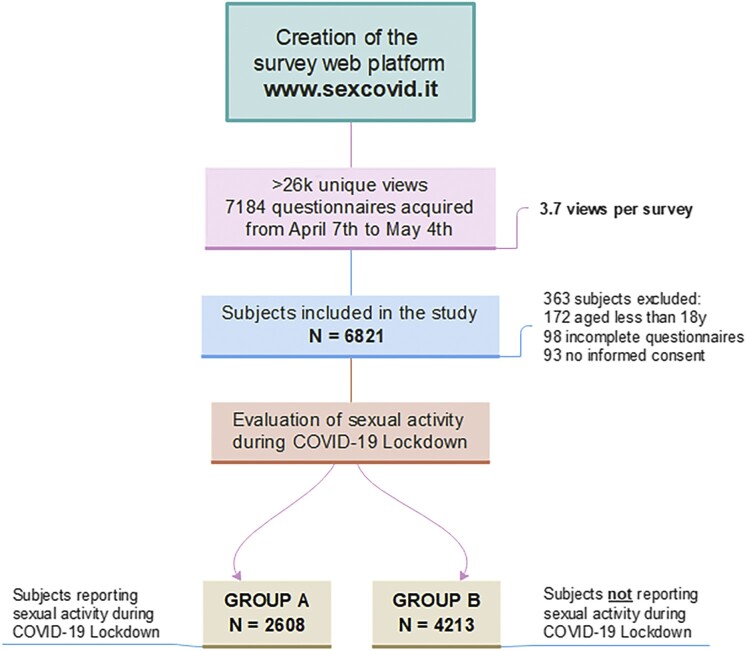
A case-control study was performed through a web-based survey and comparing subjects of both genders with (group A, N = 2,608) and without (group B, N = 4,213) sexual activity during lockdown. The Welch and chi-square tests were used to assess differences between groups. Univariate analysis of covariance, logistic regression models, and structural equation modeling were performed to measure influence and mediation effects of sexual activity on psychological, relational, and sexual outcomes.
Main outcome measures were General Anxiety Disorder-7 for anxiety, Patient Health Questionnaire-9 for depression, Dyadic Adjustment Scale for quality of relationship and a set of well-validated sexological inventories (International Index of Erectile Function, Female Sexual Function Index, and male-female versions of the Orgasmometer).
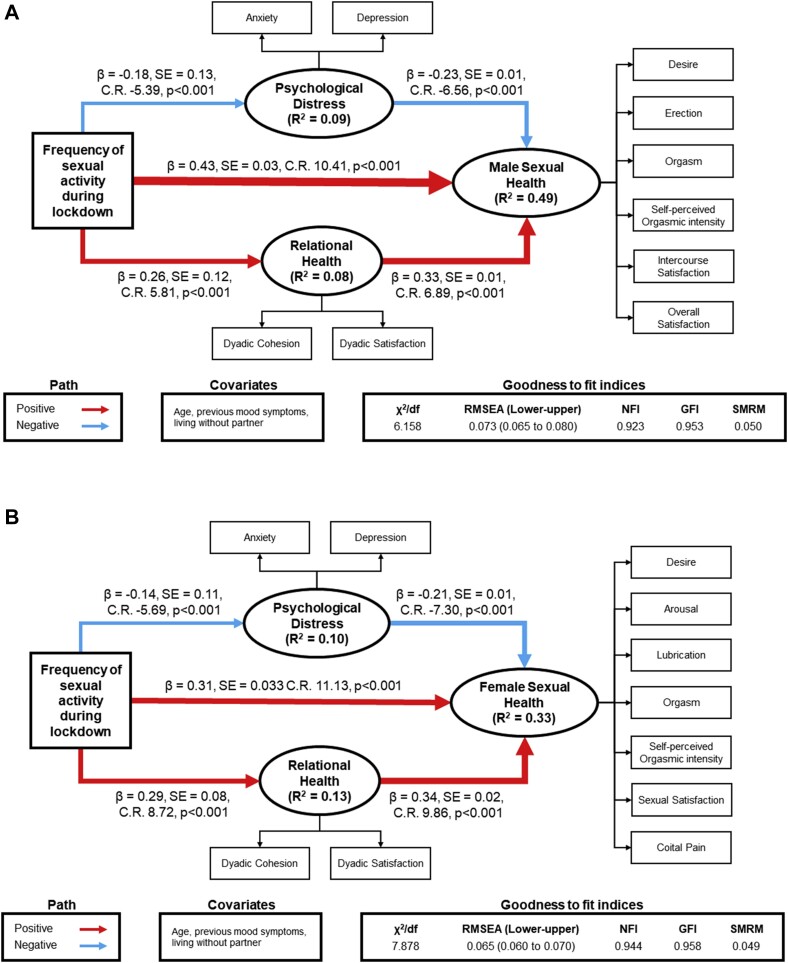
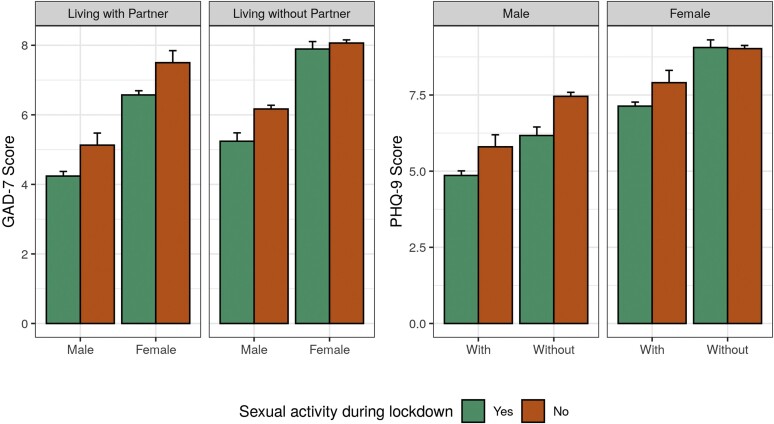
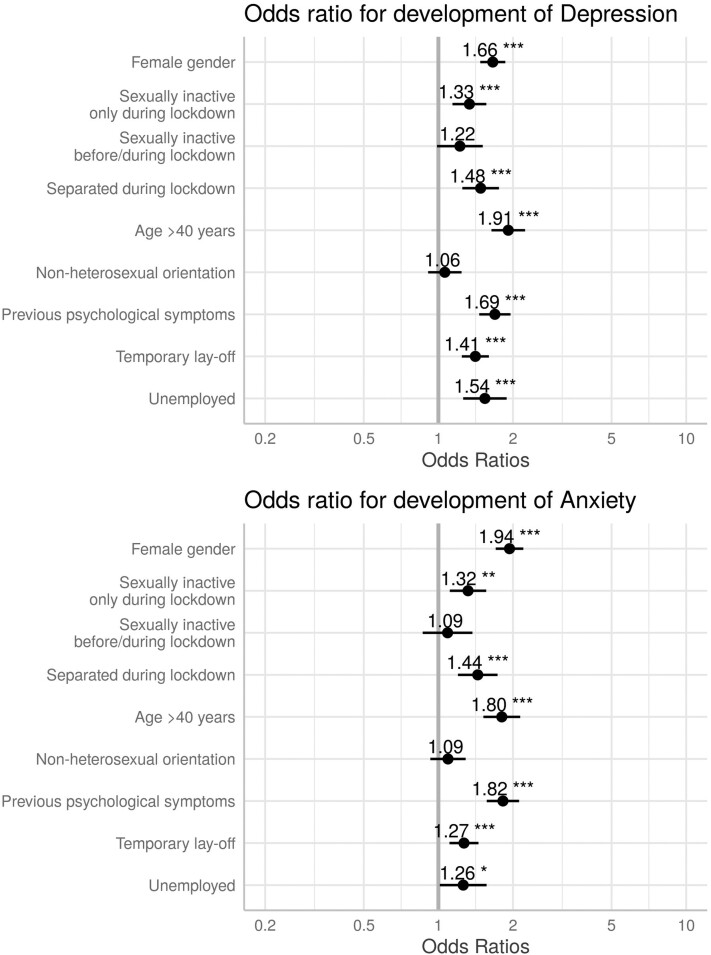
Anxiety and depression scores were significantly lower in subjects sexually active during lockdown. Analysis of covariance identified gender, sexual activity, and living without partner during lockdown as significantly affecting anxiety and depression scores (P < .0001). Logistic regression models showed that lack of sexual activity during lockdown was associated with a significantly higher risk of developing anxiety and depression (OR: 1.32 [95% CI: 1.12 - 1.57, P < .001] and 1.34 [95% CI: 1.15 - 1.57, P < .0001], respectively). Structural equation modeling evidenced the protective role of sexual activity toward psychological distress (β = -0.18 and β = -0.14), relational health (β = 0.26 and β = 0.29) and sexual health, both directly (β = 0.43 and β = 0.31), and indirectly (β = 0.13 and β = 0.13).
The demonstrated mutual influence of sexual health on psychological and relational health could direct the clinical community toward a reinterpretation of the relationship among these factors.
Based on a large number of subjects and well-validated psychometric tools, this study elucidated the protective role of sexual activity for psychological distress, as well for relational and sexual health. Main limitations were the web-based characteristics of the protocol and the retrospective nature of prelockdown data on psychorelational and sexual health of subjects recruited.
COVID-19 lockdown dramatically impacted on psychological, relational, and sexual health of the population. In this scenario, sexual activity played a protective effect, in both genders, on the quarantine-related plague of anxiety and mood disorders. Mollaioli D, Sansone A, Ciocca G, et al. Benefits of Sexual Activity on Psychological, Relational, and Sexual Health During the COVID-19 Breakout. J Sex Med 2021;18:35-49.
COVID-19 相关的封锁措施极大地改变了人类的行为和习惯,影响了人们的整体健康和心理健康。除了带来心理社会后果外,性行为也可能受到影响。
本研究通过使用标准化心理测评工具,评估社区范围的遏制措施和随之而来的社交距离限制对内在心理、人际关系和性健康的影响。
通过网络调查进行病例对照研究,比较有(A 组,N=2608)和无(B 组,N=4213)性行为的男性和女性受试者。使用 Welch 和卡方检验比较组间差异。采用单变量协方差分析、逻辑回归模型和结构方程模型来衡量性行为对心理、关系和性结果的影响和中介作用。
在封锁期间有性行为的受试者焦虑和抑郁评分显著较低。协方差分析确定了性别、性行为和封锁期间无伴侣生活是显著影响焦虑和抑郁评分的因素(P<.0001)。逻辑回归模型显示,封锁期间缺乏性行为与焦虑和抑郁的发生风险显著增加相关(OR:1.32[95%CI:1.12-1.57,P<.001]和 1.34[95%CI:1.15-1.57,P<.0001])。结构方程模型证明了性行为对心理困扰(β=-0.18 和 β=-0.14)、关系健康(β=0.26 和 β=0.29)和性健康都具有保护作用,直接影响(β=0.43 和 β=0.31)和间接影响(β=0.13 和 β=0.13)。
性健康对心理和关系健康的相互影响可以指导临床社区重新解释这些因素之间的关系。
基于大量受试者和经过充分验证的心理测评工具,本研究阐明了性行为对心理困扰以及关系和性健康的保护作用。主要限制因素是协议的网络特征和招募的受试者在封锁前的心理关系和性健康的回顾性数据。
COVID-19 封锁对人群的心理、关系和性健康产生了巨大影响。在这种情况下,性行为在两性中对与隔离相关的焦虑和情绪障碍瘟疫都具有保护作用。