Departments of Geography and Demography, The Pennsylvania State University, University Park, PA 16802, USA.
Center for Tobacco Control Research and Education, University of California San Francisco, San Francisco, CA 94117, USA.
Int J Environ Res Public Health. 2022 Mar 15;19(6):3455. doi: 10.3390/ijerph19063455.
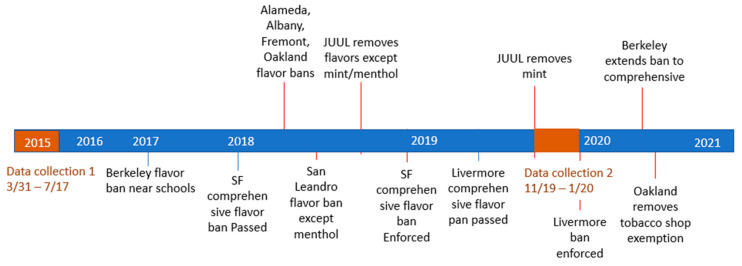
This study examined differences in the availability and advertising of flavored tobacco products before and after flavored tobacco sales restrictions were enacted in Alameda and San Francisco Counties in California.
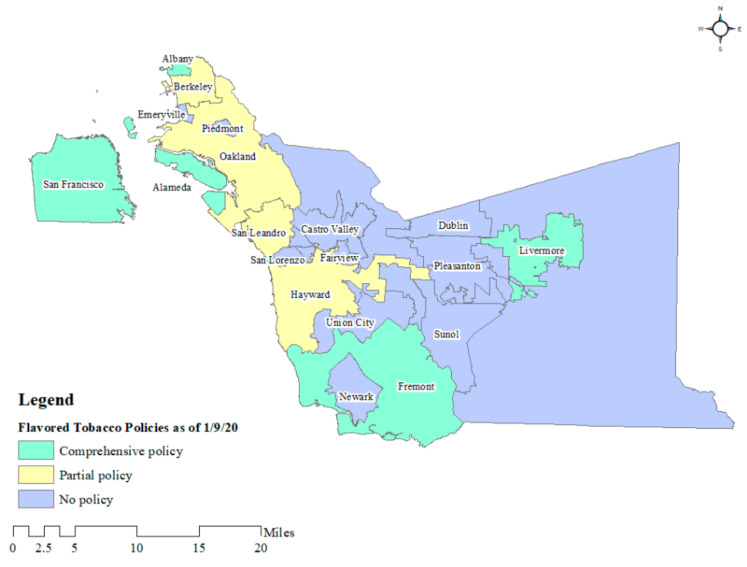
Data were collected from a sample of tobacco retailers in Alameda and San Francisco Counties at two time points: 2015, before flavored tobacco policies were enacted, and in 2019-2020, after some cities had enacted policies. Retailers were separated by city into Category 1 ( = 442)-retailers in cities that enacted a flavored tobacco policy between the two data collection periods, and Category 2 ( = 89), those that had not. Means comparison tests were conducted to evaluate significant differences over time and by category.
There was significantly reduced availability of menthol cigarettes, flavored little cigars, smokeless tobacco, vape pens, and Blu brand menthol e-cigarettes between 2015 and 2020 in Category 1 retailers. Category 2 retailers had reduced availability only for Blu menthol e-cigarettes and demonstrated an increase in smokeless tobacco availability. Exterior store advertising for cigarettes, little cigars, cigars, and e-cigarettes also decreased significantly in Category 1 cities relative to Category 2 cities; 8.1% of Category 1 stores were advertising flavored tobacco products in 2019-2020 compared to 36.2% of Category 2 stores. There was also a 78% reduction in flavored ads between 2015-2019 in Category 1 cities compared to a 38% decrease in Category 2 cities. Tobacco advertising inside Category 2 stores increased. Finally, Category 2 cities had significantly greater availability of cigalikes, mod or tank vapes, flavored e-cigarettes, and e-liquids compared to Category 1 cities.
Comprehensive flavored sales restriction policies reduce flavored tobacco availability and tobacco advertising, which may help prevent youth tobacco initiation and exposure.
本研究考察了加利福尼亚州阿拉米达县和旧金山县在实施调味烟草销售限制前后,调味烟草制品的供应和广告情况的差异。
数据来自阿拉米达县和旧金山县的烟草零售商样本,在两个时间点收集:2015 年,在调味烟草政策颁布之前,以及 2019-2020 年,在一些城市颁布政策之后。零售商按城市分为两类:第一类(=442)——在两个数据收集期间颁布了调味烟草政策的城市的零售商,以及第二类(=89)——没有颁布政策的城市的零售商。进行了均值比较检验,以评估随时间和类别发生的显著差异。
在 2015 年至 2020 年期间,第一类零售商的薄荷醇香烟、调味小雪茄、无烟烟草、电子烟笔和 Blu 牌薄荷醇电子烟的供应显著减少。第二类零售商仅减少了 Blu 薄荷醇电子烟的供应,并显示无烟烟草供应增加。香烟、小雪茄、雪茄和电子烟的外部店面广告在第一类城市相对于第二类城市也显著减少;2019-2020 年,8.1%的第一类商店在宣传调味烟草产品,而 36.2%的第二类商店在宣传调味烟草产品。与第二类城市相比,第一类城市的调味广告在 2015-2019 年间减少了 78%,而第二类城市减少了 38%。第二类商店的烟草广告有所增加。最后,与第一类城市相比,第二类城市的 cigalikes、mod 或 tank 电子烟、调味电子烟和电子烟液的供应显著增加。
全面的调味销售限制政策减少了调味烟草的供应和烟草广告,这可能有助于防止青少年开始使用烟草和接触烟草。