Department of Preventive Dental Sciences (Orthodontics), College of Dentistry, Majmaah University, Al-Majmaah 11952, Saudi Arabia.
Department of Preventive Dental Sciences (Periodontics), College of Dentistry, Majmaah University, Al-Majmaah 11952, Saudi Arabia.
Int J Environ Res Public Health. 2022 Mar 21;19(6):3723. doi: 10.3390/ijerph19063723.
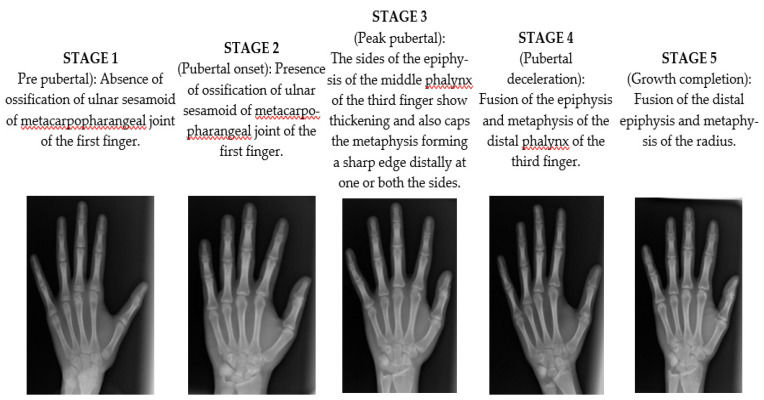
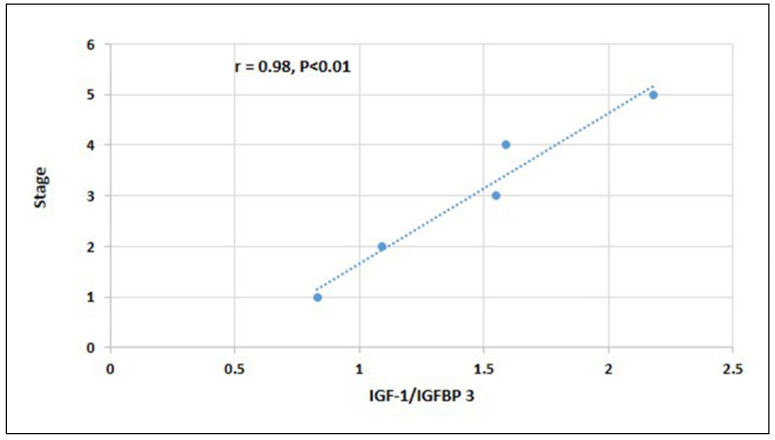
Objective: The relevance of growth determination in orthodontics is driving the search for the most precise and least invasive way of tracking the pubertal growth spurt. Our aim was to explore whether minimally invasive salivary estimation of biomarkers Insulin-like growth factor (IGF-1) and Insulin-like growth factor binding protein-3 (IGFBP-3) could be used to estimate skeletal maturity for clinical convenience, especially in children and adolescent age groups. Materials and Method: The cross-sectional study was conducted on 90 participants (56 girls and 34 males) with ages ranging from 6 to 25 years. Each subject’s hand-wrist radiograph was categorized based on skeletal maturity, and saliva samples were estimated for IGF-1 and IGFBP-3 using the respective ELISA kits. Kruskal−Wallis nonparametric ANOVA was applied to compare different skeletal stages. Results: The study demonstrated low salivary IGF-1 levels at the prepubertal stage, with increase during pubertal onset and peak pubertal stage followed by a decline during pubertal deceleration to growth completion. Spearman’s correlation coefficient demonstrated a strong positive association (r = 0.98 p < 0.01) between salivary IGF/IGFBP-3 ratio and different stages of skeletal maturity. Conclusion: Salivary IGF-1, IGFBP-3, and IGF/IGFBP-3 ratio could serve as a potential biochemical marker for predicting the completion of skeletal maturity.
正畸学中生长发育的相关性促使人们寻找最精确、最微创的方法来跟踪青春期生长突增。我们的目的是探讨微创唾液生物标志物胰岛素样生长因子(IGF-1)和胰岛素样生长因子结合蛋白-3(IGFBP-3)的估计是否可用于临床方便地估计骨骼成熟度,特别是在儿童和青少年年龄段。
这项横断面研究共纳入了 90 名参与者(56 名女性和 34 名男性),年龄在 6 至 25 岁之间。根据骨骼成熟度对每位受试者的手-腕部 X 光片进行分类,并使用相应的 ELISA 试剂盒估计唾液中的 IGF-1 和 IGFBP-3。应用 Kruskal−Wallis 非参数 ANOVA 比较不同的骨骼阶段。
研究表明,在青春前期阶段唾液 IGF-1 水平较低,在青春期开始和高峰期会增加,随后在青春期减速到生长完成时会下降。Spearman 相关系数表明唾液 IGF/IGFBP-3 比值与骨骼成熟度的不同阶段之间存在强烈的正相关(r = 0.98,p < 0.01)。
唾液 IGF-1、IGFBP-3 和 IGF/IGFBP-3 比值可以作为预测骨骼成熟度完成的潜在生化标志物。