Ogiso Yui, Hanai Tatsunori, Nishimura Kayoko, Miwa Takao, Maeda Toshihide, Imai Kenji, Suetsugu Atsushi, Takai Koji, Shimizu Masahito
Department of Gastroenterology/Internal Medicine, Gifu University Graduate School of Medicine, Gifu 501-1194, Japan.
Center for Nutrition Support and Infection Control, Gifu University Hospital, Gifu 501-1194, Japan.
J Clin Med. 2022 Mar 12;11(6):1562. doi: 10.3390/jcm11061562.
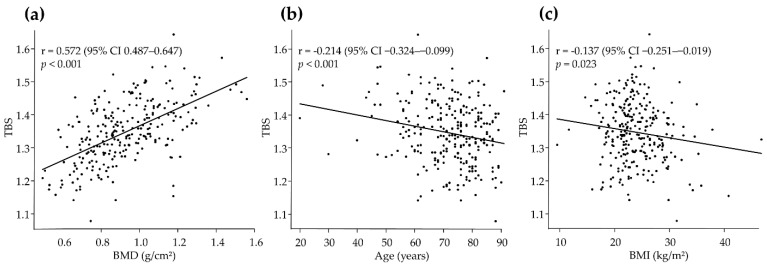
The trabecular bone score (TBS), a surrogate measure of bone microarchitecture, provides complementary information to bone mineral density (BMD) in the assessment of osteoporotic fracture risk. This cross-sectional study aimed to determine whether TBS can identify patients with liver cirrhosis that are at risk of vertebral fractures. We enrolled 275 patients who completed evaluations for lumbar BMD, TBS, and vertebral fractures between November 2018 and April 2021. BMD was measured using dual-energy X-ray absorptiometry (DXA), TBS was calculated by analyzing DXA images using TBS iNsight software, and vertebral fractures were evaluated using Genant’s semi-quantitative method with lateral X-ray images. Factors associated with vertebral fractures and their correlation with the TBS were identified using regression models. Of the enrolled patients, 128 (47%) were female, the mean age was 72 years, and 62 (23%) were diagnosed with vertebral fractures. The prevalence of vertebral fractures was higher in women than in men (33% vs. 14%; p < 0.001). The unadjusted odds ratio (OR) of the vertebral fractures for one standard deviation decrease in TBS and BMD was 2.14 (95% confidence interval [CI], 1.69−2.73) and 1.55 (95% CI, 1.26−1.90), respectively. After adjusting for age, sex, and BMD, the adjusted OR of the vertebral fractures in TBS was 2.26 (95% CI, 1.52−3.35). Multivariate linear regression analysis showed that TBS was independently correlated with age (β = −0.211), body mass index (β = −0.251), and BMD (β = 0.583). TBS can help identify patients with cirrhosis at risk of vertebral fractures.
小梁骨评分(TBS)是骨微结构的替代指标,在评估骨质疏松性骨折风险时,能为骨密度(BMD)提供补充信息。这项横断面研究旨在确定TBS能否识别有椎体骨折风险的肝硬化患者。我们纳入了275例在2018年11月至2021年4月期间完成腰椎BMD、TBS和椎体骨折评估的患者。使用双能X线吸收法(DXA)测量BMD,通过TBS iNsight软件分析DXA图像计算TBS,并使用Genant半定量方法通过侧位X线图像评估椎体骨折。使用回归模型确定与椎体骨折相关的因素及其与TBS的相关性。在纳入的患者中,128例(47%)为女性,平均年龄为72岁,62例(23%)被诊断为椎体骨折。女性椎体骨折的患病率高于男性(33%对14%;p<0.001)。TBS和BMD每降低一个标准差,椎体骨折的未调整优势比(OR)分别为2.14(95%置信区间[CI],1.69−2.73)和1.55(95%CI,1.26−1.90)。在调整年龄、性别和BMD后,TBS中椎体骨折的调整后OR为2.26(95%CI,1.52−3.35)。多变量线性回归分析显示,TBS与年龄(β = -0.211)、体重指数(β = -0.251)和BMD(β = 0.583)独立相关。TBS有助于识别有椎体骨折风险的肝硬化患者。