Jung Saemi, Lee Seung-Yeon, Lee Wanhyung
Department of Occupational and Environmental Medicine, Pusan National University Yangsan Hospital, Yangsan 50612, Korea.
Department of Family Medicine, International Healthcare Center, Seoul National University Bundang Hospital, Seongnam 13620, Korea.
J Clin Med. 2022 Mar 20;11(6):1725. doi: 10.3390/jcm11061725.
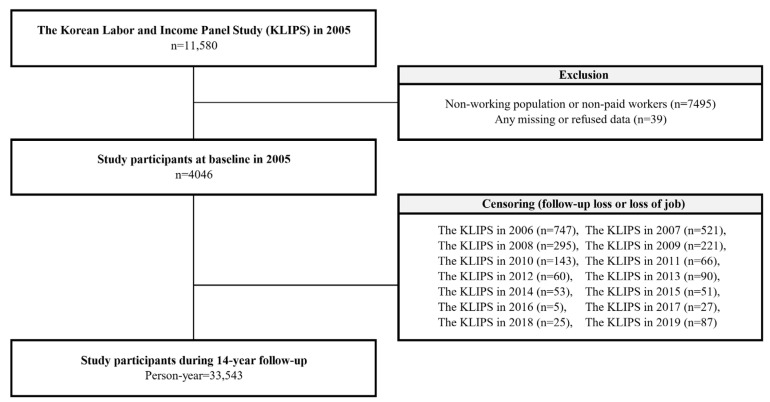
This study investigated whether changes in work schedule are associated with health behavior changes. We used data from the Korea Labor and Income Panel Survey from 2005 to 2019. A generalized estimating equation model was used to assess the association between changes of work schedules (day-day, day-shift, shift-day, and shift-shift) and health behaviors. Odds ratios (ORs) with 95% confidence intervals (CIs) were calculated after adjusting for general and socioeconomic characteristics. Fixed daytime work was observed for 25,716 person-years, and fixed shift work was observed for 2370 person-years out of the total 4046 participants during a 14 year period. Workers who changed their work schedule from fixed daytime to shift work and from shift to fixed daytime work contributed to 670 and 739 person-years, respectively. Considering continuous fixed daytime workers as a reference group, continuous exposure to shift work (aOR 1.11, CI 1.01-1.26) and changes from fixed daytime to shift work (aOR 1.18, CI 1.05-1.44) were significantly associated with an increased risk of changing either smoking or drinking behavior to unhealthy patterns. The results of our study suggest that workers who work irregular shift times, in contrast to those with more standard, regular work schedules, are at a higher risk of changing smoking and/or drinking behavior to unhealthy patterns.
本研究调查了工作时间表的变化是否与健康行为的改变相关。我们使用了2005年至2019年韩国劳动与收入面板调查的数据。采用广义估计方程模型来评估工作时间表的变化(日对日、日对班、班对日和班对班)与健康行为之间的关联。在对一般和社会经济特征进行调整后,计算了具有95%置信区间(CIs)的优势比(ORs)。在14年期间的4046名参与者中,固定白天工作观察到25716人年,固定轮班工作观察到2370人年。从固定白天工作改为轮班工作以及从轮班改为固定白天工作的工人分别贡献了670和739人年。以持续固定白天工作的工人作为参照组,持续接触轮班工作(调整后优势比1.11,置信区间1.01 - 1.26)以及从固定白天工作改为轮班工作(调整后优势比1.