Choi Yong Seon, Park Kwan Kyu, Lee Bora, Nam Won Seok, Kim Do-Hyeong
Department of Anesthesiology and Pain Medicine, Anesthesia and Pain Research Institute, Yonsei University College of Medicine, 50-1 Yonsei-ro, Seodaemun-gu, Seoul 03722, Korea.
Department of Orthopedic Surgery, Yonsei University College of Medicine, 50-1 Yonsei-ro, Seodaemun-gu, Seoul 03722, Korea.
J Pers Med. 2022 Mar 6;12(3):408. doi: 10.3390/jpm12030408.
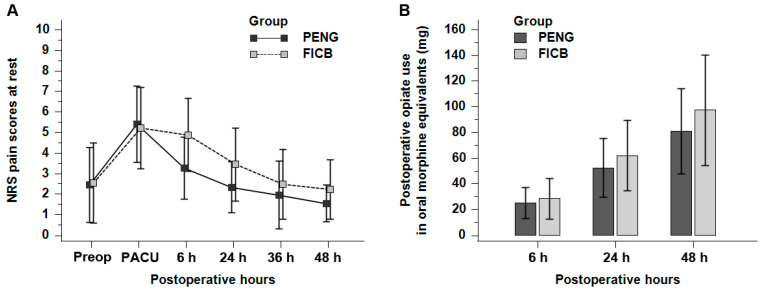
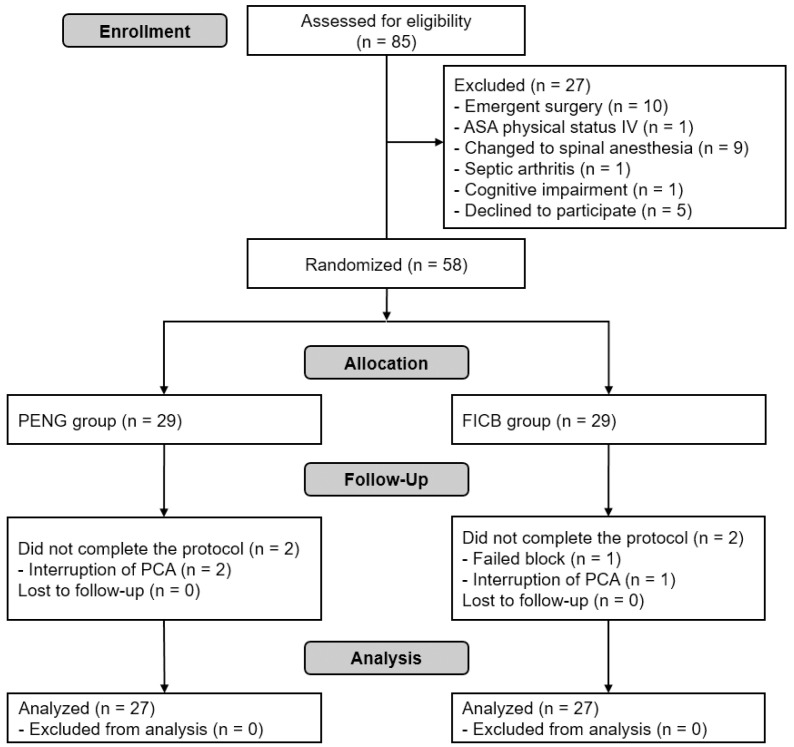
This study compared the effects of the pericapsular nerve group (PENG) block and supra-inguinal fascia iliaca compartment block (FICB) on postoperative analgesia and quadriceps strength following total hip arthroplasty under general anesthesia. A total of 58 patients were randomized to receive either PENG block (PENG group) or supra-inguinal FICB (FICB group) following anesthetic induction. The primary outcomes were the postoperative pain scores. Patients were randomized to receive either PENG block or supra-inguinal FICB following anesthetic induction. Pain scores at rest and with movement were assessed preoperatively, at the postanesthesia care unit (only at rest), and at 6, 24, 36, and 48 h postoperatively. Opioid consumption was also assessed for 48 h postoperatively. Quadriceps strength measurements were performed preoperatively, at 6, 24, and 36 h postoperatively. In total, 54 patients completed the study: 27 in the PENG group and 27 in the FICB group. Despite lower pain scores at rest in the PENG group at postoperative 6 and 24 h, there were no significant differences in the pain scores at rest and during movement between the two groups during postoperative 48 h in the linear mixed model analysis ( = 0.079 and = 0.323, respectively). Cumulative opioid consumption up to postoperative 48 h was also similar in the two groups ( = 0.265). The changes in quadriceps strength measurements in the operative leg and the nonoperative leg were not significantly different between the groups ( = 0.513 and = 0.523, respectively). The PENG block may have similar analgesic efficacy to the supra-inguinal FICB. No difference was detected in the quadriceps strength between the patients receiving these two blocks.
本研究比较了关节囊周围神经组(PENG)阻滞与腹股沟上髂筋膜间隙阻滞(FICB)对全身麻醉下全髋关节置换术后镇痛及股四头肌力量的影响。共有58例患者在麻醉诱导后随机接受PENG阻滞(PENG组)或腹股沟上FICB(FICB组)。主要结局指标为术后疼痛评分。患者在麻醉诱导后随机接受PENG阻滞或腹股沟上FICB。术前、麻醉后恢复室(仅静息时)以及术后6、24、36和48小时评估静息和活动时的疼痛评分。术后48小时也评估阿片类药物的消耗量。术前、术后6、24和36小时进行股四头肌力量测量。共有54例患者完成了研究:PENG组27例,FICB组27例。尽管PENG组术后6小时和24小时静息时疼痛评分较低,但在线性混合模型分析中,两组术后48小时静息和活动时的疼痛评分无显著差异(分别为 = 0.079和 = 0.323)。两组术后48小时累计阿片类药物消耗量也相似( = 0.265)。两组手术侧和非手术侧股四头肌力量测量的变化无显著差异(分别为 = 0.513和 = 0.523)。PENG阻滞可能与腹股沟上FICB具有相似的镇痛效果。接受这两种阻滞的患者股四头肌力量未检测到差异。