Department of Anesthesiology, Xi'an Aerospace General Hospital, Xi'an, China.
Department of Joint Surgery, Xi 'an Aerospace General Hospital, Xi'an, China.
BMC Anesthesiol. 2023 Jul 11;23(1):233. doi: 10.1186/s12871-023-02190-1.
This investigation aimed to evaluate the impact of continuous pericapsular nerve group (PENG) block and continuous fascia iliac compartment block (FICB) on postoperative pain following total hip arthroplasty (THA).
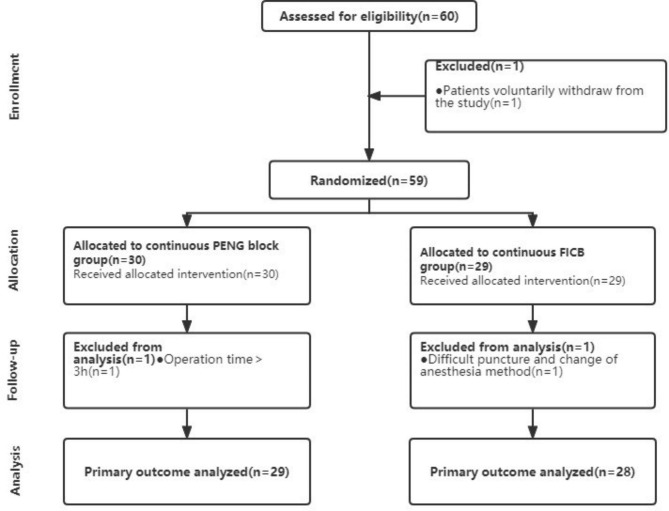
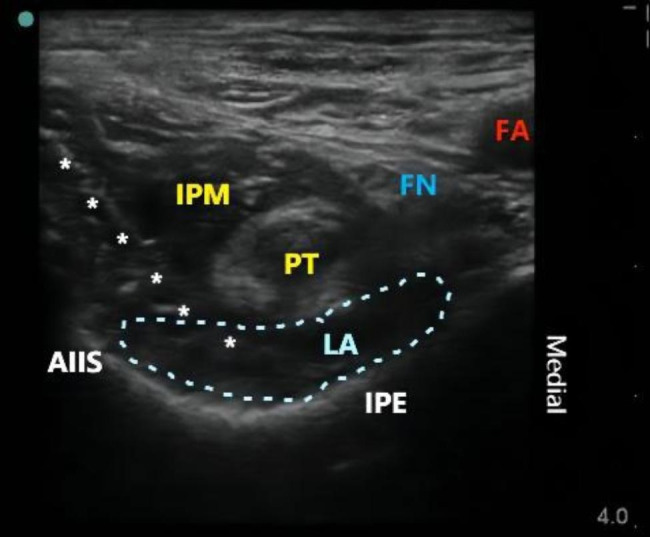
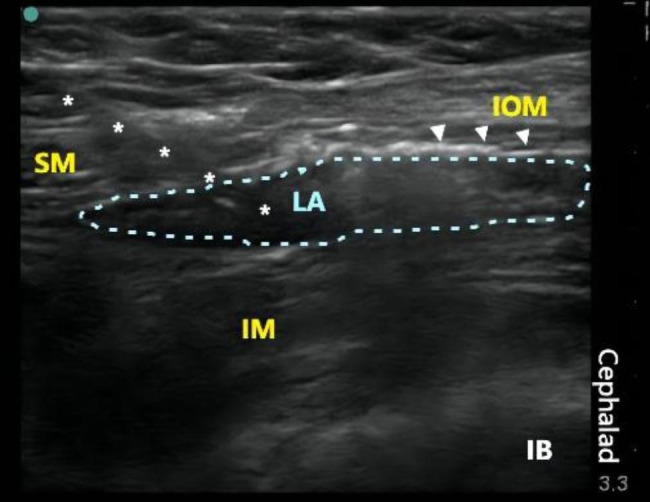
This prospective, randomized, and controlled trial recruited a cohort of fifty-seven patients with unilateral femoral neck fractures from Xi'an Aerospace General Hospital in northwest China between July 2020 and November 2021. These patients were randomly assigned to two groups: the continuous PENG block group (PENG group, n = 29) and the continuous FICB group (FICB group, n = 28). Under ultrasound guidance, PENG block and FICB procedures were performed prior to spinal anesthesia, utilizing 20 ml of 0.25% ropivacaine for PENG block and 30 ml of 0.25% ropivacaine for FICB. Subsequently, a catheter was inserted. All study participants received a standardized postoperative multimodal analgesic regimen, including intravenous administration of 30 mg Ketorolac tromethamine every eight hours and patient-controlled neural analgesia (PCNA) after surgery. Numerical rating scale (NRS) scores at rest and during exercise were recorded at various time points: prior to block (T0), 30 min post-blockade (T1), and 6 h (T2), 12 h (T3), 24 h (T4), and 48 h (T5) postoperatively. Additional data collected encompassed postoperative quadriceps muscle strength, the time of initial ambulation after surgery, the number of effective PCNA activations, rescue analgesia requirements, and occurrences of adverse events (such as nausea and vomiting, hematoma, infection, catheter detachment, or displacement) within 48 h following surgery.
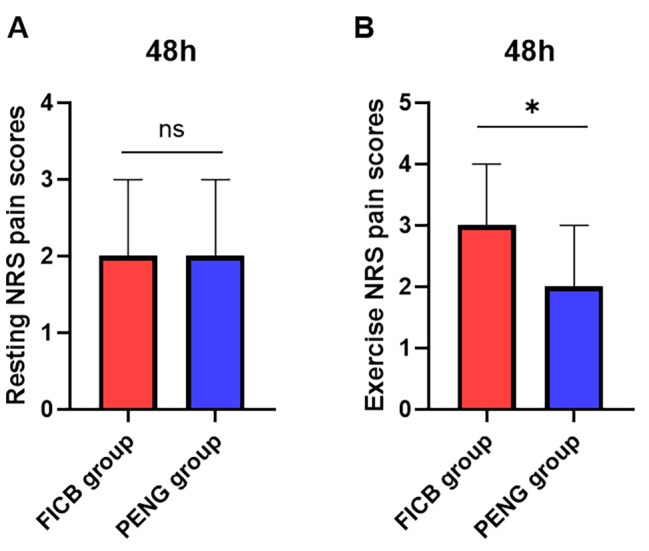
In the PENG group, the resting NRS pain scores exhibited lower values at T1, T4, and T5 than those at T0. Furthermore, exercise NRS pain scores at T1-T5 were lower in the PENG group than in the FICB group. Similarly, during the same postoperative period, the PENG group demonstrated enhanced quadriceps strength on the affected side compared to the FICB group. Additionally, the PENG group displayed earlier postoperative ambulation and reduced occurrences of effective PCNA activations and rescue analgesia requirements compared to the FICB group.
Continuous PENG block exhibited superior analgesic efficacy after THA compared to continuous FICB, promoting recovery of quadriceps strength on the affected side and facilitating early postoperative ambulation.
This clinical trial was registered in the China Clinical Trials Center ( http://www.chictr.org.cn ) on 20/07/2020, with the registration number ChiCTR2000034821.
本研究旨在评估连续囊周神经群(PENG)阻滞和连续髂筋膜间隙阻滞(FICB)对全髋关节置换术(THA)后疼痛的影响。
本前瞻性、随机、对照试验招募了 2020 年 7 月至 2021 年 11 月期间来自中国西北部西安航天总医院的 57 例单侧股骨颈骨折患者。这些患者被随机分配到两组:连续 PENG 阻滞组(PENG 组,n=29)和连续 FICB 组(FICB 组,n=28)。在超声引导下,PENG 阻滞和 FICB 术前采用 20ml 0.25%罗哌卡因进行,FICB 采用 30ml 0.25%罗哌卡因进行。随后插入导管。所有研究参与者均接受标准化术后多模式镇痛方案,包括术后每 8 小时静脉注射 30mg 酮咯酸氨丁三醇和术后患者自控神经镇痛(PCNA)。在不同时间点记录静息和运动时的数字评分量表(NRS)评分:阻滞前(T0)、阻滞后 30 分钟(T1)、术后 6 小时(T2)、12 小时(T3)、24 小时(T4)和 48 小时(T5)。收集的其他数据包括术后股四头肌肌力、术后首次下床活动时间、有效 PCNA 激活次数、解救镇痛需求以及术后 48 小时内不良反应(如恶心呕吐、血肿、感染、导管脱落或移位)的发生情况。
在 PENG 组中,T1、T4 和 T5 时的静息 NRS 疼痛评分低于 T0 时,T1-T5 时运动 NRS 疼痛评分也低于 FICB 组。同样,在相同的术后期间,与 FICB 组相比,PENG 组患侧股四头肌肌力增强。此外,与 FICB 组相比,PENG 组术后更早下床活动,有效 PCNA 激活次数和解救镇痛需求减少。
与连续 FICB 相比,THA 后连续 PENG 阻滞具有更好的镇痛效果,促进患侧股四头肌肌力恢复,促进术后早期下床活动。
本临床试验于 2020 年 7 月 20 日在中国临床试验中心(http://www.chictr.org.cn)注册,注册号 ChiCTR2000034821。