Bai Rushui, Sun Qiannan, He Ying, Peng Liying, Zhang Yunfan, Zhang Lingyun, Lu Wenhsuan, Deng Jingjing, Zhuang Zimeng, Yu Tingting, Wei Yan
Department of Orthodontics, Peking University School and Hospital of Stomatology, Beijing, China.
National Engineering Laboratory for Digital and Material Technology of Stomatology and Beijing Key Laboratory of Digital Stomatology, Beijing, China.
Front Bioeng Biotechnol. 2022 Mar 7;10:840372. doi: 10.3389/fbioe.2022.840372. eCollection 2022.
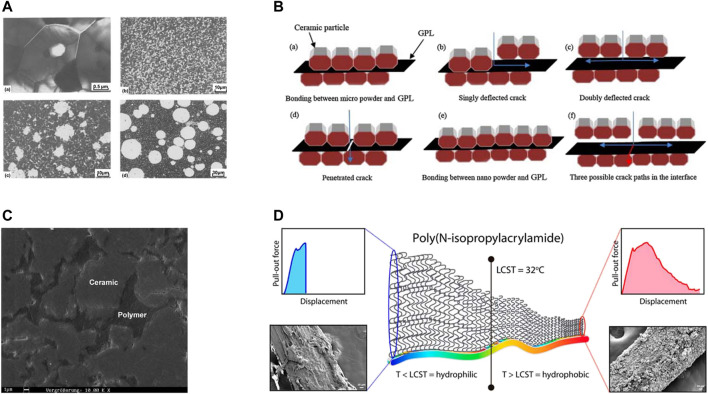
Aiming at shortage of metal materials, ceramic is increasingly applied in biomedicine due to its high strength, pleasing esthetics and good biocompatibility, especially for dental restorations and implants, artificial joints, as well as synthetic bone substitutes. However, the inherent brittleness of ceramic could lead to serious complications, such as fracture and disfunction of biomedical devices, which impede their clinical applications. Herein, several toughening strategies have been summarized in this review, including reinforcing phase addition, surface modification, and manufacturing processes improvement. Doping metal and/or non-metal reinforcing fillers modifies toughness of bulk ceramic, while surface modifications, mainly coating, chemical and thermal methods, regulate toughness on the surface layer. During fabrication, optimization should be practiced in powder preparation, green forming and densification processes. Various toughening strategies utilize mechanisms involving fine-grained, stress-induced phase transformation, and microcrack toughening, as well as crack deflection, bifurcation, bridging and pull-out. This review hopes to shed light on systematic combination of different toughening strategies and mechanisms to drive progress in biomedical devices.
针对金属材料的短缺问题,陶瓷因其高强度、美观的外观和良好的生物相容性,在生物医学领域的应用越来越广泛,特别是用于牙齿修复和植入物、人工关节以及合成骨替代物。然而,陶瓷固有的脆性可能导致严重的并发症,如生物医学装置的断裂和功能障碍,这阻碍了它们的临床应用。在此,本综述总结了几种增韧策略,包括添加增强相、表面改性和改进制造工艺。掺杂金属和/或非金属增强填料可改变块状陶瓷的韧性,而表面改性(主要是涂层、化学和热方法)则可调节表层的韧性。在制造过程中,应在粉末制备、坯体成型和致密化过程中进行优化。各种增韧策略利用的机制包括细晶、应力诱导相变和微裂纹增韧,以及裂纹偏转、分支、桥接和拔出。本综述希望阐明不同增韧策略和机制的系统组合,以推动生物医学装置的发展。