Department of Biomedical Informatics, CHA University School of Medicine, CHA University, Seongnam, Korea.
Institute for Biomedical Informatics, CHA University School of Medicine, CHA University, Seongnam, Republic of Korea.
BMC Pregnancy Childbirth. 2022 Mar 24;22(1):247. doi: 10.1186/s12884-022-04566-6.
Neonatal jaundice is common, and despite the considerable medical costs associated with it, there are still few studies on the maternal factors associated with it. Identification of maternal factors associated with neonatal jaundice is very important in terms of prevention, screening and management of neonatal jaundice. The current study aimed to identify maternal disease factors associated with neonatal jaundice.
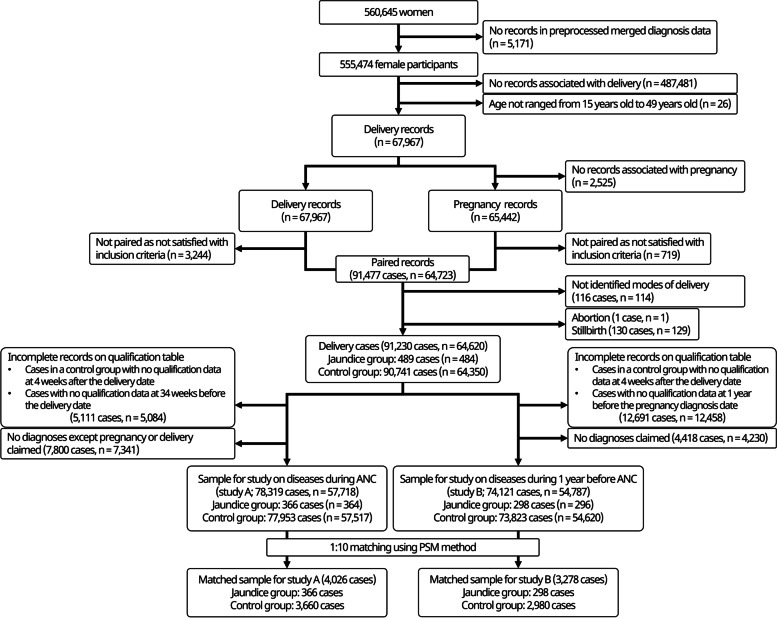
We compared the maternal disease diagnostic codes during pregnancy (study A) and 1 year before conception (study B) in mothers whose insurance claims data included newborns treated for neonatal jaundice before birth registration via the National Health Insurance Service-National Sample Cohort (control group). To decrease the effect of confounding variables, the neonatal jaundice and control groups were matched at a ratio of 1:10 via propensity score matching using covariates including age and income.
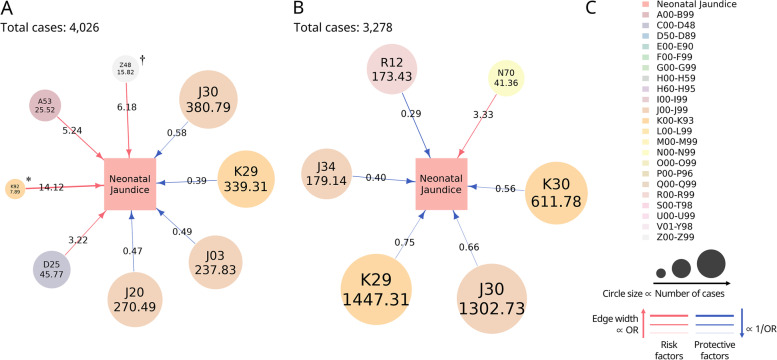
The matched samples for studies A and B included 4,026 and 3,278 (jaundice group: 366 and 298) delivery cases, respectively. In both studies, the jaundice group had a higher proportion of patients who underwent cesarean section than the control group. In study A, other diseases of the digestive system had the highest odds ratio (OR) (K92; adjusted OR: 14.12, 95% confidence interval [CI]: 2.70-82.26). Meanwhile, gastritis and duodenitis had the lowest OR (K29; adjusted OR: 0.39, 95% CI: 0.22-0.69). In study B, salpingitis and oophoritis had the highest OR (N70; adjusted OR: 3.33, 95% CI: 1.59-6.94). Heartburn had the lowest OR (R12; adjusted OR: 0.29, 95% CI:0.12-0.71).
This study identified maternal disease factors correlated with neonatal jaundice during pregnancy and 1 year before conception. Maternal risk factors for neonatal jaundice included syphilis and leiomyoma during pregnancy, and salpingo-oophoritis before pregnancy. The protective factors included infection, inflammatory diseases, and dyspepsia.
新生儿黄疸很常见,尽管与之相关的医疗费用相当可观,但目前关于与新生儿黄疸相关的产妇因素的研究仍然很少。鉴定与新生儿黄疸相关的产妇因素对于预防、筛查和管理新生儿黄疸非常重要。本研究旨在确定与新生儿黄疸相关的产妇疾病因素。
我们比较了通过国家健康保险服务-全国样本队列(对照组)在新生儿登记前接受新生儿黄疸治疗的产妇的保险索赔数据中妊娠期间(研究 A)和受孕前 1 年(研究 B)的产妇疾病诊断代码。为了减少混杂变量的影响,我们使用年龄和收入等协变量通过倾向评分匹配以 1:10 的比例对新生儿黄疸组和对照组进行匹配。
研究 A 和 B 的匹配样本分别包括 4026 例和 3278 例(黄疸组:366 例和 298 例)分娩病例。在两项研究中,黄疸组剖宫产的比例均高于对照组。在研究 A 中,消化系统其他疾病的比值比(OR)最高(K92;调整后的 OR:14.12,95%置信区间 [CI]:2.70-82.26)。同时,胃炎和十二指肠炎的 OR 最低(K29;调整后的 OR:0.39,95% CI:0.22-0.69)。在研究 B 中,输卵管炎和卵巢炎的 OR 最高(N70;调整后的 OR:3.33,95% CI:1.59-6.94)。胃灼热的 OR 最低(R12;调整后的 OR:0.29,95% CI:0.12-0.71)。
本研究确定了妊娠期间和受孕前 1 年与新生儿黄疸相关的产妇疾病因素。新生儿黄疸的产妇危险因素包括妊娠期间的梅毒和子宫肌瘤,以及妊娠前的输卵管卵巢炎。保护因素包括感染、炎症性疾病和消化不良。