Department of Medical Epidemiology and Biostatistics, Karolinska Institutet, Sweden.
Department of Nutrition, University of North Carolina at Chapel Hill, USA.
Clin Nutr ESPEN. 2022 Apr;48:186-195. doi: 10.1016/j.clnesp.2022.02.111. Epub 2022 Feb 25.
BACKGROUND & AIMS: Research quantifying dietary intake in individuals with bulimia nervosa and binge-eating disorder (i.e., binge-type eating disorders) is surprisingly scant. We assessed the dietary intake of women and men with binge-type eating disorders in a large case-control study and compared them with healthy controls. We also evaluated the extent to which their dietary intake adhered to the Nordic Nutrition Recommendations. Among cases, we assessed the relationship of binge eating frequency with energy and macronutrient intake.
We derived the total daily energy, macro-, and micronutrient intake of 430 cases with binge-type eating disorders (women: n = 391, men: n = 39) and 1227 frequency-matched controls (women: n = 1,213, men: n = 14) who completed the MiniMeal-Q, a validated food frequency questionnaire. We calculated mean intake for men and women and, in women, compared mean intake of energy and nutrients between cases and controls using linear regression. We calculated the proportion of women and men who met the recommended intake levels from the NNR, and compared these proportions in female cases and controls using logistic regression. We used linear regression to examine energy and macronutrient intake of women with varying frequencies of current binge-eating.
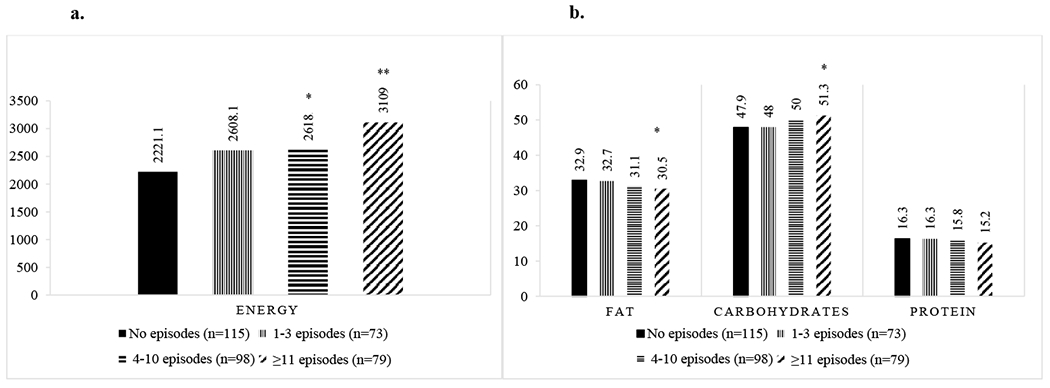
Female, but not male cases, had a higher mean intake of total energy/day compared with controls and higher intake than recommended. The majority in all groups (male and female cases and controls) exceeded saturated fat recommendations, and did not meet recommendations for omega-3 fatty acid intake. Among all groups, adherence was low for vitamin D, selenium, and salt. Iron and folate intake was low among the majority of women, especially controls. Female cases with ≥4 binge-eating episodes in the past 28 days had higher intake of energy and percent carbohydrates, and lower intake of percent fat, compared to cases with no binge-eating episodes in the past month.
Higher than recommended total daily energy intake among women with binge-type eating disorders may lead to weight gain and downstream health complications, if persistent. In most women, iron and folate intake was insufficient, which may have negative consequences for reproductive health. We found suboptimal adherence for key nutrients that are important to limit (saturated fat and salt) or meet (omega-3 fatty acids) for cardiovascular and overall health in all groups. Nutrition counseling should form an important pillar of treatment to assist with normalization of eating patterns and may also benefit individuals without eating disorders to optimize nutrient intake for long term health promotion.
研究定量摄入饮食在神经性贪食症和暴食症(即暴食型饮食障碍)个体中非常少见。我们在一项大型病例对照研究中评估了暴食型饮食障碍女性和男性的饮食摄入,并将其与健康对照组进行了比较。我们还评估了他们的饮食摄入与北欧营养推荐的相符程度。在病例中,我们评估了暴食频率与能量和宏量营养素摄入的关系。
我们从 430 名暴食型饮食障碍患者(女性:n=391,男性:n=39)和 1227 名频率匹配的对照组(女性:n=1213,男性:n=14)中得出了每日总能量、宏量营养素和微量营养素的摄入量,这些人完成了 MiniMeal-Q,这是一种经过验证的食物频率问卷。我们计算了男性和女性的平均摄入量,并在女性中,使用线性回归比较了病例和对照组之间的能量和营养素平均摄入量。我们计算了女性病例和对照组中符合 NNR 推荐摄入量水平的比例,并使用逻辑回归比较了这些比例。我们使用线性回归检查了不同频率的当前暴食女性的能量和宏量营养素摄入。
与对照组相比,女性病例的日均总能量摄入更高,且高于推荐量。大多数组(男性和女性病例和对照组)的饱和脂肪摄入量超过了建议值,且未能达到摄入欧米伽 3 脂肪酸的建议量。在所有组中,维生素 D、硒和盐的摄入量均较低。大多数女性,尤其是对照组,铁和叶酸的摄入量较低。过去 28 天内有≥4 次暴食发作的女性病例与过去一个月内无暴食发作的病例相比,能量和碳水化合物百分比摄入较高,而脂肪百分比摄入较低。
如果持续存在,暴食型饮食障碍女性的日均总能量摄入高于推荐值可能导致体重增加和下游健康并发症。在大多数女性中,铁和叶酸的摄入量不足,这可能对生殖健康产生负面影响。我们发现,所有组的关键营养素的摄入量都不理想,这些营养素对于限制(饱和脂肪和盐)或满足(欧米伽 3 脂肪酸)心血管和整体健康都很重要。营养咨询应成为治疗的重要支柱,以帮助恢复正常的饮食模式,也可能有益于没有饮食障碍的个体,以优化长期健康促进的营养摄入。