Department of Pediatrics, Amsterdam Gastroenterology Endocrinology Metabolism, Amsterdam University Medical Centers, 1105 AZ Amsterdam, The Netherlands.
Department of Human Genetics, Amsterdam Reproduction and Development, Amsterdam University Medical Centers, 1105 AZ Amsterdam, The Netherlands.
Cold Spring Harb Mol Case Stud. 2022 Mar 24;8(2). doi: 10.1101/mcs.a006200. Print 2022 Feb.
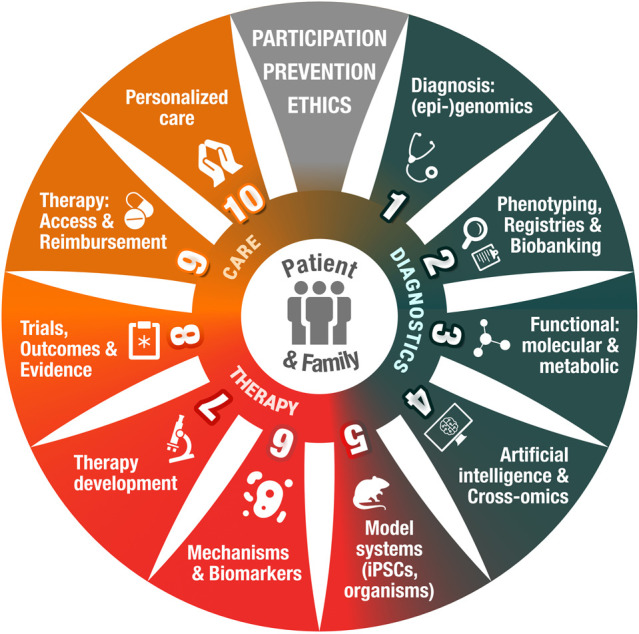
Rare neurogenetic disorders are collectively common, affecting 3% of the population, and often manifest with complex multiorgan comorbidity. With advances in genetic, -omics, and computational analysis, more children can be diagnosed and at an earlier age. Innovations in translational research facilitate the identification of treatment targets and development of disease-modifying drugs such as gene therapy, nutraceuticals, and drug repurposing. This increasingly allows targeted therapy to prevent the often devastating manifestations of rare neurogenetic disorders. In this perspective, successes in diagnosis, prevention, and treatment are discussed with a focus on inherited disorders of metabolism. Barriers for the identification, development, and implementation of rare disease-specific therapies are discussed. New methodologies, care networks, and collaborative frameworks are proposed to optimize the potential of personalized genomic medicine to decrease morbidity and improve lives of these vulnerable patients.
罕见神经遗传疾病的总体发病率较高,影响人群的 3%,且常表现为复杂的多器官合并症。随着遗传、组学和计算分析的进步,越来越多的儿童能够更早地被诊断出来。转化研究的创新促进了治疗靶点的确定和疾病修饰药物的开发,如基因治疗、营养疗法和药物再利用。这使得靶向治疗能够预防罕见神经遗传疾病的常见破坏性表现。在这篇观点文章中,重点讨论了代谢遗传障碍的诊断、预防和治疗方面的成功案例,并讨论了确定、开发和实施罕见疾病特异性疗法的障碍。提出了新的方法学、护理网络和协作框架,以优化个体化基因组医学的潜力,降低这些脆弱患者的发病率并改善他们的生活。