Department of Radiation Oncology, Columbia University Irving Medical Center, New York City, New York, USA.
Department of Radiology, Columbia University Irving Medical Center, New York City, New York, USA.
J Appl Clin Med Phys. 2022 Jul;23(7):e13595. doi: 10.1002/acm2.13595. Epub 2022 Mar 25.
Dose computation using cone beam computed tomography (CBCT) images is inaccurate for the purpose of adaptive treatment planning. The main goal of this study is to assess the dosimetric accuracy of synthetic computed tomography (CT)-based calculation for adaptive planning in the upper abdominal region. We hypothesized that deep learning-based synthetically generated CT images will produce comparable results to a deformed CT (CTdef) in terms of dose calculation, while displaying a more accurate representation of the daily anatomy and therefore superior dosimetric accuracy.
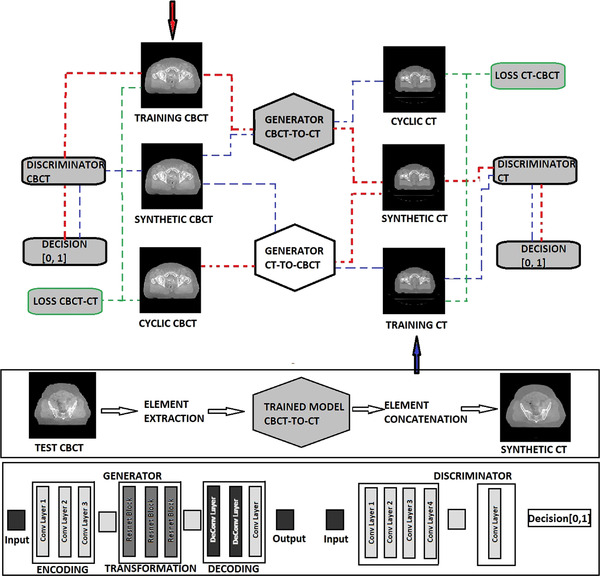
We have implemented a cycle-consistent generative adversarial networks (CycleGANs) architecture to synthesize CT images from the daily acquired CBCT image with minimal error. CBCT and CT images from 17 liver stereotactic body radiation therapy (SBRT) patients were used to train, test, and validate the algorithm.
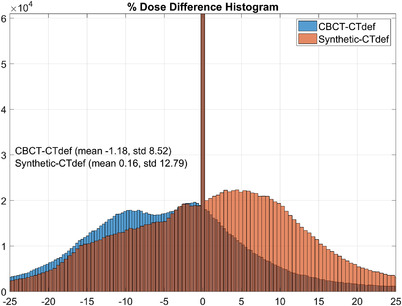
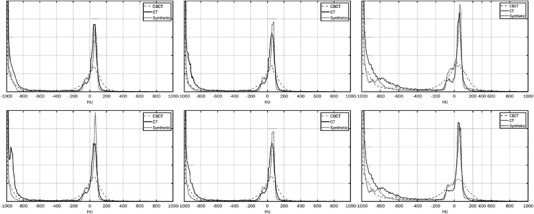
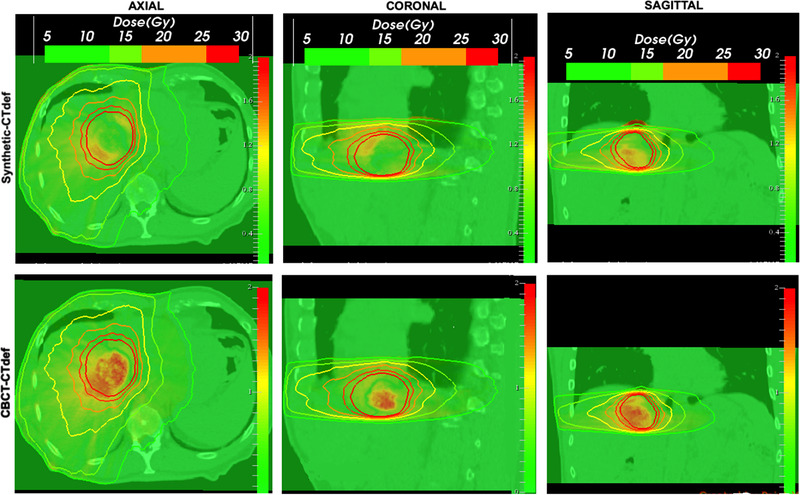
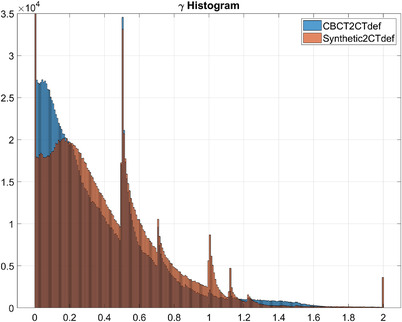
The synthetically generated images showed increased signal-to-noise ratio, contrast resolution, and reduced root mean square error, mean absolute error, noise, and artifact severity. Superior edge matching, sharpness, and preservation of anatomical structures from the CBCT images were observed for the synthetic images when compared to the CTdef registration method. Three verification plans (CBCT, CTdef, and synthetic) were created from the original treatment plan and dose volume histogram (DVH) statistics were calculated. The synthetic-based calculation shows comparatively similar results to the CTdef-based calculation with a maximum mean deviation of 1.5%.
Our findings show that CycleGANs can produce reliable synthetic images for the adaptive delivery framework. Dose calculations can be performed on synthetic images with minimal error. Additionally, enhanced image quality should translate into better daily alignment, increasing treatment delivery accuracy.
使用锥形束计算机断层扫描(CBCT)图像进行剂量计算对于自适应治疗计划而言并不准确。本研究的主要目的是评估基于合成计算机断层扫描(CT)的计算在腹部上部自适应计划中的剂量准确性。我们假设基于深度学习的合成生成 CT 图像在剂量计算方面将与变形 CT(CTdef)产生相当的结果,同时显示出对日常解剖结构更准确的表示,从而具有更高的剂量准确性。
我们已经实现了一种循环一致性生成对抗网络(CycleGANs)架构,以从每日获取的 CBCT 图像中以最小的误差生成 CT 图像。使用 17 例肝脏立体定向体部放射治疗(SBRT)患者的 CBCT 和 CT 图像来训练、测试和验证算法。
合成生成的图像显示出更高的信噪比、对比度分辨率,并且降低了均方根误差、平均绝对误差、噪声和伪影严重程度。与 CTdef 配准方法相比,合成图像显示出对 CBCT 图像的边缘匹配更好、更锐利以及更好地保留了解剖结构。从原始治疗计划中创建了三个验证计划(CBCT、CTdef 和合成),并计算了剂量体积直方图(DVH)统计数据。基于合成的计算与基于 CTdef 的计算相比具有最大平均偏差 1.5%,结果较为相似。
我们的研究结果表明,CycleGANs 可以为自适应递送框架生成可靠的合成图像。可以在合成图像上进行剂量计算,误差最小。此外,图像质量的提高应该会转化为更好的日常配准,从而提高治疗交付的准确性。