Department of Respiratory Medicine, Chinese People's Liberation Army General Hospital, Beijing, China.
Department of Pulmonary and Critical Care Medicine, Zhongnan Hospital of Wuhan University, Wuhan, Hubei, China.
Cancer Med. 2022 Nov;11(21):3982-3992. doi: 10.1002/cam4.4719. Epub 2022 Mar 24.
To explore the diagnostic value of radiomics in differentiating between lung adenocarcinomas appearing as ground-glass opacity nodules (GGO) with high- and low Ki-67 expression levels.
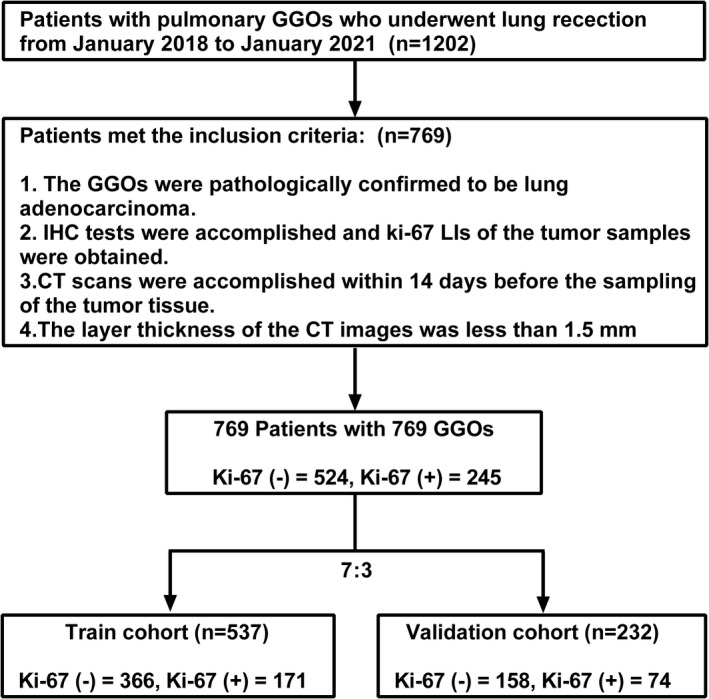
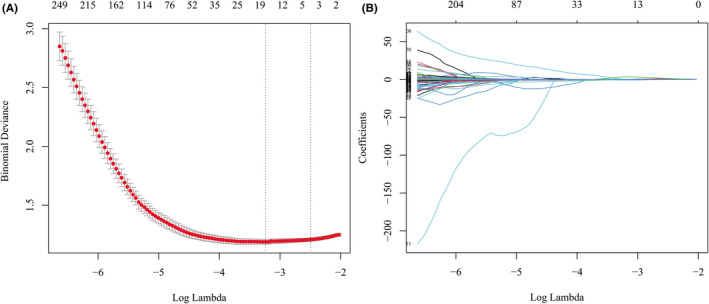
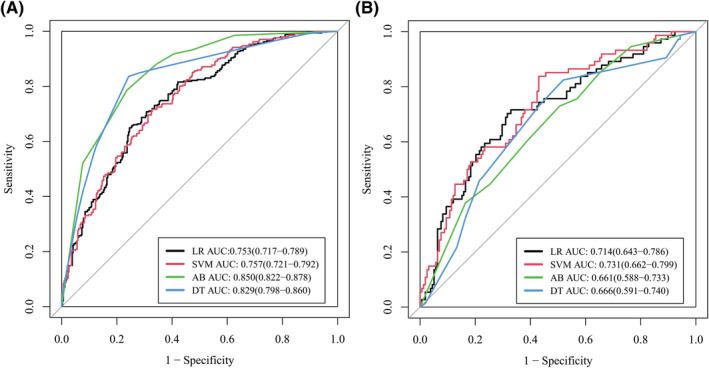
From January 2018 to January 2021, patients with pulmonary GGO who received lung resection were evaluated for potential enrollment. The included GGOs were then randomly divided into a training cohort and a validation cohort with a ratio of 7:3. Logistic regression (LR), decision tree (DT), support vector machines (SVM), and adaboost (AB) were applied for radiomic model construction. Area under the curve (AUC) of the receiver operating characteristic (ROC) curve was used to evaluate the diagnostic efficacy of the established models.
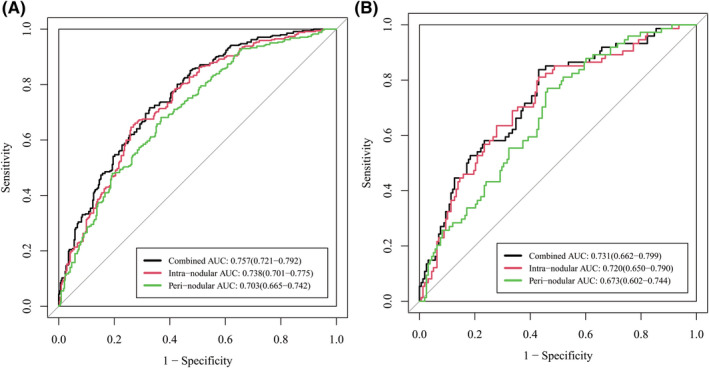
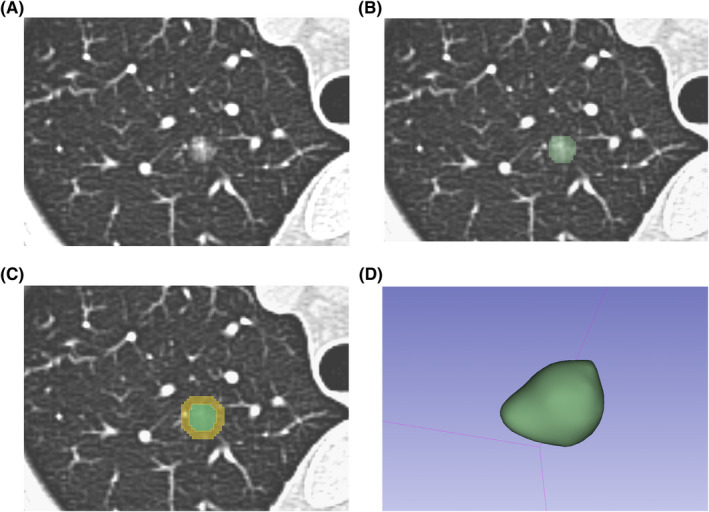
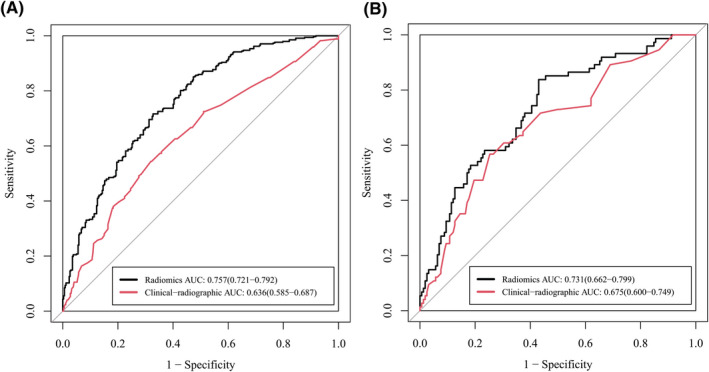
Seven hundred and sixty-nine patients with 769 GGOs were included in this study. Two hundred and forty-five GGOs were confirmed to be of high Ki-67 labeling index (LI). In the training cohort, gender, age, spiculation sign, pleural indentation sign, bubble sign, and maximum 2D diameter of the nodule were found to be significantly different between high- and low Ki-67 LI groups (p < 0.05), and spiculation sign and maximum 2D diameter of the nodule were further confirmed to be risk factors for Ki-67 LI. The radiomic model established using SVM exhibited an AUC of 0.731 in the validation cohort, which was higher than that of the clinical-radiographic model (AUC = 0.675). Moreover, radiomic model combining both intra- and peri-nodular features showed better diagnostic efficacy than using intra-nodular features alone (AUC = 0.731 and 0.720, respectively).
The established radiomic model exhibited good diagnostic efficacy in differentiating between lung adenocarcinoma GGOs with high and low Ki-67 LI, which was higher than the clinical-radiographic model. Peri-nodular radiomic features showed added benefits to the radiomic model. As a novel noninvasive method, radiomics have the potential to be applied in the preliminary classification of Ki-67 expression level in lung adenocarcinoma GGOs.
探讨影像组学在区分 Ki-67 高表达和低表达的肺腺癌磨玻璃结节(GGO)中的诊断价值。
本研究纳入了 2018 年 1 月至 2021 年 1 月期间因肺 GGO 接受肺切除术的患者,并评估了其潜在的入组情况。将纳入的 GGO 随机分为训练队列和验证队列,比例为 7:3。应用逻辑回归(LR)、决策树(DT)、支持向量机(SVM)和自适应增强(AB)构建影像组学模型。采用受试者工作特征(ROC)曲线下面积(AUC)评估建立模型的诊断效能。
本研究共纳入 769 例患者的 769 个 GGO。其中 245 个 GGO 的 Ki-67 标记指数(LI)较高。在训练队列中,高 Ki-67 LI 组和低 Ki-67 LI 组在性别、年龄、分叶征、胸膜凹陷征、泡征和结节最大二维直径方面存在显著差异(p<0.05),其中分叶征和结节最大二维直径被进一步确认为 Ki-67 LI 的危险因素。在验证队列中,SVM 构建的影像组学模型的 AUC 为 0.731,高于临床-影像学模型(AUC=0.675)。此外,同时结合结节内和结节周特征的影像组学模型比单独使用结节内特征的诊断效能更好(AUC 分别为 0.731 和 0.720)。
本研究建立的影像组学模型在区分 Ki-67 高表达和低表达的肺腺癌 GGO 方面具有良好的诊断效能,高于临床-影像学模型。结节周影像组学特征为影像组学模型提供了附加价值。作为一种新的非侵入性方法,影像组学有望用于肺腺癌 GGO 中 Ki-67 表达水平的初步分类。