Faculty of Caring Science, Work Life and Social Welfare, University of Borås, Borås, Sweden.
Department of Natural Science and Biomedicine, School of Health and Welfare, Jönköping University, Jönköping, Sweden.
Health Soc Care Community. 2022 Sep;30(5):e3207-e3218. doi: 10.1111/hsc.13765. Epub 2022 Mar 25.
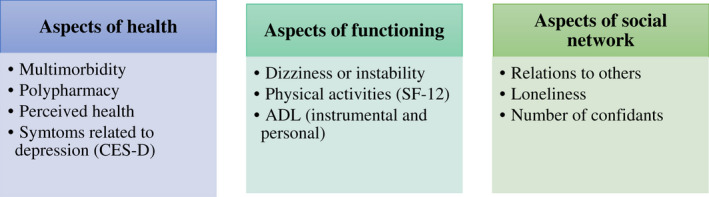
To a great extent, older people in Sweden, often with extensive care needs, are cared for in their own home. Support is often needed from both family and professional caregivers. This study aimed to describe and analyse different aspects of health, functioning and social networks, and how they relate to formal and informal care in the home among older adults. Analyses were performed utilising data from the OCTO-2 study, with a sample of 317 people living in Jönköping County, aged 75, 80, 85 or 90 years, living in their own homes. Data were collected with in-person-testing. Based on receipt of care, the participants were divided into three groups: no care, informal care only, and formal care with or without informal care. Descriptive statistics and multinomial regression analysis were performed to explore the associations between received care and different aspects of health (such as multimorbidity, polypharmacy), social networks (such as loneliness, number of confidants) and functioning (such as managing daily life). The findings demonstrate that the majority of the participants received no care at home (61%). Multimorbidity and polypharmacy were more common among those receiving some kind of care in comparison to those who received no care; moreover, those receiving some kind of care also had difficulties managing daily life and less satisfaction with their social networks. The multinomial logistic regression analyses demonstrated that age, functioning in daily life, perceived general health and satisfaction with the number of confidants were related to receipt of care, but the associations among these factors differed depending on the type of care that was received. The results show the importance of a holistic perspective that includes the older person's experiences when planning home care. The results also highlight the importance of considering social perspectives and relationships in home care rather than focusing only on health factors.
在很大程度上,瑞典的老年人,通常有广泛的护理需求,在自己的家中得到照顾。家庭和专业护理人员都经常需要提供支持。本研究旨在描述和分析老年人健康、功能和社交网络的不同方面,以及它们与家庭中正式和非正式护理的关系。分析利用了 OCTO-2 研究的数据,该研究的样本包括来自延雪平省的 317 名 75、80、85 或 90 岁的老年人,他们居住在自己的家中。数据通过面对面测试收集。根据接受护理的情况,参与者被分为三组:无护理、仅接受非正式护理以及接受正式护理和/或非正式护理。进行描述性统计和多项逻辑回归分析,以探讨接受的护理与健康的不同方面(如多种疾病、多种药物治疗)、社交网络(如孤独感、知己数量)和功能(如日常生活管理)之间的关系。研究结果表明,大多数参与者在家中没有接受任何护理(61%)。与未接受任何护理的人相比,接受某种护理的人更常见多种疾病和多种药物治疗;此外,接受某种护理的人在日常生活管理方面也有困难,对社交网络的满意度较低。多项逻辑回归分析表明,年龄、日常生活功能、一般健康感知和对知己数量的满意度与接受护理有关,但这些因素之间的关联因所接受的护理类型而异。结果表明,在规划家庭护理时,需要从整体角度考虑老年人的体验,这一点很重要。结果还强调了在家庭护理中考虑社会视角和关系的重要性,而不仅仅关注健康因素。