Division of Cardiac Surgery, Department of Cardiac, Thoracic, Vascular Sciences and Public Health, University of Padova, Via Giustiniani 2, 35128 Padova, Italy.
Division of Vascular Surgery, Department of Cardiac, Thoracic, Vascular Sciences and Public Health, University of Padova, Via Giustiniani 2, 35128 Padova, Italy.
Medicina (Kaunas). 2022 Mar 2;58(3):372. doi: 10.3390/medicina58030372.
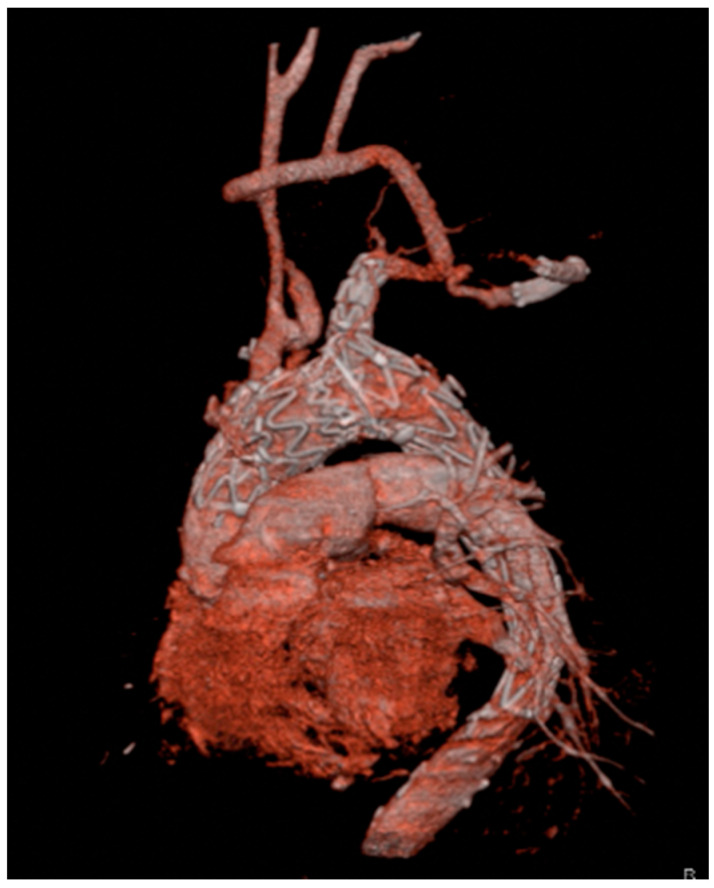
The gold-standard therapy for the treatment of aortic arch pathologies is conventional open surgery. Recently, total endovascular aortic arch replacement with branched stent-grafts has been introduced into clinical practice with the aim of reducing invasiveness especially in selected high-risk patients. The aim of this review is to describe the two most commonly used branched devices for endovascular arch stent-grafting: Nexus (Endospan, Herzlia, Israle) and RelayBranch (Terumo Aortic, Glasgow, United Kingdom). Nexus is a CE-certified off-the-shelf, single branch, double stent graft system. It consists of two different components: a main module for the aortic arch and the descending aorta with a side-branch for the brachiocephalic artery (BCA), and a curved module for the ascending aorta that lands into the sino-tubular junction and connects to the main module through a side-facing self-protecting sleeve. Nexus may be used in urgent-emergency cases and also in patients with only one suitable supra-aortic target vessel but, on the other hand, it makes cerebral blood flow dependent on one source vessel only. The RelayBranch Thoracic Stent-Graft System is a custom made, double branched endograft with a wide window on its superior portion to accommodate two inner tunnels for BCA and left common carotid artery connection; bilateral cervical accesses are generally used to advance guidewires for catheterization of the inner tunnels in a retrograde fashion. RelayBranch can be customized on every patient's specific anatomy and provides a double blood source for the brain, but it cannot be used in urgent-emergency conditions. Therefore, in order to optimize outcomes, the choice of the most appropriate device should be made considering pros and cons of each system and patient's anatomy by an experienced aortic team. In conclusion, total endovascular aortic arch exclusion is a promising reality in selected high-risk patients.
治疗主动脉弓病变的金标准疗法是传统的开放式手术。最近,带分支支架移植物的全腔内主动脉弓置换已引入临床实践,目的是减少侵袭性,特别是在选定的高危患者中。本文的目的是描述两种最常用于腔内弓支架移植的分支装置:Nexus(Endospan,Herzlia,以色列)和 RelayBranch(Terumo Aortic,Glasgow,英国)。Nexus 是一种获得 CE 认证的现成的单分支双支架移植物系统。它由两个不同的组件组成:一个用于主动脉弓和降主动脉的主模块,带有用于头臂动脉(BCA)的侧支,以及一个用于升主动脉的弯曲模块,该模块降落在窦管交界处,并通过面向侧面的自保护套管与主模块连接。Nexus 可用于紧急情况,也可用于只有一个合适的主动脉上靶血管的患者,但另一方面,它使脑血流仅依赖于一个源血管。RelayBranch 胸主动脉支架移植系统是一种定制的双分支移植物,其上部有一个宽窗口,可容纳两个用于 BCA 和左颈总动脉连接的内隧道;通常使用双侧颈部通道将导丝推进逆行导管内的内隧道。RelayBranch 可以根据每个患者的特定解剖结构进行定制,为大脑提供双重血液供应,但不能用于紧急情况。因此,为了优化结果,应由经验丰富的主动脉团队根据每个系统和患者解剖结构的优缺点来选择最合适的设备。总之,在选定的高危患者中,全腔内主动脉弓排除是一种很有前途的现实。