Zeng Xintao, Su Ning, Wu Pinghui
Fujian Provincial Key Laboratory for Advanced Micro-Nano Photonics Technology and Devices & Key Laboratory of Information Functional Material for Fujian Higher Education, Quanzhou Normal University, Quanzhou 362000, China.
Micromachines (Basel). 2022 Feb 23;13(3):349. doi: 10.3390/mi13030349.
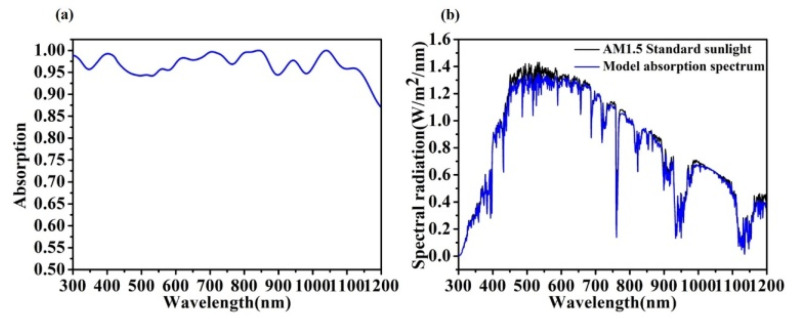
Using the finite-difference time-domain (FDTD) method, we designed an ultra-thin Ge/GaAs/P3HT:PCBM hybrid solar cell (HSC), which showed good effects of ultra-wideband (300 nm-1200 nm), high absorption, and a short-circuit current density of 44.7 mA/cm. By changing the thickness of the active layer P3HT:PCBM, we analyzed the capture of electron-hole pairs. We also studied the effect of AlO on the absorption performance of the cell. Through adding metal Al nanoparticles (Al-NPs) and then analyzing the figures of absorption and electric field intensity, we found that surface plasma is the main cause of solar cell absorption enhancement, and we explain the mechanism. The results show that the broadband absorption of the solar cell is high, and it plays a great role in capturing sunlight, which will be of great significance in the field of solar cell research.
我们使用时域有限差分(FDTD)方法设计了一种超薄的锗/砷化镓/聚(3-己基噻吩):苯基-C61-丁酸甲酯混合太阳能电池(HSC),该电池展现出超宽带(300纳米 - 1200纳米)、高吸收以及44.7毫安/平方厘米的短路电流密度等良好效果。通过改变活性层聚(3-己基噻吩):苯基-C61-丁酸甲酯的厚度,我们分析了电子 - 空穴对的俘获情况。我们还研究了氧化铝对电池吸收性能的影响。通过添加金属铝纳米颗粒(Al-NPs),然后分析吸收和电场强度数据,我们发现表面等离子体是太阳能电池吸收增强的主要原因,并对其机理进行了解释。结果表明,该太阳能电池的宽带吸收很高,在捕获太阳光方面发挥着重要作用,这在太阳能电池研究领域具有重要意义。