School of Physical Education, Shandong University, Jinan 250061, China.
Center for Health Science and Counseling, Kyushu University, Fukuoka 819-0395, Japan.
Nutrients. 2022 Mar 21;14(6):1309. doi: 10.3390/nu14061309.
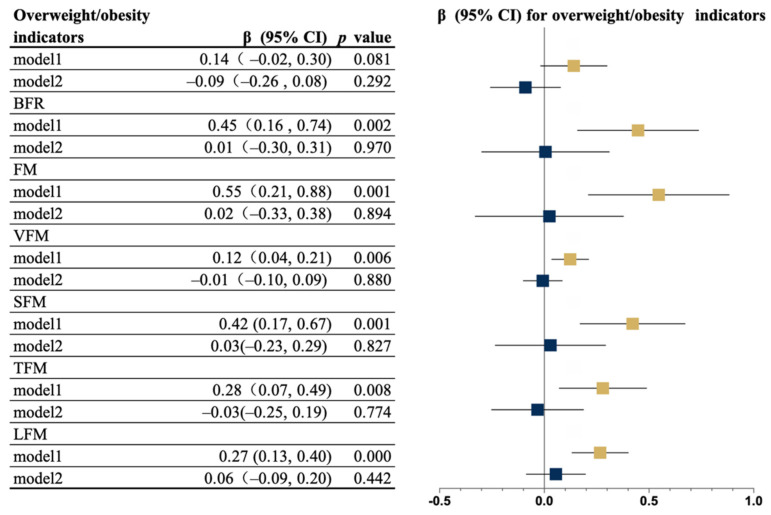
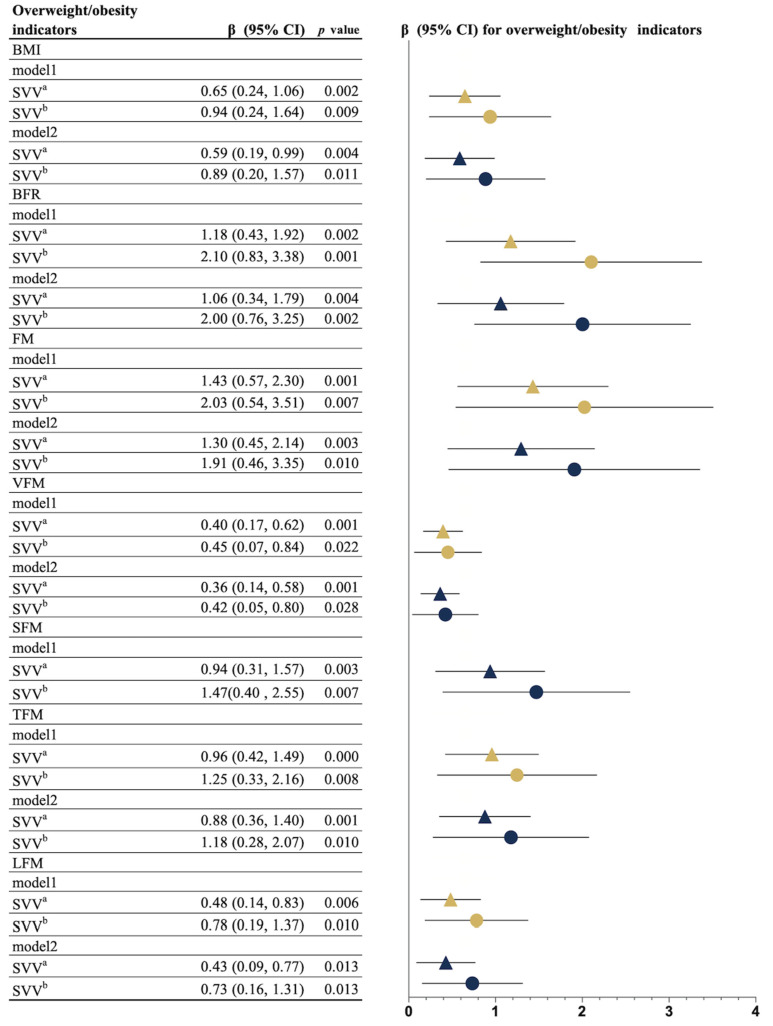
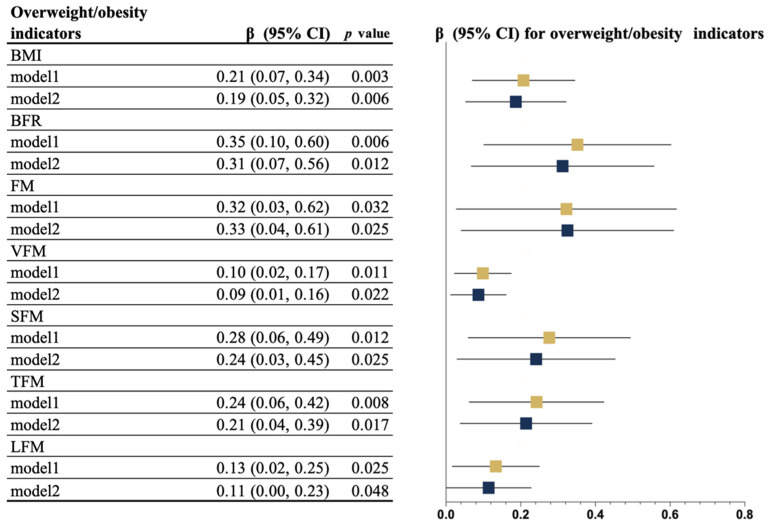
Previous studies have found that the relationship between sedentary time (ST) and overweightness/obesity is unclear. The association between sedentary behavior and overweightness/obesity may depend on the type of sedentary behavior engaged in. Nowadays, in older Chinese adults, especially females, short video viewing (SVV) is the most popular leisure sedentary behavior. However, the association between SVV and overweightness/obesity remains to be determined. This study aimed to examine the associations between ST and SVV and overweightness/obesity in Chinese community-dwelling older women. A cross-sectional analysis of baseline data from the Physical Activity and Health in Older Women Study was carried out in this study. A total of 1105 older Chinese women aged 60-70 years were included. SVV was estimated using a self-reported questionnaire, and ST was objectively measured using a tri-axial accelerometer. Overweightness/obesity indicators, including body fat ratio (BFR), fat mass (FM), visceral fat mass (VFM), subcutaneous fat mass (SFM), trunk fat mass (TFM), and limb fat mass (LFM), were assessed using multi-frequency bioimpedance analysis. The covariates included socio-demographic data and a range of health-related factors. Multiple linear regression analyses were used to assess the association between ST and SVV and overweightness/obesity. ST was significantly positively associated with all indicators of overweightness/obesity; however, the associations disappeared after adjusting for moderate-to-vigorous-intensity physical activity (MVPA). A higher SVV time was associated with a higher body mass index (BMI) (β = 0.19, 95% confidence interval (CI): 0.05 to 0.32), BFR (β = 0.31, 95% CI: 0.07 to 0.56), FM (β = 0.33, 95% CI: 0.04 to 0.61), VFM (β = 0.09, 95% CI: 0.01 to 0.16), SFM (β = 0.24, 95% CI: 0.03 to 0.45), TFM (β = 0.21, 95% CI: 0.04 to 0.39), and LFM (β = 0.11, 95% CI: 0.00 to 0.23) in the fully adjusted models. Compared with non-food short videos, short food videos had a greater effect on overweightness/obesity. SVV was an independent risk factor for overweightness/obesity. A reduction in SVV (especially the food category) rather than ST might be an effective way to prevent overweightness/obesity when incorporated in future public health policy formulations.
先前的研究发现,久坐时间(ST)与超重/肥胖之间的关系尚不清楚。久坐行为与超重/肥胖之间的关联可能取决于所从事的久坐行为的类型。如今,在中国老年人中,尤其是女性,观看短视频已成为最受欢迎的休闲久坐行为。然而,观看短视频与超重/肥胖之间的关系仍有待确定。本研究旨在探讨中国社区居住的老年女性中,ST 和观看短视频与超重/肥胖之间的关联。本研究对“老年女性身体活动与健康研究”的基线数据进行了横断面分析。共纳入 1105 名年龄在 60-70 岁的中国老年女性。使用自我报告问卷估计观看短视频时间,使用三轴加速度计客观测量久坐时间。使用多频生物阻抗分析评估超重/肥胖指标,包括体脂比(BFR)、脂肪量(FM)、内脏脂肪量(VFM)、皮下脂肪量(SFM)、躯干脂肪量(TFM)和肢体脂肪量(LFM)。协变量包括社会人口统计学数据和一系列健康相关因素。使用多元线性回归分析评估 ST 和观看短视频与超重/肥胖之间的关联。ST 与所有超重/肥胖指标均呈显著正相关;然而,在调整中等到剧烈强度体力活动(MVPA)后,这些关联消失了。观看短视频时间较长与更高的体重指数(BMI)(β=0.19,95%置信区间(CI):0.05-0.32)、BFR(β=0.31,95%CI:0.07-0.56)、FM(β=0.33,95%CI:0.04-0.61)、VFM(β=0.09,95%CI:0.01-0.16)、SFM(β=0.24,95%CI:0.03-0.45)、TFM(β=0.21,95%CI:0.04-0.39)和 LFM(β=0.11,95%CI:0.00-0.23)有关,在完全调整模型中。与非食品短视频相比,食品短视频对超重/肥胖的影响更大。观看短视频是超重/肥胖的一个独立危险因素。减少观看短视频(尤其是食品类)而不是减少久坐时间,可能是未来公共卫生政策制定中预防超重/肥胖的有效途径。