Marking Ulrika, Havervall Sebastian, Greilert-Norin Nina, Ng Henry, Blom Kim, Nilsson Peter, Phillipson Mia, Hober Sophia, Nilsson Charlotta, Mangsbo Sara, Christ Wanda, Klingström Jonas, Gordon Max, Åberg Mikael, Thålin Charlotte
Department of Clinical Sciences, Karolinska Institutet Danderyd Hospital, 182 88 Stockholm, Sweden.
Department of Medical Cell Biology, Uppsala University, 751 23 Uppsala, Sweden.
Vaccines (Basel). 2022 Feb 24;10(3):359. doi: 10.3390/vaccines10030359.
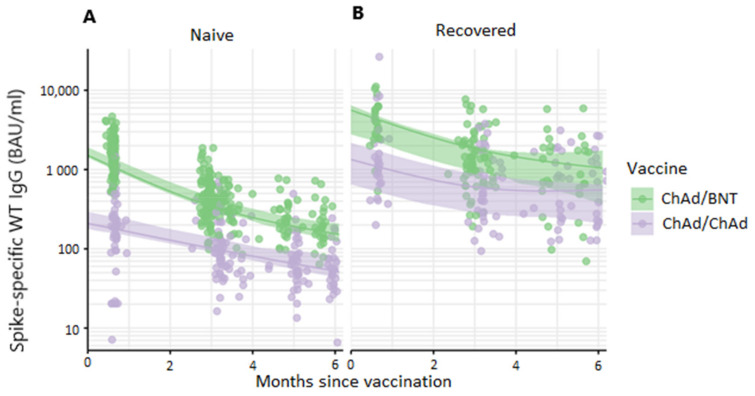
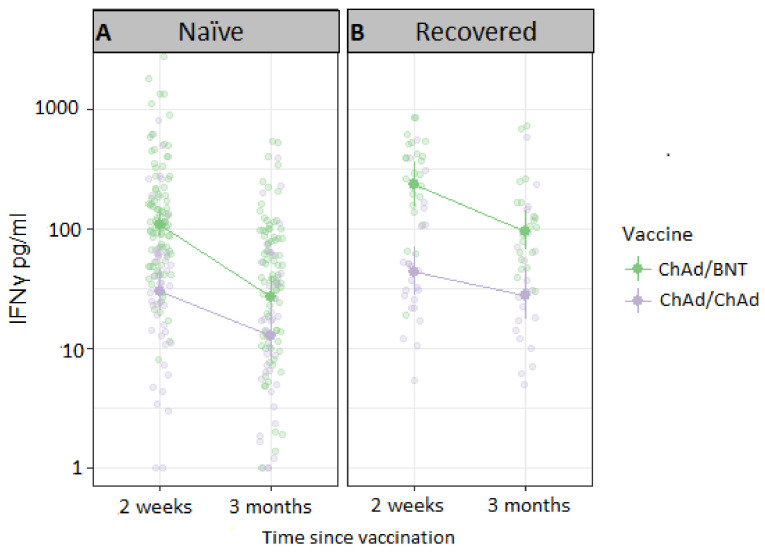
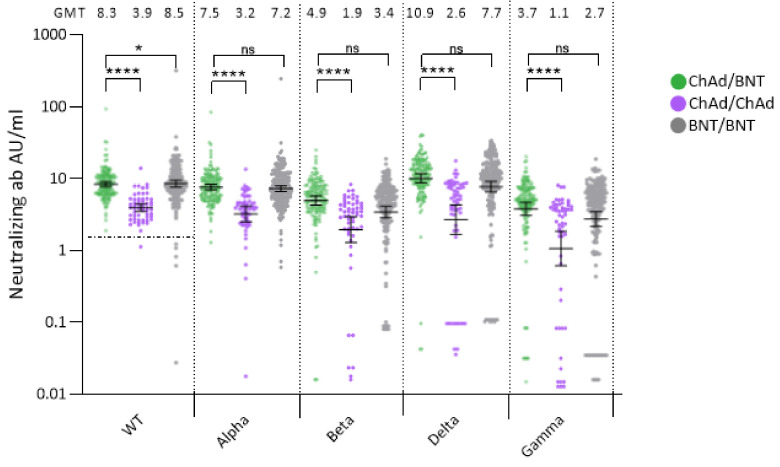
Heterologous primary immunization against SARS-CoV-2 is part of applied recommendations. However, little is known about duration of immune responses after heterologous vaccine regimens. To evaluate duration of immune responses after primary vaccination with homologous adeno-vectored ChAdOx1 nCoV-19 vaccine (ChAd) or heterologous ChAd/BNT162b2 mRNA vaccine (BNT), anti-spike-IgG and SARS-CoV-2 VOC-neutralizing antibody responses were measured in 354 healthcare workers (HCW) at 2 weeks, 3 months, 5 months and 6 months after the second vaccine dose. T-cell responses were investigated using a whole blood interferon gamma (IFN-γ) release assay 2 weeks and 3 months post second vaccine dose. Two hundred and ten HCW immunized with homologous BNT were enrolled for comparison of antibody responses. In study participants naïve to SARS-CoV-2 prior to vaccination, heterologous ChAd/BNT resulted in 6-fold higher peak anti-spike IgG antibody titers compared to homologous ChAd vaccination. The half-life of antibody titers was 3.1 months (95% CI 2.8-3.6) following homologous ChAd vaccination and 1.9 months (95% CI 1.7-2.1) after heterologous vaccination, reducing the GMT difference between the groups to 3-fold 6 months post vaccination. Peak T-cell responses were stronger in ChAd/BNT vaccinees, but no significant difference was observed 3 months post vaccination. SARS-CoV-2 infection prior to vaccination resulted in substantially higher peak GMTs and IFN-γ levels and enhanced SARS-CoV-2 specific antibody and T cell responses over time. Heterologous primary SARS-CoV-2 immunization with ChAd and BNT elicits a stronger initial immune response compared to homologous vaccination with ChAd. However, although the differences in humoral responses remain over 6 months, the difference in SARS-CoV-2 specific T cell responses are no longer significant three months after vaccination.
针对严重急性呼吸综合征冠状病毒2(SARS-CoV-2)的异源初次免疫是应用建议的一部分。然而,关于异源疫苗接种方案后的免疫反应持续时间,人们了解甚少。为了评估同源腺病毒载体ChAdOx1 nCoV-19疫苗(ChAd)或异源ChAd/BNT162b2 mRNA疫苗(BNT)初次接种后的免疫反应持续时间,在354名医护人员(HCW)第二次接种疫苗后的2周、3个月、5个月和6个月测量了抗刺突蛋白IgG和SARS-CoV-2变异株中和抗体反应。在第二次接种疫苗后的2周和3个月,使用全血干扰素γ(IFN-γ)释放试验研究了T细胞反应。招募了210名接种同源BNT的医护人员以比较抗体反应。在接种疫苗前对SARS-CoV-2无免疫力的研究参与者中,与同源ChAd疫苗接种相比,异源ChAd/BNT导致抗刺突蛋白IgG抗体峰值滴度高6倍。同源ChAd疫苗接种后抗体滴度的半衰期为3.1个月(95%置信区间2.8-3.6),异源疫苗接种后为1.9个月(95%置信区间1.7-2.1),使两组之间的几何平均滴度(GMT)差异在接种疫苗6个月后降至3倍。ChAd/BNT疫苗接种者的T细胞反应峰值更强,但在接种疫苗3个月后未观察到显著差异。接种疫苗前的SARS-CoV-2感染导致GMT峰值和IFN-γ水平显著更高,并随着时间的推移增强了SARS-CoV-2特异性抗体和T细胞反应。与同源ChAd疫苗接种相比,用ChAd和BNT进行的异源初次SARS-CoV-2免疫引发了更强的初始免疫反应。然而,尽管体液反应的差异在6个月内仍然存在,但接种疫苗三个月后,SARS-CoV-2特异性T细胞反应的差异不再显著。