Santiago Helton C, Pereira-Neto Tertuliano A, Gonçalves-Pereira Marcela H, Terzian Ana C B, Durbin Anna P
Department of Biochemistry and Immunology, Institute of Biological Sciences, Federal University of Minas Gerais, Belo Horizonte 30270-901, MG, Brazil.
Laboratory of Cellular Immunology, Rene Rachou Institute, Fiocruz, Belo Horizonte 30190-002, MG, Brazil.
Pathogens. 2022 Feb 25;11(3):294. doi: 10.3390/pathogens11030294.
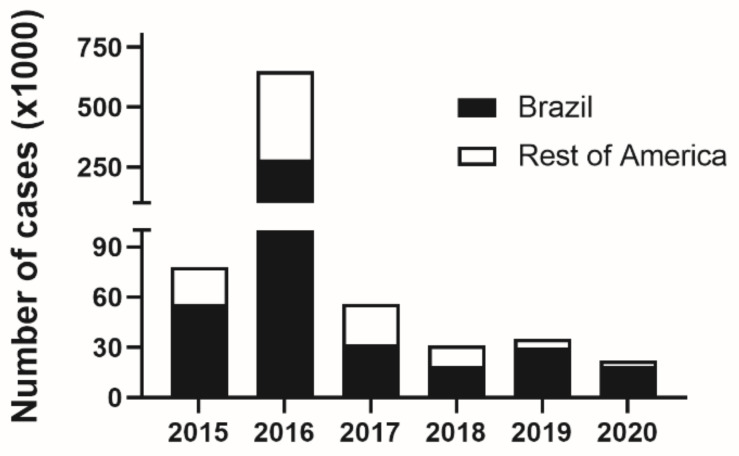
The Zika virus (ZIKV) was first isolated from a rhesus macaque in the Zika forest of Uganda in 1947. Isolated cases were reported until 2007, when the first major outbreaks of Zika infection were reported from the Island of Yap in Micronesia and from French Polynesia in 2013. In 2015, ZIKV started to circulate in Latin America, and in 2016, ZIKV was considered by WHO to be a Public Health Emergency of International Concern due to cases of Congenital Zika Syndrome (CZS), a ZIKV-associated complication never observed before. After a peak of cases in 2016, the infection incidence dropped dramatically but still causes concern because of the associated microcephaly cases, especially in regions where the dengue virus (DENV) is endemic and co-circulates with ZIKV. A vaccine could be an important tool to mitigate CZS in endemic countries. However, the immunological relationship between ZIKV and other flaviviruses, especially DENV, and the low numbers of ZIKV infections are potential challenges for developing and testing a vaccine against ZIKV. Here, we discuss ZIKV vaccine development with the perspective of the immunological concerns implicated by DENV-ZIKV cross-reactivity and the use of a controlled human infection model (CHIM) as a tool to accelerate vaccine development.
寨卡病毒(ZIKV)于1947年首次从乌干达寨卡森林的一只恒河猴体内分离出来。在2007年之前,一直有散发病例报告,直到2007年,密克罗尼西亚联邦雅浦岛和2013年法属波利尼西亚首次报告了寨卡感染的大规模暴发。2015年,寨卡病毒开始在拉丁美洲传播,2016年,由于先天性寨卡综合征(CZS)病例的出现,世界卫生组织将寨卡病毒视为国际关注的突发公共卫生事件,先天性寨卡综合征是一种此前从未见过的与寨卡病毒相关的并发症。在2016年病例达到峰值后,感染发病率大幅下降,但由于相关的小头畸形病例,仍然令人担忧,尤其是在登革热病毒(DENV)流行且与寨卡病毒共同传播的地区。疫苗可能是减轻流行国家先天性寨卡综合征的一项重要工具。然而,寨卡病毒与其他黄病毒,尤其是登革热病毒之间的免疫关系,以及寨卡病毒感染病例数量较少,是开发和测试寨卡病毒疫苗的潜在挑战。在此,我们从登革热病毒-寨卡病毒交叉反应所涉及的免疫问题以及使用受控人类感染模型(CHIM)作为加速疫苗开发工具的角度,讨论寨卡病毒疫苗的开发。