Laboratório de Biologia Estrutural de Vírus, Instituto de Bioquímica Médica Leopoldo de Meis, Universidade Federal do Rio de Janeiro, Rio de Janeiro, Brazil.
Instituto Nacional de Ciência e Tecnologia de Biologia Estrutural e Bioimagem, Centro Nacional de Biologia Estrutural e Bioimagem (CENABIO), Universidade Federal do Rio de Janeiro, Rio de Janeiro, Brazil.
PLoS Negl Trop Dis. 2021 Nov 4;15(11):e0009907. doi: 10.1371/journal.pntd.0009907. eCollection 2021 Nov.
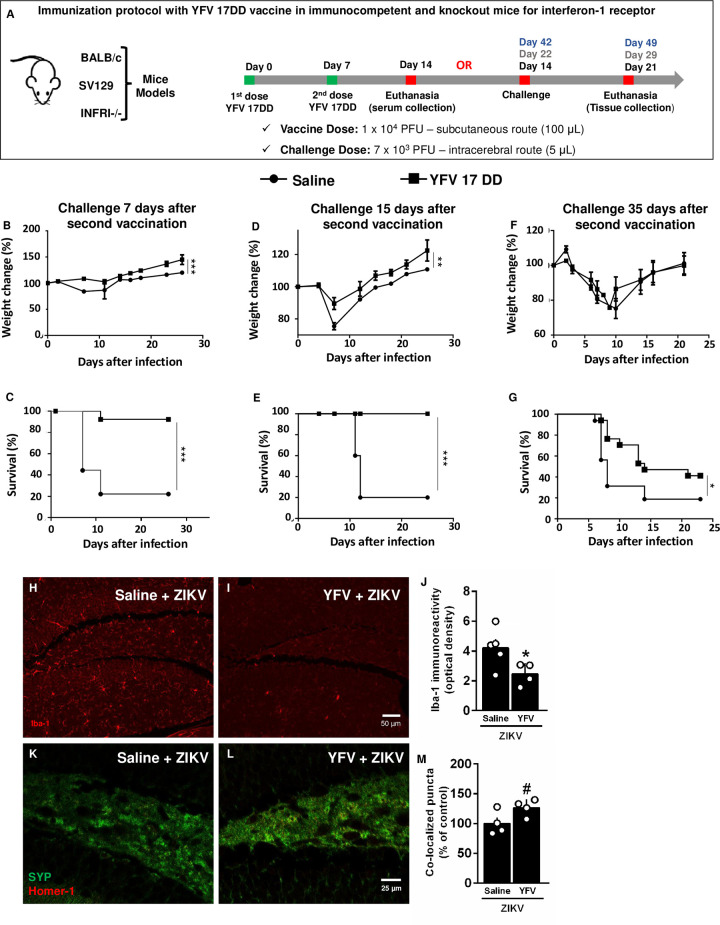
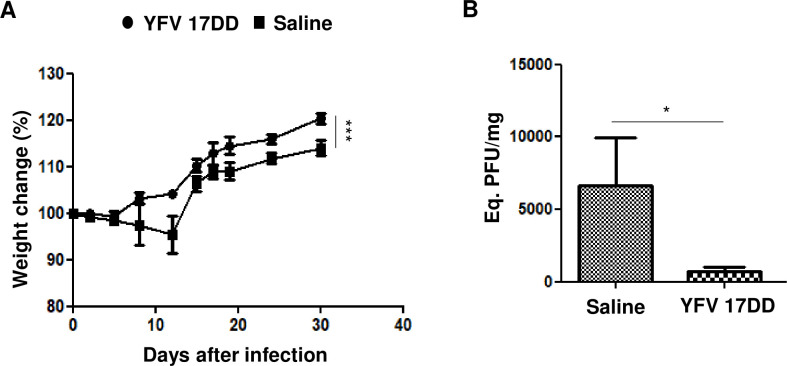
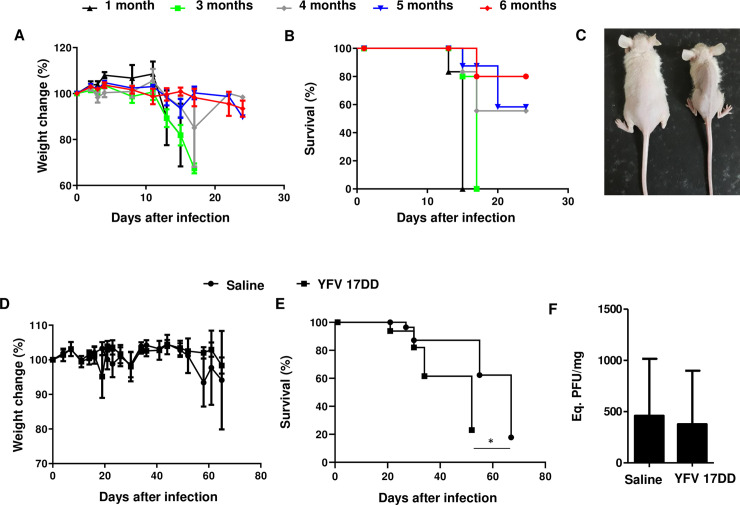
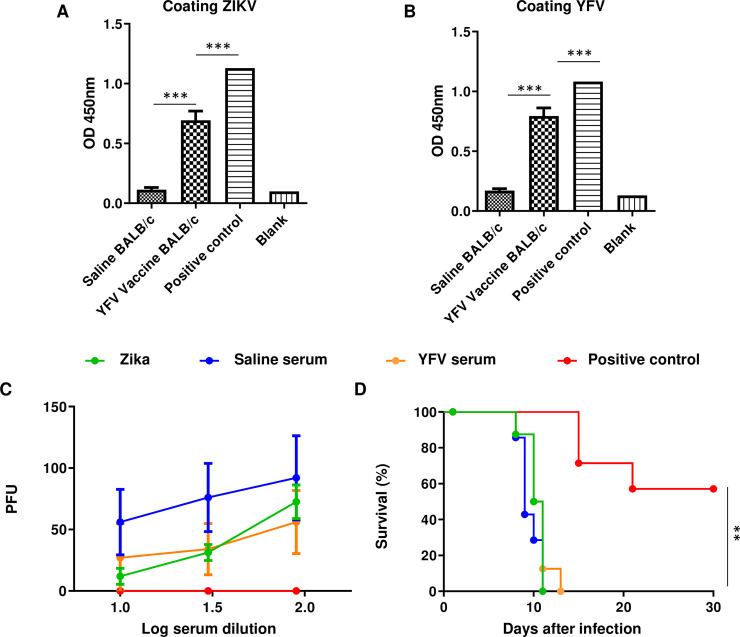
Zika virus (ZIKV) emerged as an important infectious disease agent in Brazil in 2016. Infection usually leads to mild symptoms, but severe congenital neurological disorders and Guillain-Barré syndrome have been reported following ZIKV exposure. Creating an effective vaccine against ZIKV is a public health priority. We describe the protective effect of an already licensed attenuated yellow fever vaccine (YFV, 17DD) in type-I interferon receptor knockout mice (A129) and immunocompetent BALB/c and SV-129 (A129 background) mice infected with ZIKV. YFV vaccination provided protection against ZIKV, with decreased mortality in A129 mice, a reduction in the cerebral viral load in all mice, and weight loss prevention in BALB/c mice. The A129 mice that were challenged two and three weeks after the first dose of the vaccine were fully protected, whereas partial protection was observed five weeks after vaccination. In all cases, the YFV vaccine provoked a substantial decrease in the cerebral viral load. YFV immunization also prevented hippocampal synapse loss and microgliosis in ZIKV-infected mice. Our vaccine model is T cell-dependent, with AG129 mice being unable to tolerate immunization (vaccination is lethal in this mouse model), indicating the importance of IFN-γ in immunogenicity. To confirm the role of T cells, we immunized nude mice that we demonstrated to be very susceptible to infection. Immunization with YFV and challenge 7 days after booster did not protect nude mice in terms of weight loss and showed partial protection in the survival curve. When we evaluated the humoral response, the vaccine elicited significant antibody titers against ZIKV; however, it showed no neutralizing activity in vitro and in vivo. The data indicate that a cell-mediated response promotes protection against cerebral infection, which is crucial to vaccine protection, and it appears to not necessarily require a humoral response. This protective effect can also be attributed to innate factors, but more studies are needed to strengthen this hypothesis. Our findings open the way to using an available and inexpensive vaccine for large-scale immunization in the event of a ZIKV outbreak.
寨卡病毒(ZIKV)于 2016 年在巴西成为一种重要的传染病病原体。感染通常导致轻微症状,但据报道,在接触 ZIKV 后,会出现严重的先天性神经发育障碍和格林-巴利综合征。因此,开发针对 ZIKV 的有效疫苗成为公共卫生的当务之急。我们描述了已获得许可的减毒黄热病疫苗(YFV,17DD)在 I 型干扰素受体敲除小鼠(A129)和免疫活性 BALB/c 和 SV-129(A129 背景)感染寨卡病毒中的保护作用。YFV 疫苗接种可预防 ZIKV,A129 小鼠死亡率降低,所有小鼠脑部病毒载量降低,BALB/c 小鼠体重减轻得到预防。在第一剂疫苗接种后两周和三周接受挑战的 A129 小鼠完全受到保护,而在接种疫苗五周后观察到部分保护。在所有情况下,YFV 疫苗都显著降低了脑部病毒载量。YFV 免疫还可预防 ZIKV 感染小鼠海马突触丢失和小胶质细胞增生。我们的疫苗模型是 T 细胞依赖性的,AG129 小鼠不能耐受免疫(在这种小鼠模型中接种疫苗是致命的),这表明 IFN-γ 在免疫原性中的重要性。为了确认 T 细胞的作用,我们免疫了裸鼠,我们证明这些裸鼠非常容易感染。在加强免疫后 7 天进行 YFV 免疫接种和挑战不能保护裸鼠的体重减轻,并在生存曲线中显示部分保护。当我们评估体液反应时,疫苗可针对 ZIKV 产生显著的抗体滴度;然而,它在体外和体内均没有中和活性。数据表明,细胞介导的反应可促进对脑部感染的保护,这对疫苗保护至关重要,似乎不一定需要体液反应。这种保护作用还可以归因于先天因素,但需要更多的研究来加强这一假设。我们的发现为在寨卡病毒爆发时使用现有的、廉价的疫苗进行大规模免疫开辟了道路。